DL-44 "Heavy" Blaster · Volume 2
Screen Accuracy Reference — Hero vs Stunt, ANH vs ESB vs ROTJ
Contents
The DL-44 was not one prop — it was a small family of related props, made and remade across three films and (probably) at least two prop-department refresh cycles. Building one to “screen accurate” depth requires picking which DL-44 you’re targeting and matching it consistently. This volume catalogs the variants the community has identified, where each appears on screen, what differentiates them, and what dimensions Jeff should match.
The single most-load-bearing reference for this volume is the Replica Prop Forum (RPF) — therpf.com — where prop builders have spent twenty-plus years cross-referencing screen caps, auction listings, and surviving prop pieces. Where this volume cites the RPF, the implication is “the community has done the work; the source is the cross-referenced thread, not novel original research”.
2.1 The reference hierarchy — what you trust and why
The fidelity of any DL-44 detail depends on its source:
- The surviving original hero prop — when it appears at auction (Profiles in History, Heritage Auctions, etc.) or in a museum display, this is the highest-fidelity source. Photos from these contexts are the most-trustworthy reference for sub-millimeter geometry.
- Behind-the-scenes production photos — second-best. Production stills of Harrison Ford holding the prop give scale, angle, and silhouette but rarely sub-millimeter detail.
- High-resolution screen caps — third-best. Hero-shot screen caps from 4K-remastered Blu-rays are good for proportions; lighting and motion blur limit them for precise geometry.
- Prop-community dimension sheets — fourth-best, but the practical-day-to-day reference. RPF-curated dim sheets are derived from the above sources by community members with calipers and direct prop-piece access. Treat them as well-vetted but not primary.
- Replica-maker reference — fifth-best. eFX, Master Replicas, Hot Toys, and small-shop replica makers have produced DL-44s with varying fidelity. Treat their products as a secondary reference, not a primary one — replica accuracy depends on each maker’s research.
Avoid as primary reference: fan-art reconstructions, video-game models (those are inspired by the prop, not measured from it), and merchandise.
2.2 The ANH (1977) hero — the canonical reference
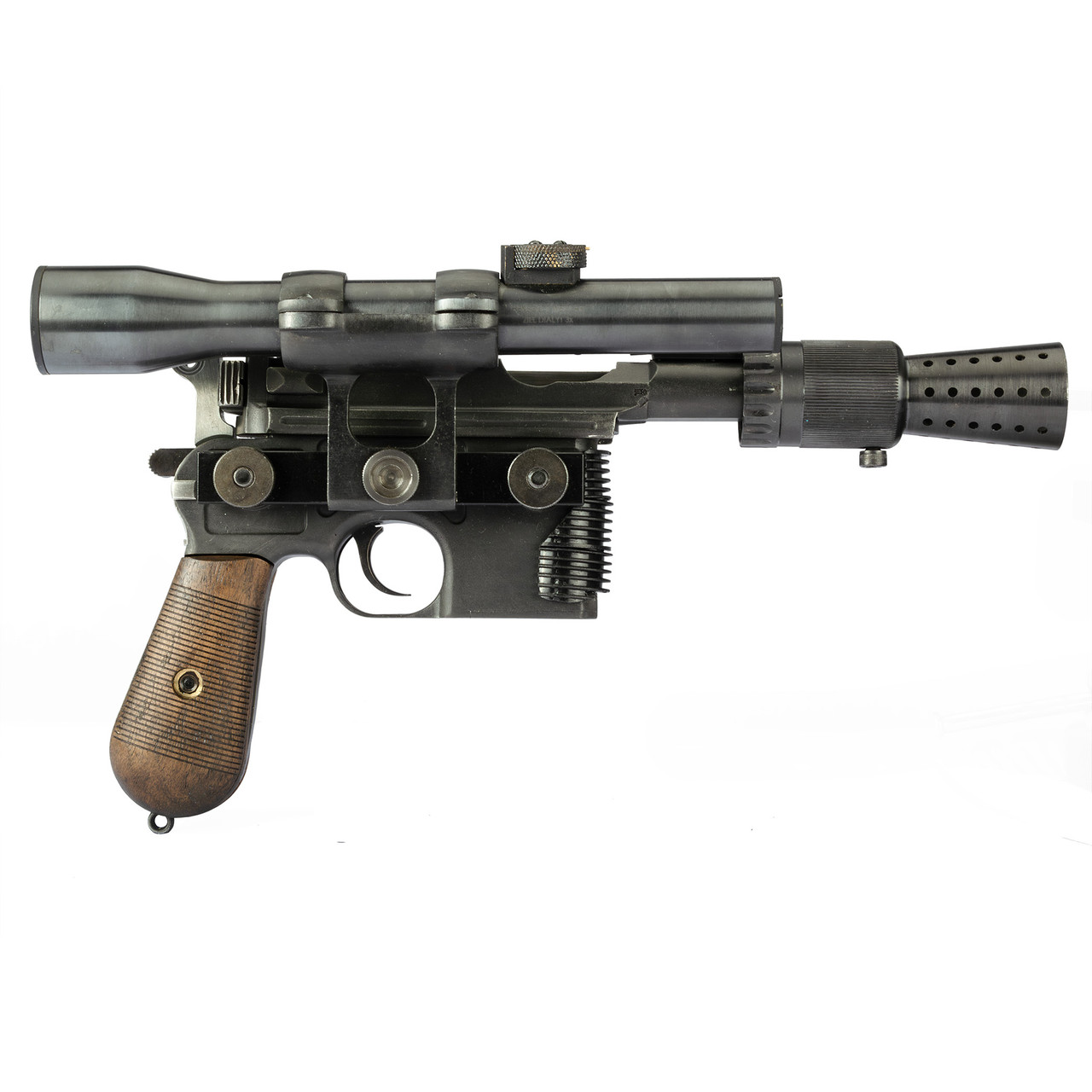
The A New Hope hero prop is the canonical DL-44 reference. Production was 1976-77 at Elstree Studios, UK. Multiple physical pieces existed even within ANH alone — at minimum a “hero” piece for close-ups, a “stunt” piece for run-and-gun, and likely several intermediate pieces.
2.2.1 Donor — the C96 frame
The hero piece is built on a Mauser C96 large-ring-hammer pistol, 7.63×25mm Mauser chambering, with the standard 5.5″ barrel length. Surviving close-up screen analysis supports this identification — the receiver markings visible in some shots are consistent with mid-1920s commercial Mauser production. The exact serial number / production year of the hero donor has not been published; production-era is inferred from the markings.
A minority position argues the hero was built on a Bolo (3.9″ short-barrel) variant with the flash hider extending the apparent length back to “looks like a standard 5.5″ in silhouette”. The Bolo position has merit for ESB-era pieces (see § 2.3) but the ANH hero appears to be a standard 5.5″ donor.
2.2.2 Scope — Hensoldt-Wetzlar Ziel-Dialyt 3×
The hero scope is a Hensoldt-Wetzlar “Ziel-Dialyt” 3× telescopic sight, made by Carl Zeiss subsidiary Hensoldt in Wetzlar, Germany — most likely a 1920s-1940s commercial-sporting / target-shooting scope, not a military-issue piece. Identifying features:
- Body length approximately 8″ / 200 mm.
- Tube diameter approximately 1″ / 25 mm, with a gentle taper from the objective bell to the eyepiece.
- Adjustment drums (windage and elevation) in the interwar-German style — knurled drums with index marks, typically protected by screw-on caps.
- Markings — “Ziel-Dialyt” engraved on the side, with the Hensoldt-Wetzlar maker mark.
- Reticle — simple crosshair, no rangefinding marks.
Reproductions and substitutes are exhaustively cataloged in Vol 7 § 7.2.
2.2.3 Flash hider — debated (MG-15 vs MG-81)
The hero’s flash hider is debated. Two leading candidates:
- MG-15 aircraft machine-gun flash hider — the MG-15 was a 1930s German aircraft gun, replaced by the MG-81 in the early 1940s. The MG-15’s flash hider is fluted, with elongated cooling slots, and has a flared trumpet-shaped end. Many builders identify the DL-44 flash hider as MG-15.
- MG-81 aircraft machine-gun flash hider — the MG-81 was the MG-15’s successor, faster-firing. Its flash hider is visually similar to the MG-15 — fluted, slotted, flared — and many builders identify the DL-44 flash hider as MG-81 instead.
A third minority position argues for MG-34 flash-hider hardware. The MG-34 was the standard German army general-purpose machine gun; its muzzle hardware differs in detail but shares the fluted-flared aesthetic.
This series presents the debate without resolving it. The visual similarity between MG-15 and MG-81 flash hiders, combined with degraded screen-cap resolution, makes definitive identification difficult. Vol 7 § 7.3 covers all three possibilities at the construction-detail level so a builder can pick a target.
2.2.4 Grips — custom dark wood
The hero grips are custom wood panels, replacing the C96’s factory checkered-wood (or checkered-rubber, on some production variants) grips. Visible features:
- Smooth finish (no checkering or grooves visible in close-up).
- Dark wood — most commonly identified as walnut or possibly rosewood, oiled / lacquered finish.
- Standard C96 grip-screw geometry — a single screw through both panels into a heel lug.
- No visible markings on the hero piece (though some lower-fidelity stunt pieces have “BlasTech Industries”-style markings added).
The hero grips are not the production-Mauser grips — Mauser shipped C96s with checkered grips; the smooth-wood panels are a deliberate prop choice. Some analyses suggest the grips were turned from a generic furniture-grade walnut blank by the prop department, not sourced from a specific period-correct grip-maker.
2.2.5 Scope mount — saddle-style, two-screw
The scope mount is a custom-machined saddle that bolts to the top of the C96 receiver, supporting the scope above the bore axis. Identifying features:
- Saddle / cradle shape that wraps around the bottom-half of the scope tube.
- Two mounting points screwing down into the C96 receiver (drilled and tapped specifically for the prop).
- Curved profile matching the C96 receiver’s slight contour, not flat.
- Material — appears to be steel, blued or finished black. Could be aluminum on some pieces.
The exact mount geometry varies subtly between hero and stunt pieces and between films (see § 2.3 and § 2.4). Vol 7 § 7.4 has the construction detail.
2.2.6 Minor details
- Small switches / studs added near the rear of the receiver — sometimes interpreted as “blaster power selector” detail. Their exact position varies between pieces.
- The C96 sights are preserved on the hero piece — the rear ramp and front blade are not modified.
- The C96 hammer is preserved — visible in some screen caps.
- The trigger guard is unmodified.
- The grip safety (where present on the C96 variant) is preserved.
2.3 The ESB (1980) variants — same family, drift
Between ANH (1977) and ESB (1980), the DL-44 prop pieces saw three years of handling, conventions, transport, and (likely) repair. The ESB-era pieces are visibly evolved rather than rebuilt:
- Scope mount geometry subtly different on at least one ESB-era piece — a slightly different profile, possibly a repair or replacement after damage.
- Flash hider attachment may have been re-pinned or replaced on some pieces. The “MG-15 vs MG-81 vs MG-34” debate is partially driven by visible differences between pieces shown to be the same prop family.
- Grip wear — handling wear evident on the grips, finishing patina.
- Finish wear — the overall finish shows handling wear (high points polished through, edges burnished).
For a builder targeting Empire-era DL-44, the ANH hero is still the closest reference — adjust for handling-wear patina and call it done. Building specifically to an “ESB look” usually means heavier aging on the finish and a slightly weathered scope mount.
The “Bolo donor” hypothesis (mentioned in § 2.2.1) is strongest for at least one ESB-era piece — the prop department may have built a replacement DL-44 between films using a Bolo C96 with an extending flash hider. The visible barrel-to-flash-hider proportion in some ESB stills is more consistent with a short-barrel donor than a standard 5.5″.
2.4 The ROTJ (1983) variants — clearly different
By Return of the Jedi (1983), at least one DL-44 prop in use is clearly different from the ANH hero in scope-rail / mount design:
- Scope mount profile more angular on the ROTJ piece compared to ANH-hero’s smoother saddle.
- Possibly a different scope — some screen analysis suggests the ROTJ piece uses a substitute scope (a Hensoldt Ziel-Dialyt or visually-similar scope, possibly not the same physical scope as the ANH piece).
- Different finish wear pattern — by 1983 the props had seven-plus years of handling.
For a builder targeting ROTJ-era DL-44 specifically, the prop community has separate dim sheets reflecting these differences. They’re a small minority of build references — most prop builders target the ANH hero. If Jeff specifically wants ROTJ-accurate, name that target up front so the dim sheets and reference photos for Vols 7-8 can adjust.
2.5 Hero vs stunt pieces — what differs
Across all three films, prop pieces fall into “hero” and “stunt” categories:
| Aspect | Hero piece | Stunt piece |
|---|---|---|
| Donor | Real Mauser C96 (functional or de-functioned) | Cast resin / metal-look replica |
| Scope | Real Hensoldt-Wetzlar Ziel-Dialyt | Cast or molded scope-look replacement |
| Flash hider | Real WWII muzzle hardware | Cast / machined approximation |
| Grips | Custom wood panels | Cast or carved approximation |
| Weight | Heavy — feels like a real C96 (~1 kg / 2.2 lb) | Light — much lighter than a real C96 |
| Use | Close-ups, dialogue scenes | Run-and-gun, action, anywhere stunt-Ford is on screen |
Stunt pieces are easier to replicate (no need for a real donor, scope, or muzzle hardware) and read less well in close-up. For a builder, the choice mirrors the build path:
- Path A (donor mod) → produces something close to a hero piece in feel and visual fidelity.
- Path B (replica donor) → produces something close to a stunt piece — display-grade, lighter weight, no functional internals.
- Path C (from scratch) → can be either, depending on material choices. Steel-and-real-scope from scratch reads as hero; aluminum-and-printed-scope from scratch reads as stunt.
2.6 Surviving original prop pieces — where they are now
Several of the original prop pieces have been tracked over the years by the prop-collecting community:
- The “Olin Lathrop” hero — one of the ANH-era hero pieces, owned for many years by collector Olin Lathrop, sold via Profiles in History in the 2010s. Reference photos from auction catalog have been a primary source for community dim sheets.
- Other auction appearances — periodic appearances of DL-44-attributed pieces at Profiles in History, Heritage Auctions, Sotheby’s. Attribution to specific films varies in reliability; auction-catalog provenance documentation is what to trust.
- Lucasfilm Archives — Lucasfilm reportedly retains at least one original DL-44 (or DL-44 family piece) in its prop archives. Not publicly accessible for measurement.
For the highest-fidelity reference Jeff can practically use, the auction-catalog photography from documented hero-piece sales is the gold standard. The RPF threads cataloging these auction appearances are linked in Vol 12 § 12.9.
2.7 The dimension sheet — canonical measurements
The community-canonical DL-44 dim sheet (RPF-derived, multiple iterations by multiple builders, converged on the figures below):
| Measurement | Approximate value | Notes |
|---|---|---|
| Overall length (with scope, with flash hider) | ~340 mm / 13.4″ | Tip of flash hider to back of grip frame |
| Barrel length (C96 barrel) | ~140 mm / 5.5″ | Standard C96 large-ring-hammer barrel; from chamber mouth to muzzle |
| Flash hider length | ~85-95 mm / 3.4-3.7″ | Depends on whether MG-15 or MG-81 reference |
| Scope length | ~200 mm / 7.9″ | Hensoldt Ziel-Dialyt approximate |
| Scope tube outer diameter (mid-tube) | ~22-25 mm / 0.87-1.0″ | Tapered; objective end slightly larger |
| Scope mount height (centerline of scope above receiver top) | ~32-38 mm / 1.25-1.5″ | Varies by piece |
| Frame width (slab sides) | ~32 mm / 1.26″ | Standard C96 dimension |
| Frame height (top of receiver to bottom of grip frame) | ~135-140 mm / 5.3-5.5″ | Standard C96 dimension |
| Grip panel length | ~95 mm / 3.74″ | Standard C96 dimension |
| Grip panel width (widest) | ~26 mm / 1.02″ | At the heel |
| Trigger guard ID | ~25 mm / 1.0″ | Standard C96 dimension |
| Weight (assembled, no scope) | ~900 g / 2 lb | C96 + flash hider + mount + grips, no scope |
| Weight (with scope) | ~1100 g / 2.4 lb | Adds the Ziel-Dialyt (~200 g) |
These are approximate community-consensus dimensions. Specific dim sheets on the RPF give tighter tolerances on individual sub-assemblies; treat the above as silhouette-targeting, not sub-millimeter authoritative.
2.8 What to verify before committing to a build
Before locking the build path, verify the following match Jeff’s intended target:
- Which film era? ANH (default), ESB, or ROTJ. Affects scope mount geometry and finish wear style.
- Hero or stunt? Hero = real-weight, more accurate. Stunt = lighter, replica-grade.
- Which flash hider donor target? MG-15, MG-81, or MG-34 (or “screen-accurate ambiguous”, picking whichever donor is easier to source).
- Which C96 donor target? Standard 5.5″ (ANH-canonical) or Bolo short-barrel (ESB-debated). Affects barrel-to-flash-hider proportion.
- Functional or display? Affects whether the C96 internals need to remain operational (Path A or some Path B3 builds) or can be simplified.
Each downstream volume’s recommendations assume defaults: ANH hero, standard 5.5″ donor, MG-15-or-MG-81 flash hider (builder’s choice), display-grade. If Jeff is targeting different defaults, the volumes’ specifics shift — but the build-path frameworks themselves don’t change.
2.9 References (Vol 2)
- Replica Prop Forum (RPF),
therpf.com, “DL-44 Resources” and “DL-44 Hero” mega-threads (cumulative, 2003–present). - Profiles in History auction catalog entries for DL-44 attributed pieces (multiple years; see Vol 12 § 12.9 for specific lot references).
- Star Wars Insider archive — periodic feature articles on original-trilogy props.
- Bishop, Chris. Star Wars: The Blueprints (2013) — production design references where dim sheets surface.
- Mauer, Albert, ed. Mauser Pistolen: Development and Production, 1877-1946. Mowbray Publishing, 2009. — Donor-side reference for C96 variant identification.