Mauser C96 Broomhandle · Volume 5
Provenance, Serial Ranges & Dating
Reading a C96's age from its features and serial — and the antique vs C&R line that drives its legal status
Contents
Dating a C96 matters for two reasons: it tells you what you have (Vol 4), and it sets the legal category — pre-1899 antique vs post-1899 Curio & Relic — which is the single most consequential fact about owning one (Vol 11). This volume gives the dating handles and the serial-feature timeline; it does not give legal advice (Vol 11, ../../_shared/legal_ethics.md).
5.1 The big caveat on C96 serials
C96 serial numbering is not one clean sequence. Commercial production ran its own range; military contracts (Italian Navy, Red 9, etc.) and some variants got separate serial blocks; and there are skips (the 15,000–20,000 commercial gap left by the Italian contract was never backfilled). So a serial number alone does not date a gun — you read it together with the feature set (Vol 4). Treat every serial-range figure below as approximate and variant-specific, and verify against a dedicated reference (Breathed & Schroeder; Jan C. Still) before relying on it — especially for the antique determination.
5.2 Feature-vs-serial timeline (commercial range)
Approximate, for the main commercial lineage:
| Approx. serial | ~Year | Feature change |
|---|---|---|
| pre-prod (~1–90) | 1895–96 | Spur → cone hammer; single locking lug; stepped barrel; “SYSTEM MAUSER” chamber |
| ~90–360 | 1896–97 | ”Transitional” (~270 guns); two locking lugs adopted; lock-sub-frame support groove added |
| from ~360 | 1897 | Mass production; chamber marking → “WAFFENFABRIK MAUSER OBERNDORF” |
| ~1,000 | 1897–98 | Rear barrel extension widened below the rear-sight head; bolt-stop cut strengthened |
| ~15,000 | 1899 | Large ring hammer; Flat Side; Italian Navy contract (own serials 1–5,000) |
| ~30,000 | ~1900 | ”Shallow-milled” side panels; rear narrow panels (later the name/address stamp) |
| ~29,000 | 1901–02 | Bolo introduced |
| ~40,000 | ~1904 | Small ring hammer; rifling 4→6 grooves; shorter extractor; two-lug firing pin standard; early pull-down safety discontinued |
| 40,000–80,000 | ~1907–14 | 9 mm Export guns |
| ~140,000–200,000 | ~1912 | ”Ns” (New Safety) phased in (officially cited from 200,000; found from ~140,000) |
| own range | 1916 | Red 9 (9×19), ~150,000 made |
| — | 1920 | Versailles reworks (“1920” stamp) |
| ~600,000 | 1920s | Post-war Bolo; Mauser banner; glossy “charcoal-like” blue |
| ~800,000 | 1930 | Model 1930; Universal Safety; D.R.P.u.A.P. |
| ~900,000+ | early–mid 1930s | Late M30; Schnellfeuer era |
Total production across all types ≈ 1 million.
5.3 Chamber & receiver markings as a dating handle
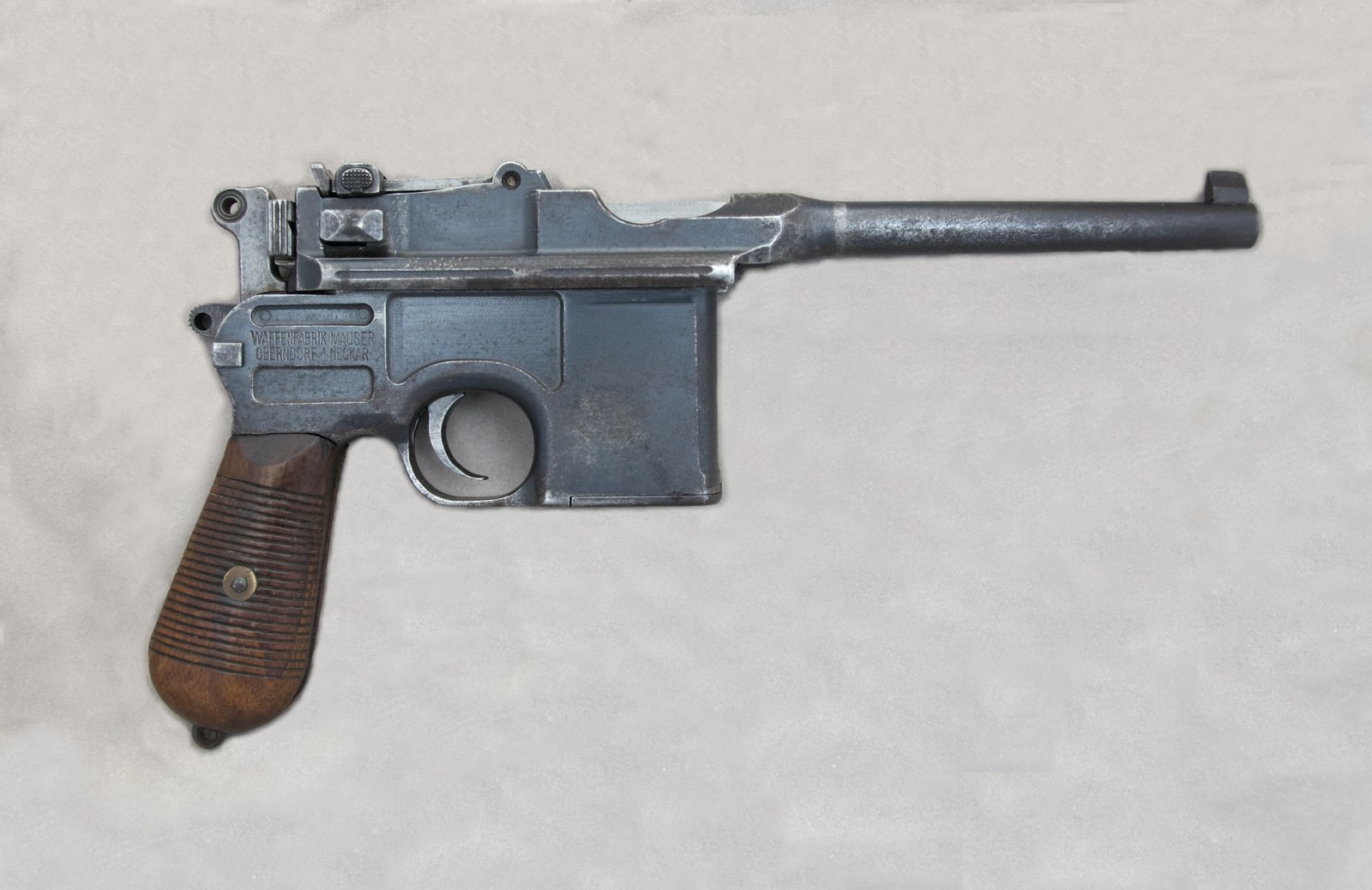
- “SYSTEM MAUSER” (chamber) — earliest guns.
- “WAFFENFABRIK MAUSER OBERNDORF” (chamber) — from ~serial 360 into the main run.
- Mauser banner (chamber, then later on the frame) — a subset of pre-war guns (~10,000), then standard on post-war/M30 guns.
- D.R.P.u.A.P. on the M30 frame — German + foreign patent protection notice.
- Proof marks (e.g. crown/letter Imperial proofs, later Weimar/Nazi commercial proofs) and import/unit marks (Italian “DV/AV”, Finnish “SA”, etc.) further pin down provenance.
5.4 Matching numbers
Quality C96s were serialized on many parts (bolt, barrel extension, lock components, floorplate, grips, and the detachable stock). “Matching numbers” — all the small-part serials agreeing with the receiver — substantially affects collector value and is a strong authenticity signal. For a build donor (Vol 4 §4.5) the opposite logic applies: a mismatched / force-matched / renumbered gun is the ethical one to modify.
5.5 Antique vs C&R — the line that matters
This is the legal pivot (full treatment in Vol 11):
- Pre-1899 manufacture = a federal “antique” in the US (not a “firearm” under the GCA), regardless of caliber, as long as it’s not later reworked into a non-antique configuration.
- Post-1899 = a modern firearm, though most C96s are Curio & Relic eligible (over 50 years old / on the C&R list), which matters for C&R FFL holders.
- The cutoff is by manufacture date, inferred from serial + features — and because of the separate serial blocks (§5.1), the exact pre-1899 serial boundary is variant-specific and debated at the margins. A gun near the boundary must be documented carefully; do not assert “antique” from a round-number serial alone.
- Reworks confuse the category: a 1920-reworked gun, a rebarreled hybrid, or a re-serialized copy may not carry the provenance its base suggests.
Bottom line for dating → legal: establish the variant (Vol 4), read the serial against a real reference, and treat the antique/C&R call as a documented determination, not a guess. Carry it into the per-piece record (../00-inventory/_TEMPLATE.md) and Vol 11.
5.6 References (Vol 5)
- Breathed & Schroeder, System Mauser; Jan C. Still, Pistols of Germany (
../references/) — the standard serial/dating references; verify boundary serials here. - Henrotin, The Mauser C96 Explained (©2002) — facts only.
../../_shared/legal_ethics.md; legal posture in Vol 11.- Synthesis:
../volume_sources/research_notes.md§5. Full bibliography: Vol 12.