SIG P320-M17 · Volume 9
How It Works, and How to Keep It Working — the Cycle, the Failures, and Who Fixes What
The P320's cycle of operation part by part, SIG's own troubleshooting, the wear parts, the comp-and-light-spring failure mode, and SIG's warranty and parts
Volume 2 describes the P320’s three assemblies — fire control unit, slide, grip module — and which of them is the firearm. Volume 8 gives SIG’s field strip, cleaning and function check. This volume completes the set: how the parts work together through one shot, what goes wrong and how to tell, which parts wear, and what an owner may repair, what goes to a gunsmith and what goes to SIG.
It is about the pistol: the FCU, slide, barrel and springs. The chassis the pistol documented here sits in has its own maintenance, wear parts and repair, which the Flux Raider dive covers; this volume links to it rather than repeating it.
Two sources carry most of the weight. SIG’s P320-M17 / P320-M18 operator’s manual (P/N 1302517-01 REV05) is the pistol’s own manual. SIG’s general P320 operator’s manual (P/N 8501909-01 REV15, 2025) covers the whole P320 family and goes further in places — it includes a torque table and SIG’s own compensator procedure. Where the general manual is quoted, that is said, because it was not written for the M17 specifically.12
9.1 The Cycle of Operation
SIG’s description of the action is one sentence: “a striker fired, mechanically locked, short recoil operated pistol with semi-automatic reloading. Firing takes place with each press of the trigger until the magazine is empty. The slide remains open after the last cartridge has been fired.”1 Its account of the internal safeties is another: “The striker safety lock and disconnect safety prevent the firearm from firing unless the trigger is pulled.”1
Everything below expands those two sentences, part by part. Where SIG’s documents name a part and its job, they are cited. Where the step is the general mechanics of every locked-breech, striker-fired pistol and SIG’s documents do not describe the P320’s specific geometry, that is said, and no P320-specific dimension or surface is invented.
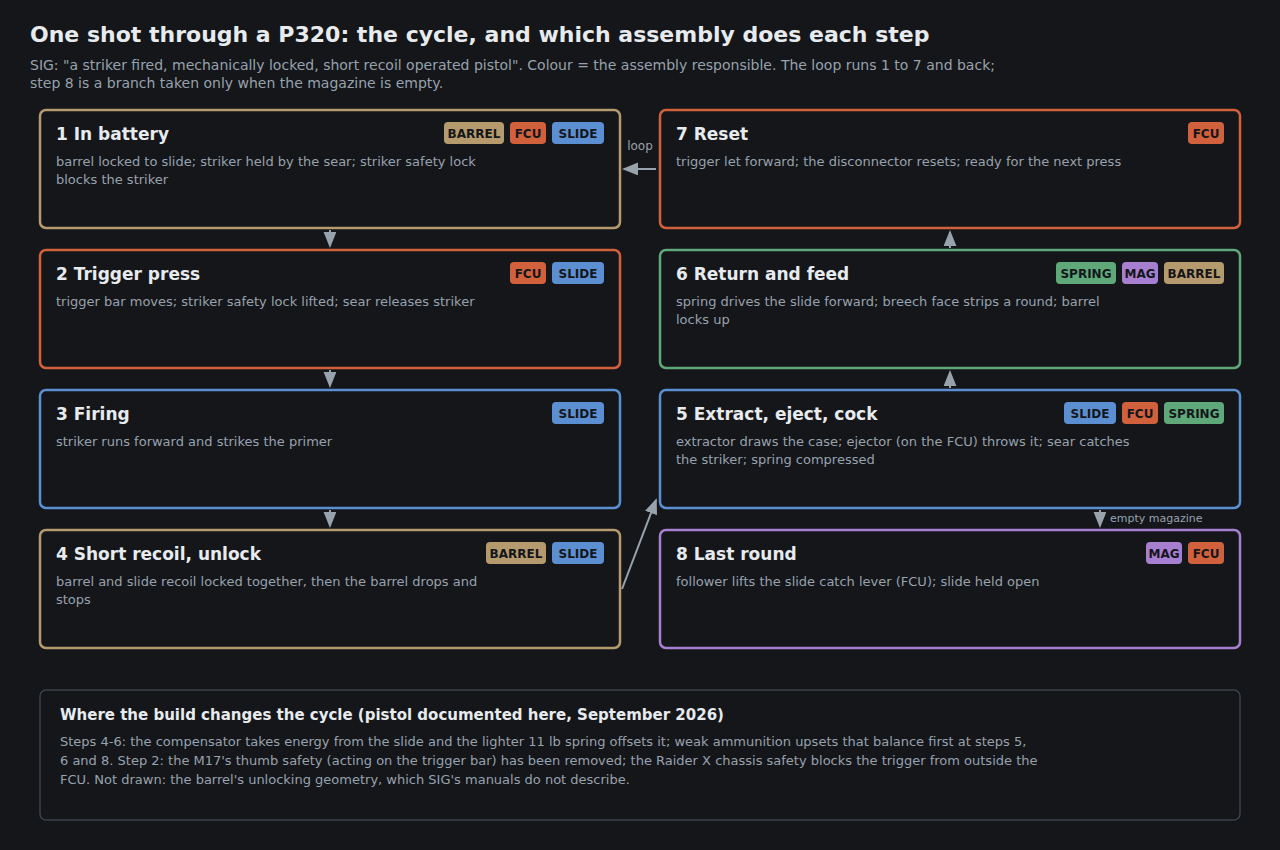
9.1.1 Step 1 — Loaded and in battery
A cartridge is in the chamber. The barrel is locked to the slide — “mechanically locked,” in SIG’s word — so the two will move together when the shot fires. The striker is in the slide and is held back by the sear, which is in the FCU. That relationship, a sear in the FCU holding a striker in the slide, is exactly the one federal regulation uses to define the FCU as the frame (Volume 2).
The striker safety lock in the slide blocks the striker from moving forward even if the sear were to let go. The Army’s test office describes the same part on the issue pistol as an “automatic striker pin safety lock.”3
9.1.2 Step 2 — The trigger press
The trigger is an FCU part. Pressing it moves the trigger bar, and it is this press, and only this press, that defeats the two internal safeties SIG names. In the general arrangement of striker-fired pistols, the trigger bar lifts the striker safety lock out of the striker’s path and then moves the sear off the striker; SIG names the parts but does not publish a drawing of their sequence. SIG’s M17 manual gives the trigger pull as 6.0–7.0 lb.1
Two manual safeties can intervene at this step, and on the pistol documented here they are different parts:
- The M17’s own thumb safety “mechanically blocks the movement of the trigger bar, preventing release of the striker.”1 On this pistol it has been removed (Volume 4).
- The Raider X chassis safety, which replaces it, is described in SIG’s Raider X manual as one that “mechanically blocks the movement of the trigger” — it acts on the trigger from the chassis rather than on the trigger bar inside the FCU. The Flux Raider dive covers it.
9.1.3 Step 3 — Firing
The striker runs forward under its spring and strikes the primer. SIG’s cleaning instructions repeat one warning three times across its manuals because it bears on this step: “DO NOT LUBRICATE THE STRIKER OR ALLOW LUBRICANT TO FLOW INTO THE STRIKER CHANNEL OF THE SLIDE. THIS MAY CAUSE A LIGHT STRIKE TO THE CARTRIDGE RESULTING IN A FAILURE TO FIRE.”1
9.1.4 Step 4 — Short recoil and unlocking
Barrel and slide recoil together, locked, for a short distance — the “short recoil” in SIG’s description — and then the barrel is cammed down out of engagement with the slide and stops, while the slide carries on rearward alone. This tilting-barrel unlocking is common to the P320 and the other pistols this hub’s Suppressors by Caliber dive, Volume 6 groups as needing a booster for a suppressor. SIG’s manuals do not describe which surface of the barrel’s lower lug does the camming or what it bears against, and the geometry is not described here.
SIG’s troubleshooting table does describe the failure of this step. Under “Failure of slide to unlock,” it lists “damage or broken locking lug” and “faulty ammunition determined by short recoil.”1
9.1.5 Step 5 — Extraction, ejection and cocking
As the slide continues rearward, the extractor in the slide draws the fired case out of the chamber. The case then strikes the ejector, which SIG’s M17 table places “on frame” — that is, on the FCU — and is thrown out of the port.1 The slide compresses the recoil spring on its guide rod.
The striker travels back with the slide and is caught by the sear. The disconnector stops the sear from releasing it again while the trigger is still held back: the pistol cannot fire a second shot until the trigger has been let forward to reset. SIG added a “mechanical disconnector” to the P320 in its 2017 upgrade; the commercial M17 postdates that change (Volume 3).
9.1.6 Step 6 — Return and feed
The compressed recoil spring drives the slide forward. The slide’s breech face strips the top cartridge from the magazine and pushes it into the chamber; the barrel is lifted and locks back into the slide as the slide reaches the end of its travel. SIG’s own warning on this step is to let the spring do it: “Do not ride the slide forward. Failure to properly complete step b may induce a stoppage.”1
9.1.7 Step 7 — Reset
Letting the trigger forward resets the disconnector, and the pistol is back at step 1. SIG’s function check tests exactly this: hold the trigger, cycle the slide, release the trigger — “You should hear a click as it resets.”1
9.1.8 Step 8 — The last round
When the magazine is empty its follower pushes up the slide catch lever, an FCU part, and the slide is held open. SIG’s function check step 2: “The magazine follower should have pushed the slide catch lever up and locked the slide to the rear.”1 This is the step the Army’s testers found failing most often in 2017; DOT&E recorded operators saying the slide catch lever’s placement let their thumbs engage it while firing, and that 8 of 132 shooters accounted for 60 per cent of those failures (Volume 1).
9.1.9 The takedown lever
The takedown lever is not part of the firing cycle, but it holds the pistol together. It passes through the grip module and the FCU — “locking the fire control unit in place,” in SIG’s words — and when rotated clockwise with the slide locked back, it frees the slide to come forward off the rails.2 No trigger press is part of the P320’s takedown, which SIG presented as a safety feature in 2017. On the pistol documented here, the lever passes through the Raider X in the same way.
9.2 Where This Build’s Parts Enter the Cycle
Table 1 — Where This Build's Parts Enter the Cycle
| Part | Step it acts on | Effect |
|---|---|---|
| ArmoryCraft P320-COMP-RH | 4–5 | redirects gas at the muzzle; less energy reaches the slide |
| ArmoryCraft rod and 11 lb spring | 5–6 | less spring force resisting the slide going back, and less driving it forward |
| SilencerCo threaded barrel | 1, 4 | the barrel that locks, unlocks and carries the comp |
| Safety-delete pin | 2 | the FCU’s thumb safety no longer acts on the trigger bar |
| Raider X chassis safety | 2 | blocks the trigger from the chassis instead |
| RipStik | 6 | a handle to drive the slide forward by hand if it stops short |
Steps 5 and 6 are where the muzzle group earns or loses its reliability, and that is the subject of the next section but one.
9.3 Malfunctions, and How to Diagnose Them
9.3.1 SIG’s first rule
Before diagnosis comes SIG’s instruction for any stoppage: “STOP FIRING IMMEDIATELY. UNLOAD AND CLEAR THE FIREARM.” And specifically: “If the firearm develops a stoppage while shooting, or a discharged round sounds or feels unusual, stop shooting immediately. It may be dangerous to continue. Do not try one more shot.”1
That warning matters more on this pistol than on a factory one, for the reason set out below: a weak-sounding shot and a slide that does not cycle can mean either weak ammunition or a bullet stuck in the bore. SIG lists “A shot sounds weak or abnormal” among the signs of an obstructed bore, and instructs: “Field strip the firearm and look through the bore of the barrel. It is not sufficient to merely look in the chamber.”1 With a compensator on the barrel, the bore has to be looked through before any other explanation is accepted.
9.3.2 SIG’s troubleshooting table
The M17 manual’s table, with SIG’s corrections as written. “Contact customer service” is SIG’s instruction wherever a part is broken.1
Table 2 — SIG's troubleshooting table
| Stoppage | Possible cause (SIG) | Correction (SIG) |
|---|---|---|
| Failure to feed | top cartridge badly positioned; dirty, corroded or damaged ammunition; dirty magazine; magazine wrongly assembled; broken, damaged or bent magazine parts | reload magazine; clean or replace ammunition; clean and lubricate; reassemble; replace magazine |
| Failure to chamber | dirty or obstructed chamber; bad ammunition; broken recoil spring | clean chamber and bore; replace ammunition; contact customer service |
| Slide does not lock fully forward | broken recoil spring; damaged or burred slide rails or frame rails | contact customer service |
| Failure to fire | manual safety engaged; faulty ammunition; light or no striker indent on the primer | disengage; replace ammunition; contact customer service |
| Failure of slide to unlock | damaged barrel or broken locking lug; “faulty ammunition determined by short recoil”; damaged slide | contact customer service; inspect bore and replace ammunition |
| Failure to extract | rough or dirty chamber; broken or weak extractor spring; broken extractor hook | clean; contact customer service |
| Failure to eject | ”broken ejector on frame” | contact customer service |
The general P320 manual adds one cause the M17 table omits, under both failure to feed and failure to chamber: “Relaxed grip / shooter induced,” corrected by “Increase grip on pistol.”2 A pistol that cycles only as far as the frame lets it recoil against is sensitive to how firmly that frame is held — the same effect the Army saw at step 8.
9.3.3 Diagnosis in the order SIG implies
SIG’s own advice sets the order: “Most stoppages are directly related to the magazine,” and “A good practice is to mark the magazines so a magazine that is related to a stoppage can be easily identified.”1 A reasonable sequence, built from the table rather than added to it:
- Bore first, whenever a shot sounded weak.
- Magazine next. Number the magazines. A stoppage that follows one magazine is that magazine.
- Ammunition. A stoppage that follows one box or one load is that load.
- Cleanliness. Chamber, extractor, breech face, rails — SIG’s cleaning interval is “before or after every day the pistol is fired or at a minimum of every 500 rounds.”
- Springs and the build. Only then the recoil spring and, on this pistol, the comp-and-spring combination.
- Broken parts — extractor, ejector, lug, striker — go to SIG.
9.4 The Comp, the Light Spring, and Weak Ammunition
Volume 6 explains why a compensator calls for a lighter recoil spring: the comp takes energy away from the slide, so the spring that resists the slide has to be weaker for the slide to complete its travel. ArmoryCraft’s wording is that its light springs are for “tuning compensators and supressors, or to be used with lower power / competition reloads.”4 What follows is the other side of that tuning. It is reasoning from the cycle above, not a maker’s statement, and it is labelled as such.
The margin is set by the ammunition the spring was chosen with. A comp and an 11 lb spring chosen to run full-power ammunition leave the slide with enough energy — just — to complete steps 5 and 6. Weaker ammunition makes less gas and less recoil impulse, and the comp still takes its share. The slide can then fall short at either end of its stroke, and each shortfall has its own signature:
Table 3 — The margin is set by the ammunition the spring was chosen with. A comp and an 11 lb spring chosen to run full-power ammunition leave the slide with enough energy — just — to complete steps 5 and 6. Weaker ammunition makes less gas and less recoil impulse, and the comp still takes its share. The slide can then fall short at either end of its stroke, and each shortfall has its own signature
| Where the slide falls short | What it looks like | Cycle step |
|---|---|---|
| Does not travel far enough back to throw the case clear | case caught in the port, standing up (“stovepipe”), or dribbling out | 5 |
| Does not travel far enough back to pass the next round | slide closes on an empty chamber; round left in the magazine | 5–6 |
| Does not travel far enough back on the last round | slide fails to lock open on an empty magazine | 8 |
| Does not carry enough energy forward | slide stops short of battery with a round partly chambered | 6 |
The last row is the one the light spring makes worse rather than better. An 11 lb spring stores less energy to drive the slide home than a heavier one. With dirty, dry or tight-chambered conditions, or a round that is slightly long, the slide may stop out of battery. SIG’s table lists “Slide does not lock fully forward” and puts “broken recoil spring” first among the causes.1 On this pistol, “too light a spring for these conditions” is a cause SIG’s table was not written to name. The RipStik’s “Bump Forward Battery Assist” exists for exactly this case.
How to tell weak ammunition from a bore obstruction: a squib — a round with too little or no powder — also produces a weak shot and a slide that does not cycle, and it can leave the bullet in the barrel. The symptom is the same as a light load. SIG’s instruction is to stop and look through the bore, and that instruction comes before any conclusion about the spring.
The practical consequence is the one stated in Volume 6: the spring is chosen for a load, and changing the load re-opens the choice. The slide locking open on the last round, with the ammunition actually carried, is the most sensitive single test.
9.5 Parts That Wear or Break
9.5.1 What SIG publishes
SIG publishes no round-count replacement interval for any P320 part in either manual examined. Its maintenance table is condition-based: inspect “all parts for serviceability,” and the pistol is “NOT READY/AVAILABLE IF: Any parts require replacement.”1 The parts its troubleshooting names as ones that break are the recoil spring, the extractor and its spring, the ejector, the barrel’s locking lug, the striker assembly, and the magazine and its spring.12
9.5.2 What the Air Force found in 7,970 pistols
The one published inspection of a large P320-family fleet is Air Force Global Strike Command’s 2025 inspection of its M18s. It found discrepancies in 191 pistols: “The primary discrepancy was related to component wear. The most frequent issues centered on problems with the safety lever, striker assembly and sear.”5 Those are military M18s with thumb safeties, used under a military inspection regime; they are cited here because they identify the parts that wore, not as a measure of how fast.
9.5.3 Springs, and the 11 lb spring’s effect on the interval
A recoil spring loses force with use, and the rate is not published for SIG’s captive spring or for ArmoryCraft’s springs. ArmoryCraft sells its springs individually and cheaply ($8.95 on 19 September 2026), which makes replacement easy but does not say when.4
The effect of running a light spring is reasoning, stated as such:
- Less reserve. The 11 lb spring was chosen as the lightest that runs the pistol with its comp. As it weakens, it drifts further from the force the slide needs to close reliably, so the gap between “works” and “does not return to battery” narrows sooner than it would with a spring chosen with margin.
- Harder arrival. A lighter spring lets the slide arrive at the rear of its travel faster. With the comp taking energy out, that effect is intended to cancel. With hotter ammunition than the spring was chosen for, it does not, and the slide and FCU take the difference.
- What this means in practice. Without a published interval, the defensible course is to record the round count on the spring, treat the step-8 test and return to battery as the measure, and replace the spring when either starts to fail. A replacement at a fixed count may be chosen by the owner; none is published by either maker, and none is given here.
9.5.4 The other parts
- Magazine springs and followers. SIG’s own diagnosis starts here. The Army’s 2018 fix for its reliability problems included “the magazine spring, magazine follower” (Volume 1).
- Extractor and its spring. SIG’s test is in its table: “Check for broken or weak extractor spring by pulling up on extractor.”1
- Striker assembly and sear. These are named in the AFGSC findings and in SIG’s “Return to SIG SAUER for repair” entries. They are inside the slide and the FCU respectively.
- Tritium sights. SIG: “TRITIUM NIGHT SIGHTS ARE EXPECTED TO LOSE APPROXIMATELY HALF THEIR BRIGHTNESS AFTER 5 YEARS.”1 The pistol documented here has had its front sight replaced by the RipStik, whose tritium option is Tactical Development’s, not SIG’s.
9.6 How the Threaded Barrel Changes Cleaning
SIG’s M17 manual does not deal with a threaded barrel, because the M17’s barrel is not threaded. SIG’s general P320 manual does, for its own compensated models, and three of its points carry over directly:2
- The comp does not have to come off to clean. “The compensator (if installed) does not need to be removed for routine maintenance and cleaning.” And: “Removing the compensator is not required for normal preventive maintenance of the pistol. Compensator removal and replacement should only be performed should the compensator need cleaning or become loose during shooting.”
- Clean the bore from the chamber, with the barrel pushed forward. “If compensator is installed, push barrel forward in the slide to allow space to run rods and patches through the barrel.” SIG’s rule for every P320 is “NEVER CLEAN THE BARREL FROM THE MUZZLE END”; the comp makes that the only practical direction anyway.
- Threads are cleaned and degreased before a device goes back on. SIG: “Before installing the compensator, clean and degrease the threads of the barrel and compensator.”
Three points do not carry over, and they are where a reader could go wrong:
- SIG’s torque and thread-locker figures are for SIG’s own compensator. SIG’s comp is held by two T10 screws at 20 in-lbf with Loctite 243 and uses Loctite 246 on the barrel threads.2 The ArmoryCraft comp on this pistol is retained by a single set screw that ArmoryCraft supplies with a wrench, and ArmoryCraft’s pages give no torque or thread-locker figure.6 SIG’s numbers are not a specification for ArmoryCraft’s part and are not offered as one.
- Carbon on the threads and shoulder. A comp or suppressor seats against the barrel’s shoulder. Carbon on the shoulder changes how the device seats, and on a suppressor that changes its alignment — the How Suppressors Work dive, Volume 10 treats mounts as wear items for that reason.
- The thread protector. SilencerCo supplies one with the barrel. With the comp off and no protector fitted, the exposed thread is the most easily damaged part of the barrel.
9.7 What the Owner Does, What a Gunsmith Does, What SIG Does
SIG draws the line in its own documents, and it is drawn more tightly for the M17 than for the P320 family generally.
Table 4 — What the Owner Does, What a Gunsmith Does, What SIG Does
| Work | Who, by SIG’s documents | Source |
|---|---|---|
| Field strip, cleaning, lubrication, function check | Owner | M17 manual §§12–13 |
| Removing the FCU from the grip module and fitting it to another (or to a chassis) | Owner | M17 manual §12.8 |
| Any disassembly of the FCU itself — including removing the M17’s safety levers | SIG armorer only: “NO FURTHER DISASSEMBLY OF THE FIRE CONTROL UNIT (FCU) IS AUTHORIZED” | M17 manual §12.8, §3.0 |
| Reversing the magazine catch; removing the sight plate, extractor and striker assembly from the slide | Owner — under the general P320 manual, which gives these procedures and torque values. The M17 manual does not include them. | P320 manual §§13.1–13.6 |
| Fitting a replacement part bought without returning the pistol | ”a qualified gunsmith” — SIG places the responsibility for fit on the purchaser | M17 manual §16.0 |
| Broken recoil spring, striker assembly, extractor, ejector, locking lug, slide or frame rails | SIG: “Contact customer service” / “Return to SIG SAUER for repair” | M17 manual §14; P320 manual §16.3 |
| Suspected malfunction, damage, persistent stoppage | ”a certified SIG SAUER Armorer” | M17 manual §14.0 |
| The chassis, its safety and its springs | The chassis maker’s and SIG’s Raider X instructions — see the Flux Raider dive | — |
⚠ Two of these rows conflict with the configuration of the pistol documented here, and both are stated plainly. The safety removal falls in the “SIG armorer only” row; who did it is not recorded (Volume 4). And the general manual’s slide-level procedures are published by SIG for P320s generally, but not in the M17’s own manual; an M17 owner who uses them is following SIG’s instructions for the family rather than for the model.
SIG’s own view of third-party repair, in its parts policy: “Even though most gunsmiths have the knowledge, training, and the ability to make necessary repairs to your firearm, the skill and workmanship of any particular third-party gunsmith is totally beyond our control. Should your firearm ever require service, we strongly recommend that you return it to SIG SAUER Inc.”1
For the chassis, its own safety, its brace springs and its repair, the Flux Raider dive is the reference.
9.8 SIG’s Warranty and Service
9.8.1 Two texts on one page
SIG’s warranty page, as captured in June 2026, carries two different texts, and they do not say the same thing.7
The “Infinite Guarantee” is presented as a headline: “Fully Transferable · No Warranty Card Required · No Receipt Required · No Time Limit Applies · No Charge,” with the promise “We guarantee that your new SIG SAUER firearm, optic, or suppressor was originally manufactured free of defects in material, workmanship, electrical, optical, and mechanical function. In the event it becomes damaged from defect in any way we will repair your SIG SAUER product, at no charge to you.”
The “Limited Lifetime Warranty” that follows on the same page runs “For the lifetime of the original purchaser” and says the right to repair “is not transferable to any other person.” It is “null and void if the firearm has been misused, damaged (by accident or otherwise), fired with hand loaded, reloaded, or improper ammunition, fired with an obstruction in the barrel, damaged through failure to provide reasonable and necessary maintenance as described in the manual accompanying the firearm, or if unauthorized repair or any alteration, including of a cosmetic nature, has been performed on the firearm.” It “does not apply to normal wear and tear of any parts” and “does not apply to any accessory items attached or appurtenant to the firearm.”
Which text governs which purchase is not stated on the page, and this series does not resolve it. What both texts share is the operative point for this pistol: alteration and unauthorised repair are excluded, and the M17 manual adds, of aftermarket parts, that their use “WILL VOID THE WARRANTY OF THIS FIREARM.”1 SIG’s page does add that “Cerakote and other decorative finishes will not void your warranty if applied properly.”
9.8.2 How service works
From the M17 manual §17:1
- Get an RMA first. “Please do not ship your firearm until you obtain an RMA number from Customer Service.” Contact: (603) 610-3000, option 1; CustomerService@sigsauer.com; or sigsauer.com/customer-support.
- Unloaded, no ammunition, no accessories. “DO NOT SHIP AMMUNITION WITH A FIREARM.” “Do not include any accessories such as scopes or mounts unless directed to do so.”
- Shipping law. “Federal law prohibits persons who do not possess a Federal Firearms License (FFL) from shipping a firearm via the U.S. Postal Service,” and “Some states and localities, require firearms to be shipped and returned to SIG SAUER using a federally licensed firearms dealer.” Freight is insured and prepaid by the sender.
What would go to SIG from this pistol is the serialized FCU and the slide — the SIG parts. The chassis, comp, barrel, rod and spring, pedal, optic, mount and light are accessories or aftermarket parts in SIG’s terms and, by SIG’s instruction, stay behind unless SIG asks for them.
9.9 Parts Availability
- SIG’s parts. SIG’s manual says: “Our Service Department maintains a full complement of replacement parts,” and points to a “Small Parts Shopper” page on its site.1 The M17 manual’s own parts diagram lists only five assemblies: the full-size slide assembly, the full-size 9×19 barrel, the frame and grip module assembly, the magazine, and the full-size recoil spring guide assembly. SIG sells its manual-safety parts kit (SKU 8901023, $99.99 in a 2025 capture), with the note that “only certified SIG SAUER armorers” should install it — the route back to a thumb safety if the pistol ever leaves the chassis (Volume 4).
- The FCU. SIG has sold bare FCUs since November 2020. Because the FCU is the serialized firearm (Volume 2), a replacement FCU is a firearm transfer, through a dealer, with Michigan’s licence and record requirements (Volume 5) — not a spare part.
- Magazines. SIG’s own naming shows P250, P320 and M17 full-size magazines as common parts: “P250, P320 FULL/CARRY/M17 9MM 17RD MAGAZINE.”8
- The build’s parts. ArmoryCraft sells its springs singly ($8.95) and the full-size tuning kit ($44.95); its compensator was in stock at $99.75 on 19 September 2026. SilencerCo’s barrel was $169.00 on its page as captured in February 2026. The RipStik was shown sold out on Tactical Development’s page on 19 September 2026. Prices and stock are dated to those pages.46
- Parts sources change. sigsauer.com and silencerco.com both refused automated access during this work, so current SIG part numbers and prices could not be confirmed directly; SIG’s customer service is the authority on what is current for an M17.
References
Footnotes
-
SIG Sauer, P320-M17 / P320-M18 Pistol, Semi-Automatic, 9mm — Operator’s Manual: Handling & Safety Instructions, P/N 1302517-01 REV05 (©2025): §§3.0, 8.1, 8.3, 9.2, 12.3, 13.0, 14.0–14.8, 15.0, 16.0, 17.0, 18.0–18.2 and the periodic inspection table. https://www.sigsauer.com/media/sigsauer/resources/OPERATOR_MANUAL_M17_M18_COMMERCIAL_1302517-01_REV05_WEB_FILE.pdf (downloaded 2026-09-19). ↩ ↩2 ↩3 ↩4 ↩5 ↩6 ↩7 ↩8 ↩9 ↩10 ↩11 ↩12 ↩13 ↩14 ↩15 ↩16 ↩17 ↩18 ↩19 ↩20 ↩21 ↩22 ↩23 ↩24
-
SIG Sauer, P320 Operator’s Manual, P/N 8501909-01 REV15 (©2025): cleaning (compensator notes), §13.1 torque specifications, §13.2 sight plate removal (extractor and striker assembly), §13.5 compensator removal and installation, §13.8 FCU removal and installation, §16.3 general troubleshooting, §17.0 replacement parts policy. https://www.sigsauer.com/media/sigsauer/resources/OPERATORS_MANUAL_P320_8501909-01_REV15_WEB.pdf (downloaded 2026-09-19). ↩ ↩2 ↩3 ↩4 ↩5 ↩6
-
Director, Operational Test and Evaluation, FY2017 Annual Report, “XM17/XM18 Modular Handgun System (MHS).” https://www.dote.osd.mil/Portals/97/pub/reports/FY2017/army/2017mhs.pdf ↩
-
Armory Craft, “P320 Full Size / P320 X5 & X5 Legion Solid Guide Rod & Recoil Spring Tuning Kit.” https://www.armorycraft.com/product-page/p320-p320-x5-legion-style-solid-guide-rod-recoil-spring-tuning-kit (accessed 2026-09-19). ↩ ↩2 ↩3
-
Air Force Global Strike Command, “AFGSC Completes M18 Handgun Inspection, Returns to Service,” 24 August 2025; read from the Internet Archive capture of the command’s page. See Volume 3. ↩
-
Armory Craft, “Sig Sauer Compensators – for 9mm P320 & P226, P228, P229, P225/P6”: “A set screw and a wrench are included.” No torque or thread-locker figure appears on the page. https://www.armorycraft.com/product-page/sig-sauer-compensators-p320-p226-228-229 (accessed 2026-09-19). ↩ ↩2
-
SIG Sauer, warranty page, Internet Archive capture of 18 June 2026 of https://www.sigsauer.com/warranty (sigsauer.com refuses automated requests). Both the “Infinite Guarantee” and the “Limited Lifetime Warranty” texts are quoted from that capture. ↩
-
SIG Sauer, P320-M17 product page, Internet Archive capture of 19 July 2026 of https://www.sigsauer.com/p320-m17.html ↩
Comments (0)