STEN Gun · Volume 10
Legal & Regulatory Posture
NFA Class III; 922(r); closed-bolt semi-auto (ATF Rul. 83-5); state SBR + imitation-firearm
10.1 Contents
(Generated by build/inject_toc.py at build time. Section headers below are the source of truth.)
This is the heaviest legal volume in the deep dive — heavier than the DL-44 Vol 10 (which is mostly about state imitation-firearm rules) and on par with the E-11 Vol 10 (which adds the 922(r) + NFA + state-imitation triple-layer). The STEN’s legal posture is heavy because the gun sits at the intersection of three federal regimes:
- The NFA (National Firearms Act of 1934 + FOPA-86 § 922(o)) — governs Path A (Vol 5), the registered-machine-gun acquisition path.
- 18 USC § 922(r) + 27 CFR § 478.39 — governs Path B (Vol 6), the parts-kit-on-US-receiver build, via the 20-parts compliance rule.
- ATF Rulings 82-2, 82-8 and 83-5 (1982–83) — the published classifications of open-bolt, fixed-firing-pin semi-automatics as machine guns; 83-5 names a semi-auto STEN. They are why a new semi-auto STEN must be closed-bolt, which applies to both Path B (Vol 6 § 6.6.2) and Path C (Vol 7 § 7.5). This is the rule that mechanically reshapes a from-scratch or kit STEN build away from the WWII open-bolt design.
On top of these three federal layers sit the state-by-state regimes: SBR posture (barrel <16″), imitation-firearm rules (mostly irrelevant for a real STEN, but relevant for the airsoft-conversion path which is not in scope here), and state-level NFA prohibitions for Path A buyers.
This volume restates each layer in a builder-usable form, with cross-references to the path volumes (5, 6, 7) where the rules are applied rather than stated. It is not legal advice. Confirm any specific posture with a firearms attorney licensed in the relevant state before acting on it; ATF rulings have changed and can change again.
The hub’s general legal framework lives in the hub’s legal-posture notes — read that file before this one if not already current. The standing rules there (know-what-is-a-firearm, constructive-possession, state-overrides-federal, when-in-doubt-ask) apply to every build in the hub including the STEN.
10.2 Read-this-first — scope and disclaimer
10.2.1 Scope
What follows is the legal posture for possession, manufacture, and use of a STEN-pattern firearm in the United States by a private individual under federal and state law. It addresses:
- Path A — acquisition and possession of a pre-86 registered transferable STEN under the NFA (Vol 5 owns the procedure; this volume owns the law).
- Path B — assembly of a parts-kit STEN on a US-made semi-auto receiver under 18 USC § 922(r) and ATF Rul. 83-5 (Vol 6 owns the procedure; this volume owns the law).
- Path C — from-scratch fabrication of a semi-auto STEN under the manufacture-for-personal-use exemption (Vol 7 owns the procedure; this volume owns the law).
- State-by-state map of restrictive jurisdictions.
- Constructive-possession traps specific to open-bolt designs.
The volume does not cover commercial manufacture (FFL/SOT-licensed operations), import/export (ITAR), or military/government acquisition. It assumes a private individual builder/owner.
10.2.2 Disclaimer
This is not legal advice. ATF rulings have shifted over decades and continue to shift; state laws change; case law evolves; specific factual circumstances determine the law’s application to any particular gun. Before acting on the posture stated here:
- Verify the current ATF posture by checking the ATF Open Letters and Rulings archive (atf.gov) for any superseding rulings.
- Verify the current state posture by consulting a firearms attorney licensed in the relevant state.
- For NFA acquisitions (Path A), use a Class III SOT-licensed dealer; their compliance posture is the working-day verification of the legal framework.
- For 922(r) parts-counts, retain the documentation as a personal record of compliance.
This volume captures the framework as it stood in 2026 and as it has been stable for decades on the federal side. Recent ATF activity (the 2022 frame-and-receiver definition rule, the 2023 stabilizing-brace rule, ongoing congressional and litigation activity on suppressors and machine guns) suggests the federal landscape is more contested than it has been in 30 years; the canonical rules below are stable but the implementing details may shift.
10.3 The NFA framework — Path A foundation
10.3.1 The National Firearms Act of 1934 (26 USC §§ 5801–5872)
The NFA is the federal statute that regulates a specific category of firearms — NFA items — through a registration-and-tax framework rather than outright prohibition. The categories:
- Machine guns — any firearm that fires more than one shot per single trigger pull, or any combination of parts designed and intended to convert a weapon into a machine gun.
- Short-Barreled Rifles (SBRs) — rifles with a barrel under 16″ or an overall length under 26″.
- Short-Barreled Shotguns (SBSs) — shotguns with a barrel under 18″ or overall length under 26″.
- Suppressors / silencers — any device designed to muffle a firearm’s report.
- AOW (Any Other Weapon) — pen guns, disguised firearms, smooth-bore handguns, certain pistol-with-vertical-foregrip configurations, etc.
- Destructive Devices — explosives, grenades, large-bore firearms.
The STEN is a machine gun by NFA definition (Mk II UK production is select-fire, full-auto capable). A WWII STEN possessed by a private individual must be registered under the NFA — i.e., must be in the pre-86 transferable registry (Vol 5).
10.3.2 Registration and tax
The NFA requires:
- Registration of every NFA item with ATF (the National Firearms Registration and Transfer Record, the “NFA registry”).
- Tax payment on transfer: $200 for machine guns / SBRs / SBSs / silencers / destructive devices; $5 for AOWs.
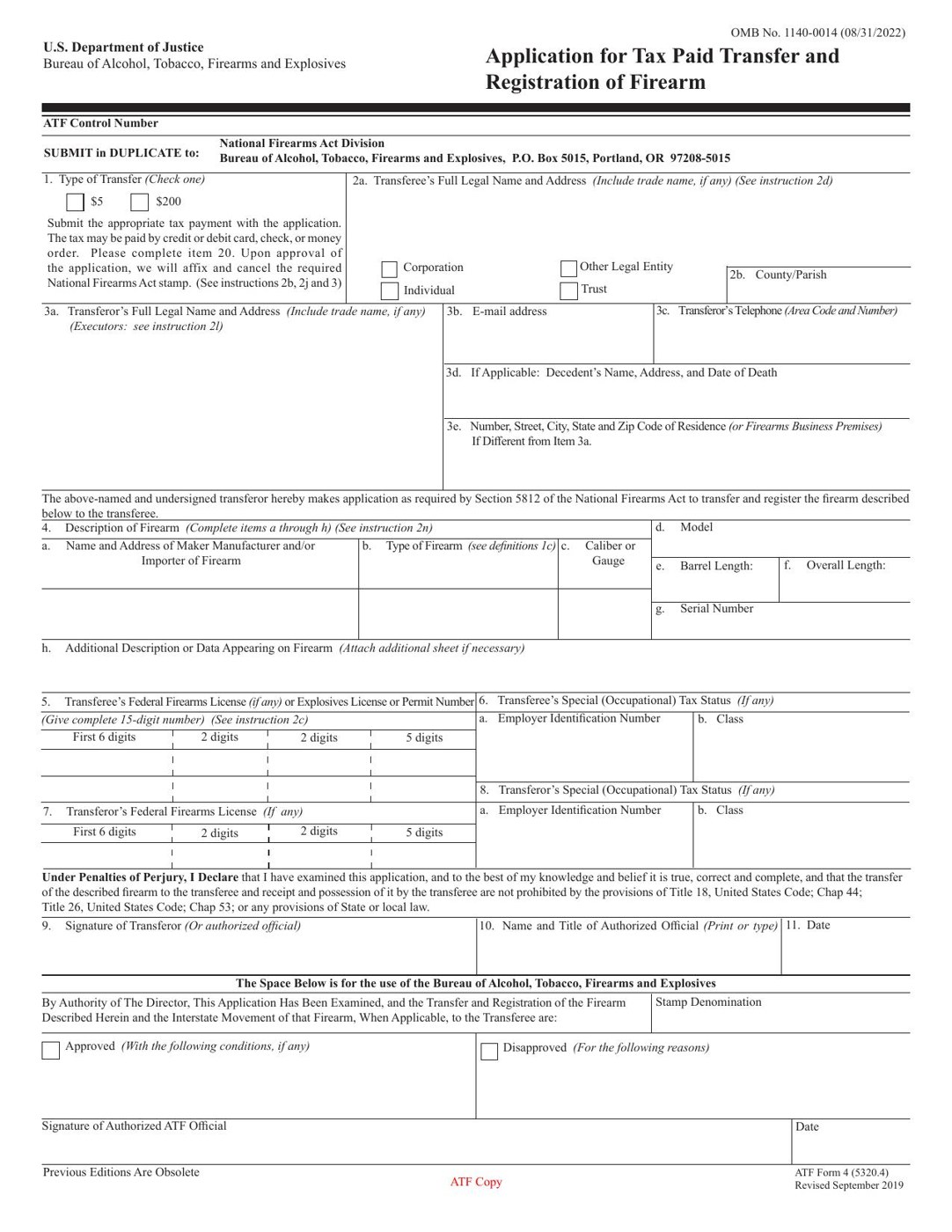
- Form 4 for tax-paid transfer to a non-SOT private buyer.
- Form 1 for tax-paid manufacture by a private individual (e.g., making an SBR by attaching a stock to a pistol; this does not apply to manufacturing a machine gun — that’s prohibited by FOPA-86 § 922(o)).
- Form 5 for tax-exempt estate transfer.
- Form 5320.20 for interstate transport notification.
The $200 tax has not changed since 1934. In 1934 dollars, $200 was prohibitive (equivalent to ~$4,500 in 2026 dollars). In 2026 dollars, $200 is a paperwork friction rather than a financial barrier.
10.3.3 FOPA-86 § 922(o) — the May 19, 1986 cutoff
18 USC § 922(o) (added by the Firearm Owners Protection Act of 1986) prohibits the transfer or possession of a machine gun manufactured on or after May 19, 1986, with two exceptions:
- Lawfully possessed before that date (the transferable registry) — these guns remain transferable forever via Form 4.
- Owned by the United States or any state/political subdivision, or owned by an SOT-licensed manufacturer/dealer — the dealer-sample registry.
Practical effect: no new STENs can be added to the transferable registry. The pool of transferable STENs is frozen at whatever was registered before May 19, 1986 — approximately 600–1,200 individual guns (Vol 5 § 5.2.4). A private individual cannot manufacture a new machine gun (no Form 1 path for machine guns — § 922(o) closed it). A private individual cannot acquire a post-86 machine gun even via dealer-sample channels.
10.3.4 Constructive possession and the registered owner
The NFA requires the registered owner (or authorized possessor under an NFA gun trust) to have exclusive control over the registered item. The legal doctrine: anyone with access to the registered item (e.g., the key to the safe where it’s stored) may be in constructive possession, and if that person is not the registered owner or an authorized trustee, they may be in unlawful possession of an unregistered NFA item.
Practical implications:
- Store NFA items in a safe to which only the registered owner (or authorized trustees) have access.
- If using an NFA gun trust, name all family members or co-residents who need access as trustees (subject to the Rule 41F paperwork burden).
- Do not allow non-authorized persons to handle the gun in the registered owner’s absence.
- Do not loan the gun to anyone; loan to another registered Class III owner requires a Form 4 transfer.
The constructive-possession framework is the most-litigated aspect of NFA law. See § 10.7 for the application to STEN-specific scenarios.
10.3.5 Cross-reference
Vol 5 owns the Form 4 procedure, market reality, per-state acquisition map, and lifetime posture maintenance. This volume owns the statutory framework.
10.4 18 USC § 922(r) and 27 CFR § 478.39 — the Path B foundation
10.4.1 The statute and the regulation
18 USC § 922(r) (added by the 1990 Crime Control Act, amended subsequently) makes it unlawful to:
“…assemble from imported parts any semiautomatic rifle or any shotgun which is identical to any rifle or shotgun prohibited from importation under section 925(d)(3)…”
27 CFR § 478.39 is ATF’s implementing regulation. It specifies that a semi-automatic rifle or any shotgun assembled from imported parts, if the assembled firearm could not be imported under § 925(d)(3), must contain no more than 10 of 20 specified parts that are imported.
10.4.2 The 20-parts list (27 CFR § 478.39)
The 20 parts:
- Frames, receivers, receiver castings, forgings, or stampings
- Barrels
- Barrel extensions
- Mounting blocks (trunnions)
- Muzzle attachments
- Bolts
- Bolt carriers
- Operating rods
- Gas pistons
- Trigger housings
- Triggers
- Hammers
- Sears
- Disconnectors
- Buttstocks
- Pistol grips
- Forearms, handguards
- Magazine bodies
- Followers
- Floorplates
For a Mk II STEN build, approximately 11 of the 20 categories apply (the rest are n/a — no operating rod, no gas piston, no pistol grip, etc.). Vol 6 § 6.5.2 has the worked example with applicable parts and the canonical replacement-package arithmetic.
10.4.3 Why this applies to a STEN
§ 922(r) says “rifle or shotgun.” A semi-auto STEN carbine with its buttstock fitted is a rifle under 18 U.S.C. § 921(a)(7): a weapon designed to be fired from the shoulder, firing one projectile through a rifled bore per pull of the trigger. Its submachine-gun ancestry does not change that, so the section applies on its own text. The 925(d)(3) “sporting purposes” test excludes submachine guns and their semi-auto derivatives, so a semi-auto STEN carbine built from imported parts is non-importable, and § 922(r) prohibits assembling it with more than ten imported listed parts.
The flip side follows from the same text: § 922(r) and § 478.39 name rifles and shotguns, not pistols. A stockless build made as a pistol from the outset is outside this section, though it brings its own questions (a stock added later makes it a short-barreled rifle under the NFA if the barrel is under 16 in; see § 10.2).
The working posture: treat § 922(r) as applying to every imported-parts-kit SMG-pattern carbine, including the STEN. The ceiling is ten imported listed parts; there is no US-made quota, and the ceiling does not shrink when fewer than twenty listed parts exist on the design (Vol 6 § 6.5.1; AK-47 Vol 17 quotes § 478.39(a) verbatim).
10.4.4 What “US-made” means
A part is US-made if it was:
- Manufactured in the United States by a US person/entity from start to finish, or
- Substantially transformed in the United States from imported raw material (the substantial-transformation rule).
Practical implications:
- A purchased US-made replacement part is US-made when the seller says so; Indianapolis Ordnance, for example, describes its STEN disconnector as “new US made” (product page, 2026-10-18). Keep the listing with the receipt.
- A builder-fabricated part is US-made if substantially transformed by the builder in the US — regardless of the raw-material origin. A buttstock turned from a piece of imported European steel rod is US-made under substantial-transformation; the imported rod is “raw material,” the turning is “substantial transformation.”
- A modified imported part is not US-made — it remains imported. Grinding the engagement surface of an imported Sten sear does not convert it to US-made.
10.4.5 Documentation
ATF does not specify documentation requirements for 922(r) compliance — the builder’s own records are the documentation. Standard practice:
- Retain receipts for purchased US-made parts.
- Retain a build log noting which parts were fabricated, which were purchased US-made, and which remain imported.
- Keep a written count of the listed parts, part by part, with the build log as the count-of-record (Vol 6 § 6.5.2 is a template).
- Document the substantial-transformation rationale for any fabricated parts (typical: “buttstock fabricated by builder from steel rod stock in the builder’s lab, in the US, on YYYY-MM-DD”).
ATF has historically not aggressively audited 922(r) compliance for personal builds, but the documentation protects against any future challenge or compliance review.
10.4.6 Cross-reference
Vol 6 § 6.5 owns the applied-to-a-Sten 922(r) treatment, including the worked count and the recommended replacement package. This volume owns the statutory and regulatory framework.
10.5 Open-bolt designs — ATF Rulings 82-2, 82-8 and 83-5
Correction, 2026-10-20. Earlier versions of this dive cited “ATF Ruling 80-21 (1982)” as a closed-bolt-only rule for new semi-auto SMG designs, effective January 1, 1982, with pre-1982 open-bolt semi-auto STENs grandfathered. That was wrong on all three counts. ATF Rul. 80-21 is about the state of residence of out-of-state college students under the Gun Control Act and says nothing about firearm design. The rulings that deal with open-bolt semi-automatics are 82-2, 82-8 and 83-5, quoted below. They classify named designs as machine guns; none of them is a general closed-bolt rule, none is dated January 1, 1982, and the one that names the STEN (83-5) contains no grandfather date. This section, and every passage in Vols 1, 4, 5, 6, 7, 8, 10, 11 and 12 that relied on it, has been rewritten from ATF’s own texts (read 2026-10-20 from the Internet Archive copies of atf.gov, captured 2015-09-06 and 2016-12-15, because atf.gov refuses scripted requests).
10.5.1 The rulings
ATF published three rulings in 1982–83 that classify open-bolt semi-automatic firearms as machine guns. Each one examines a named design, finds the same combination of features, and holds that design to be “designed to shoot automatically” under the NFA definition (26 USC § 5845(b)):
Table 1 — ATF published three rulings in 1982–83 that classify open-bolt semi-automatic firearms as machine guns. Each one examines a named design, finds the same combination of features, and holds that design to be "designed to shoot automatically" under the NFA definition (26 USC § 5845(b))
| Ruling | Firearm | ATF’s description | Grandfather date |
|---|---|---|---|
| ATF Rul. 82-2 | KG-9 pistol | ”blowback operated and which fires from the open bolt position with the bolt incorporating a fixed firing pin”; a disconnector that “a simple modification to it, such as cutting, filing, or grinding, allows the pistol to operate automatically" | "this ruling will not be applied to KG-9 pistols manufactured before January 19, 1982” |
| ATF Rul. 82-8 | SM10 and SM11A1 pistols, SAC carbines | the same features, plus “the barrels of the pistols are threaded to accept a silencer”; a disconnector and trip open to “cutting, filing, or grinding” | not applied to those “manufactured or assembled before June 21, 1982” |
| ATF Rul. 83-5 | YAC STEN MK II carbine | ”identical design characteristics to the original selective fire STEN submachinegun designed by Reginald Vernon Shepherd and Harold John Turpin. The weapon is blowback operated and fires from the open bolt position with the bolt incorporating a fixed firing pin”; a trip lever “modified to prevent more than one shot” which “a simple modification to it, such as bending, breaking or cutting allows the weapon to operate automatically” | none — the ruling has no § 7805(b) clause |
The reasoning is the same in all three. The NFA’s “designed” prong, in ATF’s words in 83-5, “includes weapons which have not previously functioned as machineguns but possess specific machinegun design features which facilitate automatic fire by simple alteration or elimination of existing component parts.” Open bolt, fixed firing pin and blowback operation, together with a disconnector that can be defeated by a simple cut, are the features; ATF calls the combination one “normally not found in the typical sporting firearm.” 83-5 then holds: “the STEN MK II semiautomatic carbine is a machinegun as defined in Section 5845(b) of the Act.”
The 83-5 classification was challenged and upheld: York v. Secretary of Treasury, 774 F.2d 417 (10th Cir. 1985), in which the court held “the BATF classification was based on relevant factors”. The opinion records that in 1982 ATF became aware that York was selling the YAC STEN MK II, and that agents told York to recall the guns already sold.
What the rulings are not. No ATF ruling, regulation or published policy statement was found that sets a general rule that every new semi-automatic design must fire from a closed bolt. ATF’s published position is design-by-design. An ATF FFL Newsletter of about 1990–91 (undated on the copy; it reports a court decision of September 13, 1990) applies the same test to the Holmes MP-83 and MP-22 open-bolt pistols, says their design features “are similar to weapons identified in ATF Rulings 82-2, 82-8, and 83-5 which were determined to be machineguns”, and classes them as machine guns. The common statement that ATF “banned open-bolt semi-autos in 1982” is a summary of these classifications and of ATF’s classification practice since, not the text of any ruling.
Practical effect for a STEN. It does not matter that no general rule exists: 83-5 classifies the open-bolt, fixed-firing-pin semi-auto STEN itself, and the “designed to shoot automatically” test it applies is what a new semi-auto STEN would be measured against. A semi-auto STEN that keeps the original open bolt and fixed firing pin, with only the trip lever altered, is the design 83-5 holds to be a machine gun.
10.5.2 The closed-bolt requirement applies to STEN builds
The WWII STEN is an open-bolt fixed-firing-pin design:
- The bolt is held rearward by a sear engagement.
- Trigger pull releases the sear, the bolt flies forward, chambers a cartridge, and the fixed firing pin on the bolt face strikes the primer at the instant of full chambering.
- The design is mechanically open-bolt by necessity — there is no separate firing pin, no separate hammer/striker, no closed-bolt geometry.
A new semi-auto STEN built today must use a closed-bolt FCG — adding a separate firing pin in the bolt, a striker mechanism in the FCG, and a closed-bolt sear/disconnector arrangement. Vol 7 § 7.5 documents the closed-bolt FCG fabrication procedure; Vol 6 § 6.6.2 documents the closed-bolt rework for a parts-kit build (using the Professor Parabellum Vol III drawings as the canonical reference).
This is the largest single mechanical change a modern US semi-auto Sten build requires relative to the WWII original. The result is a Sten that visually resembles a 1944 Mk II from the outside but operates from a closed bolt on the inside.
10.5.3 Pre-1982 grandfathered open-bolt semi-auto STENs
Earlier versions of this section described a grandfathered population of open-bolt semi-auto STENs “registered as semi-auto firearms before January 1, 1982”. ATF’s texts do not support it. Rulings 82-2 and 82-8 do contain grandfather dates, but only for the KG-9 (January 19, 1982) and the SM10, SM11A1 and SAC carbine (June 21, 1982). 83-5, the STEN ruling, contains none: it holds the YAC STEN MK II semi-automatic carbine to be a machine gun without exception, and York records that ATF told the maker to recall the guns already sold. There is also no federal registry of ordinary (non-NFA) firearms in which a semi-auto could have been “registered”. No ATF text was found that exempts any open-bolt semi-auto STEN, of any date, from 83-5.
Treat an open-bolt semi-auto STEN offered for sale as a possible unregistered machine gun, whatever its claimed date, and get a written classification from ATF or a firearms attorney’s opinion before going near one. Modifying any STEN to fire from an open bolt with a fixed firing pin creates exactly the design 83-5 classifies as a machine gun (a federal felony under 18 USC § 922(o) and 26 USC § 5861 unless it is a registered pre-1986 transferable).
10.5.4 Why this matters for the from-scratch build (Vol 7)
A Vol 7 from-scratch build is creating a new firearm for the first time. ATF Rul. 83-5 applies — Vol 7 § 7.5 implements a closed-bolt FCG by adding a separate firing pin to the bolt and a striker mechanism to the FCG housing.
The closed-bolt design is not historically accurate to the WWII Sten — it is an adaptation forced by ATF Rul. 83-5. Builders who want a historically-accurate Sten configuration must go Path A (Vol 5) and acquire a pre-86 registered transferable, which is already a registered machine gun, so 83-5’s classification is no obstacle.
10.5.5 Constructive-possession implications
Possession of the parts to convert a closed-bolt Sten back to open-bolt is a constructive-possession trap. A builder who has:
- A semi-auto closed-bolt Sten, and
- A spare bolt with a fixed firing pin (e.g., the original kit bolt for a Path B build), and
- The original FCG configured for open-bolt operation,
possesses a “combination of parts” that could be assembled into a machine gun, and may be in constructive possession of an unregistered machine gun under 26 USC § 5861.
Mitigations:
- Destroy or surrender the original open-bolt parts after a Path B closed-bolt conversion. Cut the original bolt’s firing pin off; disable the original FCG by removing the sear engagement.
- Use a CMP / ATF-approved disposal path for the open-bolt parts.
- Document the disposition of the original parts in the build log.
This is the most-litigated constructive-possession scenario for parts-kit SMG builders and warrants careful attention. § 10.7 has more on constructive possession.
10.6 State-by-state map — SBR, NFA, and imitation-firearm posture
State laws vary widely on private firearms ownership in general and on NFA items specifically. The map below is not exhaustive and is current as of 2026 — verify with current state law before acting.
10.6.1 The SBR question
A new semi-auto Sten built today has a barrel length of ~7.75″ (Mk II) or ~7.8″ (Mk V). Under federal law (NFA), a rifle with a barrel under 16″ or an overall length under 26″ is a Short-Barreled Rifle — an NFA item requiring registration and a $200 tax stamp.
A Path B or Path C STEN is, by default, a federally-defined SBR. The build options:
- Accept SBR posture — file Form 1 (manufacture by individual), pay $200 tax stamp, wait 6–10 months for approval, possess the SBR with the standard NFA posture obligations (Vol 5 § 5.6 applies). This is the canonical Vol 6 / Vol 7 path.
- Extend the barrel to ≥16″ — by welding a permanent muzzle device (a non-removable extension), or by using a long-barrel kit (some manufacturers produce 16″ Sten barrels specifically to avoid SBR posture). Result: a long-barreled rifle, not an SBR, no Form 1, no tax stamp. Aesthetic and ergonomic compromise (the long barrel changes the gun’s visual character significantly).
- Configure as a pistol — federal “pistol” classification requires no shoulder stock. A “pistol Sten” is impractical (the Sten’s design is built around the stock) but is the niche third option for builders who want to avoid SBR posture and the barrel extension. Subsequent attachment of a stock turns it back into an SBR.
The canonical Vol 6 / Vol 7 path is option 1 — accept SBR posture, file Form 1, pay the tax stamp. The Form 1 procedure parallels the Form 4 procedure (Vol 5 § 5.4) but is for individual manufacture rather than transfer.
10.6.2 State NFA posture
State laws on NFA ownership (machine guns and SBRs):
Table 2 — State laws on NFA ownership (machine guns and SBRs)
| Posture | States | Notes |
|---|---|---|
| Permissive (NFA permitted with Form 4/Form 1) | TX, FL, AZ, NV, GA, NC, SC, TN, OH, PA, KS, OK, AL, MS, LA, AR, MO, KY, IN, WV, VA, MI, WI, MN, ID, MT, ND, SD, NE, IA, NH, ME, VT, AK, WY, NM, UT (most permissive states) | Federal NFA process is the only step required. |
| Permissive with state notification or licensing | CT, MA (NFA permitted but state licensing required for some items) | Adds a state-permit step on top of federal Form 4/Form 1. |
| Restrictive on machine guns; SBR may be permitted | CA (machine guns prohibited for private ownership; SBRs effectively prohibited under “assault weapon” rules), WA (SBR restricted post-2022), CO (SBR permitted post-2023 by ballot measure; machine gun restricted) | Patchwork of state-by-state restrictions. |
| Prohibited or substantially prohibited | NY (NFA private ownership effectively prohibited), NJ (machine guns and SBRs prohibited for private ownership), HI, RI, IL (state-by-county; Cook County restrictive) | NFA acquisition for private possession not viable. |
| DC | Substantially prohibited | DC firearms law is significantly restrictive across categories. |
10.6.3 Imitation-firearm laws
The STEN is a real firearm. Imitation-firearm laws do not apply to a real STEN — those laws (15 USC § 5001 federally; state-level rules in NY, NJ, CA, MA, others) apply to airsoft, blank-firing, and non-firing replicas. Since this hub treats the STEN as a real firearm (no airsoft or replica path is in scope here — see § 10.0 in this volume), imitation-firearm rules are out of scope for Vol 10.
For builders who later branch to an airsoft Sten conversion (not currently in scope but a possible future addition), the imitation-firearm rules become relevant — orange-tip requirements, state-level transport restrictions, etc. The hub’s legal-posture notes table covers the airsoft-and-replica posture; consult it if branching that way.
10.6.4 “Assault weapon” laws
A small number of states have “assault weapon” statutes that may apply to a semi-auto STEN configuration:
- California: the AW definition includes specific feature lists; a semi-auto Sten with a detachable magazine, pistol grip equivalent, or threaded muzzle may trigger AW classification. Conservative posture in CA: do not build a Path B/C Sten; CA private ownership is restrictive across multiple dimensions.
- New York SAFE Act: similar feature-based AW rules; private semi-auto SMG-pattern builds are not viable in NY.
- New Jersey: comprehensive AW restrictions; not viable.
- Massachusetts: AW restrictions plus state licensing; consult MA firearms attorney before any Sten build.
- Connecticut: AW restrictions; some semi-auto configurations grandfathered if registered before specific cutoff dates.
- Maryland: AW restrictions; certain SMG-pattern builds prohibited.
- Washington: post-2022 AW restrictions; consult state attorney.
- Colorado: post-2023 large-capacity magazine restrictions and SBR rules adjusted.
- Hawaii, Illinois (Cook County), DC, Oregon (post-2022 Measure 114, currently in litigation): various restrictions.
The remaining ~40 states do not have AW statutes that would affect a semi-auto STEN build at the configuration level. Verify with current state law before acting.
10.6.5 Magazine-capacity rules
A standard Sten magazine holds 32 rounds. State magazine-capacity restrictions:
Table 3 — A standard Sten magazine holds 32 rounds. State magazine-capacity restrictions
| State | Magazine capacity limit | Notes |
|---|---|---|
| CA | 10 rounds | Magazine-capacity restriction in litigation; current 2026 status: 10 rounds. |
| NY | 10 rounds (some configurations exempt) | SAFE Act framework. |
| NJ | 10 rounds | Strict. |
| MA | 10 rounds | For “large capacity” feeding devices. |
| CT | 10 rounds | Some grandfathering. |
| CO | 15 rounds | Post-2013; recent adjustments. |
| WA | 10 rounds | Post-2022. |
| HI | 10 rounds for handguns; rifles less restricted | |
| IL | 15 rounds (Chicago); state-level under recent legislation | |
| DC | 10 rounds | |
| MD | 10 rounds (handgun magazines only; rifle magazines less restricted at state level but Sten may be classified as handgun-equivalent) | |
| All other states | No state-level limit |
In a state with a 10-round limit, the Sten’s 32-round magazines are not lawful to possess (with possible grandfathering for pre-cutoff magazines). Build the gun in a permissive state, or do not build. No newly made 10-round STEN magazine was found (2026-10-18).
10.7 The manufacture-for-personal-use exemption (Path C foundation)
10.7.1 The exemption
Under federal law (18 USC § 922 + 27 CFR § 478), an individual may manufacture a firearm for their own personal use without:
- A federal Firearms License (FFL).
- Federal serialization (no requirement to mark the firearm with a serial number).
- A federal record of manufacture.
The exemption is for personal use only — the manufactured firearm cannot be transferred or sold to another person within a defined time window (ATF guidance varies; conservative posture: never transfer a personally-manufactured firearm; if transfer becomes necessary, do so through an FFL with proper paperwork).
10.7.2 What this enables (Path C)
A Vol 7 from-scratch STEN build is a manufacture-for-personal-use:
- The builder fabricates the receiver tube, bolt, FCG, barrel, etc., in the home lab.
- The completed firearm is for the builder’s own use.
- No federal serialization is required.
- No federal record of manufacture is required.
The build is subject to:
- NFA SBR posture (if barrel <16″; Form 1 required — Vol 7 § 7.1.2 prerequisite).
- ATF Rul. 83-5 — an open-bolt semi-auto STEN is a machine gun, so the build must be closed-bolt (Vol 7 § 7.5 implements closed-bolt FCG).
- State law (some states require state-level serialization or notification — see § 10.6.3).
- Manufacture-for-personal-use only (do not build with intent to transfer).
10.7.3 State serialization requirements
Some states have post-2018 requirements for individually-manufactured firearms to be serialized:
- California (since 2018, AB 857): individually-manufactured firearms must be serialized by the manufacturer (the individual builder) before completion; the serial number must be applied for through the CA DOJ.
- New Jersey (since 2018): similar requirement.
- Washington (post-2022): similar requirement.
- New York (post-2022): similar requirement.
- Connecticut, Maryland, Hawaii, Rhode Island, Illinois: various state-level serialization requirements.
Federal manufacture-for-personal-use does not preempt state serialization requirements. A builder in a state with state-level serialization must follow the state procedure.
In permissive states (TX, FL, AZ, etc.), no state-level serialization is required. The federal exemption stands alone.
10.7.4 80% receiver and “ghost gun” rules
A related framework: the 80% receiver is a partially-formed receiver that, under BATFE precedent, is not yet a “firearm” — it requires final machining (typically the magazine-well slot, FCG attachment holes, etc.) to become a firearm. An 80% receiver sale is not a firearm sale federally; no 4473 paperwork is required.
The 2022 ATF Frame and Receiver Final Rule (27 CFR § 478.12, effective Aug 24, 2022) expanded the definition of “readily convertible” to include some 80% receivers as “firearms” if they are accompanied by jigs, tooling, or instructions that make completion trivial. The rule has been challenged upheld against a facial challenge by the Supreme Court in Bondi v. VanDerStok (26 March 2025); ATF treats certain 80% receivers as firearms.
For the STEN, the 80% receiver question is mostly moot — most US-made semi-auto Sten receivers are sold either as complete receivers (which are firearms) or as rolled-and-welded tubes that require substantial additional machining (which are not “firearms” under any reasonable reading). The Vol 6 § 6.4.2 80%-receiver option is robust under the 2022 rule because the final machining (CNC milling the magazine-well slot, ejection port, etc.) is non-trivial.
State 80%-receiver rules vary; CA, NY, NJ, WA, RI, IL effectively prohibit 80% receivers for private builders. Permissive states allow them.
10.7.5 Cross-reference
Vol 7 owns the fabrication procedure under the manufacture-for-personal-use exemption. This volume owns the legal framework for the exemption.
10.8 Constructive possession — the STEN-specific traps
Constructive possession is the legal doctrine that a person can be in possession of a firearm (or NFA item) even without having physical custody, if that person has the ability to exercise control over it. For a STEN owner, several specific scenarios warrant attention.
10.8.1 Open-bolt parts after a closed-bolt build
As noted in § 10.4.5: a Path B builder who reworks the kit FCG to closed-bolt and retains the original open-bolt FCG parts has, in their possession, a “combination of parts” that could be assembled into an open-bolt semi-auto Sten. Under ATF Rul. 83-5, an open-bolt semi-auto Sten is a machine gun. Therefore the builder may be in constructive possession of an unregistered machine gun.
Mitigation:
- Destroy the original FCG sear and bolt firing-pin tip after the closed-bolt conversion. Cut, grind, or weld so they cannot be re-assembled to function.
- Document the destruction in the build log with photos.
- Do not keep them as “collector” or “reference” parts — they are constructive-possession evidence.
Some builders ship the original open-bolt parts to ATF for destruction or to a Class III dealer for proper disposition. The conservative posture is to make them unusable before disposing of them.
10.8.2 Auto-sear possession
A standalone auto-sear for a Sten (a part that, when installed in a Sten FCG, converts it from semi-auto to full-auto) is, under ATF interpretation, itself a machine gun under the “combination of parts” prong of 26 USC § 5845(b).
Possession of an auto-sear without NFA registration is a federal felony, regardless of whether a Sten is in hand to install it in. This applies to:
- Original WWII Sten auto-sear parts.
- Modern fabricated auto-sears.
- Drop-in auto-sear devices (DIAS for Sten or similar).
- Components that could be readily assembled into an auto-sear.
The constructive-possession trap: a Path B builder who receives a complete Sten parts kit including the original WWII FCG with its select-fire selector and disconnector may, depending on ATF’s interpretation of the specific parts, be in possession of “auto-sear components.” The conservative posture:
- Do not retain any kit parts that, in combination, could be readily assembled into an auto-sear.
- Destroy the fire-mode selector and the full-auto sear engagement features of the kit FCG before installing the FCG in the build, or use only the closed-bolt rework (which structurally eliminates these features).
- Document the modifications in the build log.
10.8.3 Pre-86 transferable owner with kit parts
A Path A owner (Vol 5) who also acquires a Path B kit (for parts donor or hybrid build per Vol 5 § 5.9) is in a special posture:
- The registered receiver is a machine gun under NFA — lawful by registration.
- The kit’s bolt, FCG, and barrel are service parts for the registered receiver — lawful as service parts.
- The kit’s original WWII fire-control features (full-auto sear, select-fire selector) are appropriate for the registered receiver — lawful.
This is the only scenario where the WWII full-auto parts are lawful. Outside of an NFA-registered receiver, the parts are constructive-possession evidence.
10.8.4 Magazine constructive possession
A 32-round Sten magazine is not a constructive-possession item under federal law (magazines are not NFA items). In states with magazine-capacity limits (§ 10.5.5), a 32-round magazine may be unlawful to possess under state law, but the issue is direct state-law possession, not constructive possession of a machine gun.
10.8.5 Documentation as defense
The best defense against a constructive-possession challenge is a build log documenting:
- What parts were possessed, from what source, at what date.
- What modifications were made to convert open-bolt to closed-bolt.
- What dispositions were made of the original open-bolt parts.
- What 922(r) compliance count was documented (Vol 6 § 6.5.2).
- What NFA paperwork (Form 1 SBR, if applicable) was filed.
A builder who can show a clear record of compliance has a robust defense against a constructive-possession inquiry. A builder with no records has no defense.
10.9 ATF rulings and current posture (the contested landscape)
ATF has issued numerous rulings affecting the STEN posture over decades. The most-load-bearing:
- ATF Rulings 82-2, 82-8 and 83-5 (1982–83) — open-bolt, fixed-firing-pin semi-automatics classified as machine guns; 83-5 is the YAC STEN MK II carbine (§ 10.4).
- Open Letter 04-21-1990 and subsequent — 922(r) interpretation for SMG-pattern builds (§ 10.3).
- 2014 ATF Letter to Pomerantz — clarified that an unmodified pre-86 transferable receiver, when combined with kit parts, retains its registered status (relevant to Vol 5 § 5.9 hybrid build).
- 2022 Frame and Receiver Final Rule (27 CFR § 478.12) — expanded definition of “firearm” to include some 80% receivers if accompanied by jigs/instructions (§ 10.6.4).
- 2023 Stabilizing Brace Rule — reclassified many pistol-with-brace configurations as SBRs (not directly relevant to STEN; the Sten has no pistol-brace path).
- Bondi v. VanDerStok (decided 26 March 2025) — the Supreme Court upheld the 2022 frame-and-receiver rule against a facial challenge; kits that are readily completed into a working firearm can be regulated as firearms.
The federal landscape has been more contested in 2022–2026 than in any period since 1986. The canonical rules in this volume are stable, but the implementing details may shift. Re-verify current ATF posture before any acquisition or build step that depends on the specific application of these rules.
10.10 Decision framework — which path is legal where
A consolidated decision framework for the three build paths by jurisdiction:
Table 4 — A consolidated decision framework for the three build paths by jurisdiction
| State posture | Path A (NFA Class III) | Path B (parts kit + US receiver) | Path C (from scratch) |
|---|---|---|---|
| Permissive (TX, FL, AZ, NV, GA, NC, etc.) | ✓ Form 4 + $200 stamp + 6–14 mo wait. Lifetime NFA posture. | ✓ 922(r) compliance + closed-bolt rework + Form 1 SBR + $200 stamp. | ✓ Manufacture-for-personal-use + closed-bolt FCG + Form 1 SBR + $200 stamp. |
| Permissive with state licensing (CT, MA) | ✓ Form 4 + state license. | ✓ With state license + state serialization requirements (if any). | ✓ With state serialization + state license. |
| Restrictive on AWs / SBR (CA, WA, CO, MD) | △ Form 4 path may be viable; SBR may not. State-level legal advice required. | × Generally not viable for new builds (state AW + magazine + SBR rules). | × Generally not viable. |
| Prohibited (NY, NJ, HI, RI, IL outside Cook) | × Not viable. | × Not viable. | × Not viable. |
| Restrictive (DC) | × Not viable. | × Not viable. | × Not viable. |
For a builder in a prohibited or substantially restrictive state, the practical posture is:
- Move to a permissive state before building, or
- Not build at all, or
- Acquire a deactivated specimen for collector reference (Vol 11 covers the deactivated-specimen posture in less detail than Vol 5 covers transferable).
10.11 References (Vol 10)
- Vol 5 of this series — Build Path A (NFA Class III). Owns the Form 4 procedure, market reality, lifetime NFA posture.
- Vol 6 of this series — Build Path B (parts kit + US receiver). Owns the applied-to-a-Sten 922(r) treatment, closed-bolt FCG rework, SBR posture as applied.
- Vol 7 of this series — Build Path C (from scratch). Owns the manufacture-for-personal-use procedure, closed-bolt FCG fabrication.
- Vol 11 of this series — Live-Fire Operation & Use. Owns the lawful range-use posture.
- the hub’s legal-posture notes — hub-wide legal framework: NFA categories on sight, real-vs-replica-vs-airsoft distinction, when-in-doubt-ask rule.
- 26 USC §§ 5801–5872 — National Firearms Act statutory framework.
- 18 USC § 921 — federal firearm definitions.
- 18 USC § 922(o) — FOPA-86 machine-gun manufacturing/transfer cutoff.
- 18 USC § 922(r) — non-importable-firearms parts-count rule.
- 27 CFR Part 478 — ATF regulations implementing the Gun Control Act.
- 27 CFR Part 479 — ATF regulations implementing the National Firearms Act.
- 27 CFR § 478.39 — the 20-parts list implementing 922(r).
- 27 CFR § 478.12 (2022 Frame and Receiver Final Rule) — definition of firearm including some 80% receivers.
- ATF Rul. 82-2 (KG-9 pistol), 82-8 (SM10, SM11A1, SAC carbine) and 83-5 (YAC STEN MK II carbine) — each classifies an open-bolt, fixed-firing-pin semi-automatic design as a machine gun under 26 USC § 5845(b). Texts at atf.gov (rulings library); read 2026-10-20 from Internet Archive copies. All three also print in the ATF NFA Handbook (ATF E-Publication 5320.8, revised April 2009), Appendix B.
- York v. Secretary of Treasury, 774 F.2d 417 (10th Cir. 1985) — upholds the 83-5 classification.
- ATF Open Letters — searchable at atf.gov; specific letter numbers cited above.
- ATF Forms — Form 1 (manufacture by individual), Form 4 (tax-paid transfer), Form 5 (estate transfer), Form 5320.20 (interstate transport).
- Rule 41F (2016) — fingerprints, photos, CLEO notification for NFA trust trustees.
- NFA Owners Association (nfaoa.org) — owner-advocacy organization with legal resources and attorney referrals.
- Prince Law Offices, Sean Brady, Adam Kraut — firearms attorneys with NFA practice.
- Apex Gun Parts technical documentation — per-kit 922(r) and compliance documentation.
- State firearms-law summaries — published per-state by NRA-ILA, Gun Owners of America, NFAOA, and state-level organizations; verify current state law before acting.
- Bondi v. VanDerStok, 604 U.S. ___ (26 March 2025) — Supreme Court review of the 2022 ATF Frame and Receiver Final Rule; the rule was upheld against a facial challenge.
Comments (0)