Steyr AUG · Volume 4
Generations and Variants — A1 to A3 M2, the Stocks, the Barrels, the 9 mm, the Heavy Barrel, and How to Tell Them Apart
Every AUG variant for which a maker's or user's document was found, the barrel sets Steyr has changed three times, and an identification guide with comparison plates, close-ups and a tell-them-apart table
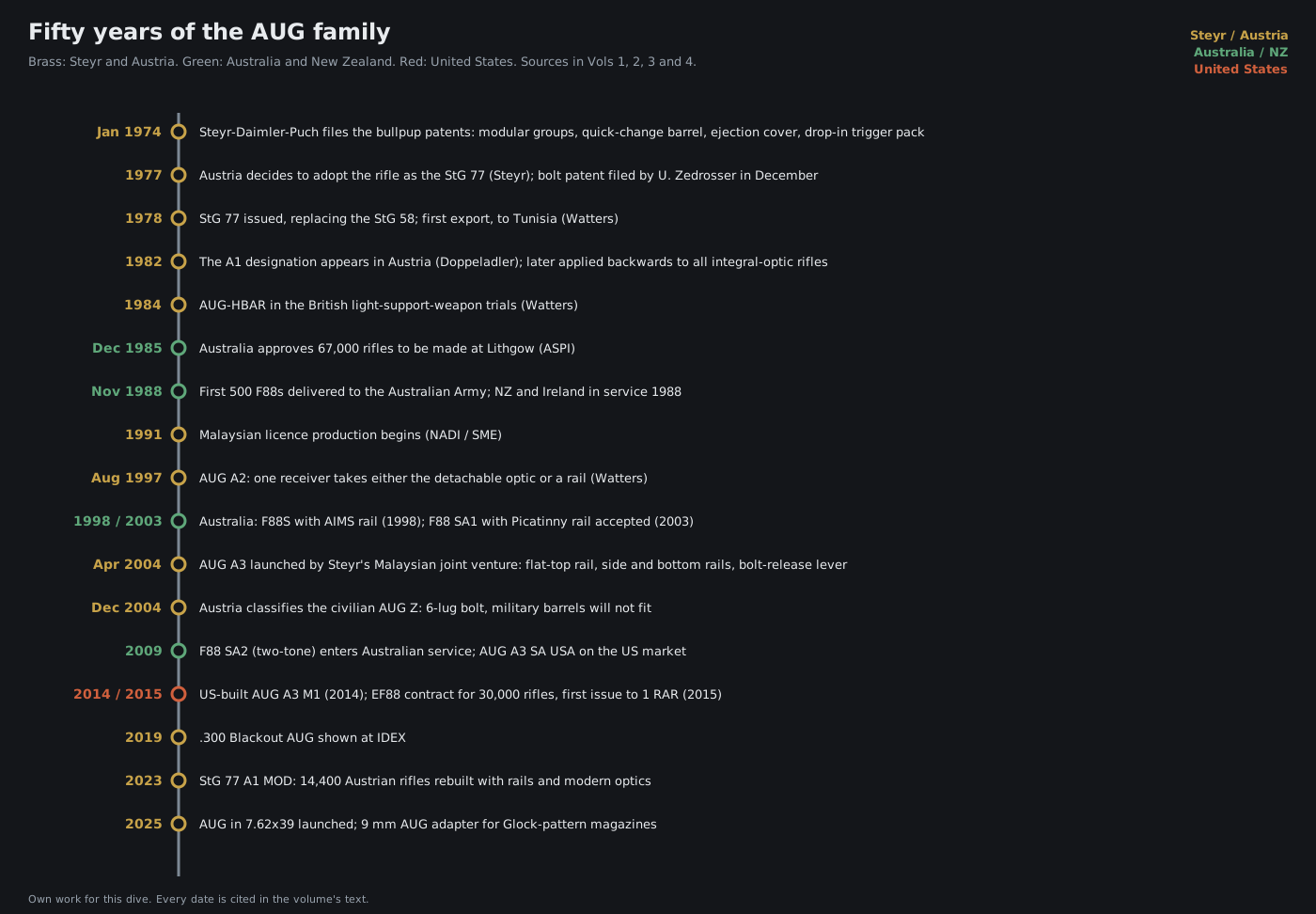
4.1 Names, and a Name Applied Backwards
The AUG’s variant names are used loosely, and they overlap across three markets. Three conventions need fixing before the variants make sense.
- StG 77 and AUG. StG 77 is the Austrian Army’s designation; AUG is Steyr’s export name (Vol 1 §1.2).
- “A1” for the original rifle is a retronym. Doppeladler, a reference site on the Austrian Army, dates the A1 to 1982 and calls the 1977 rifle the StG 77 or, retrospectively, the “A0.” Steyr’s own history page nonetheless calls the 1977 rifle the “AUG A1.”12 This dive uses “A1” in the English-language way, for any AUG with the integral optic in its carrying handle, with that caveat.
- Civilian and military names differ by market. In the United States the civilian rifles have been the AUG-SA (1980s), the USR, the A3 SA USA (2009), the A3 M1 (2014) and the A3 M2. In Europe they are the AUG Z, the AUG Z A3 and the AUG SA. The Austrian service names add the A2 Commando, the lMG 77 and the MP 88 (Vol 1 §1.7).
4.2 The StG 77 and the A1
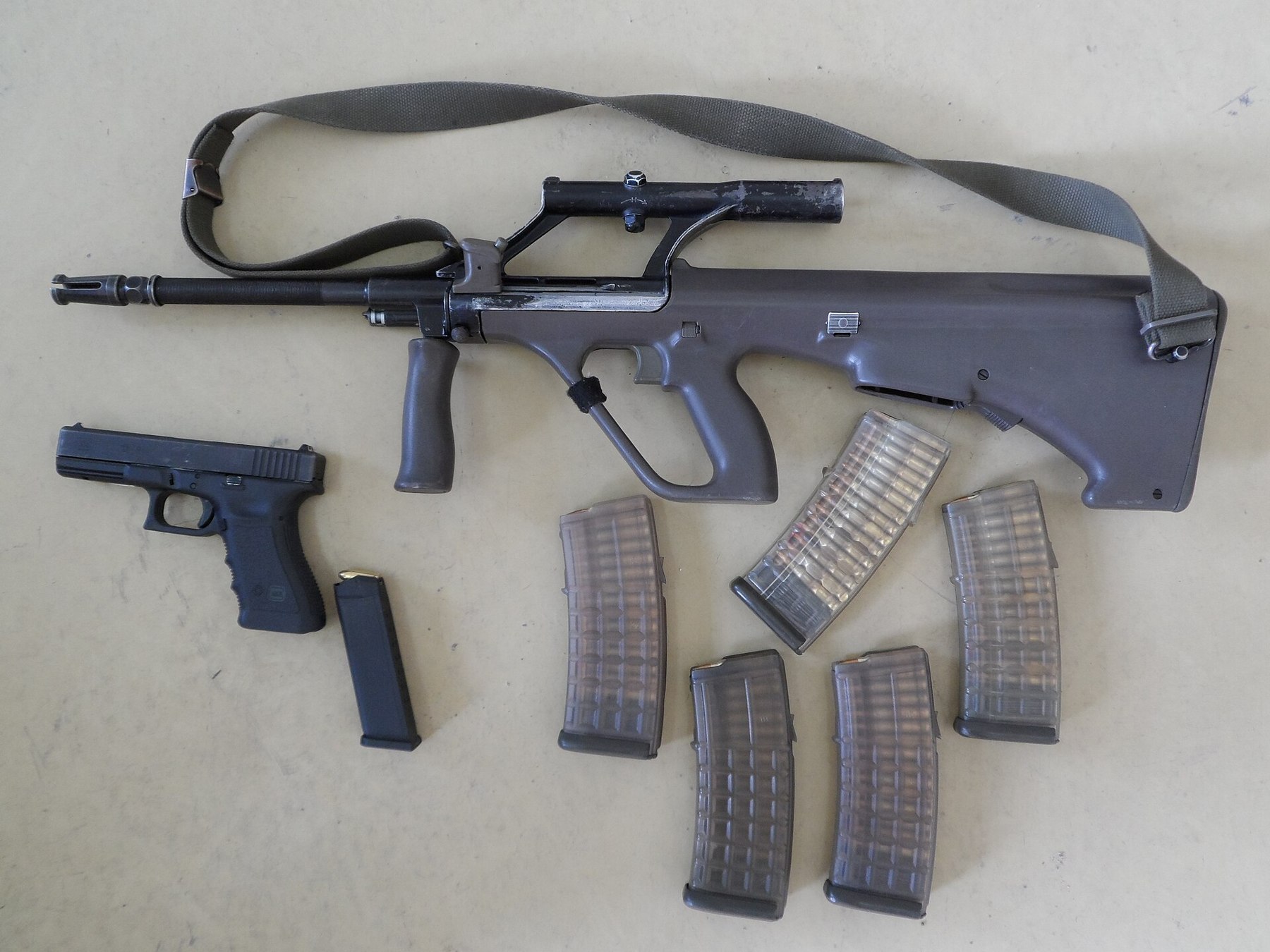
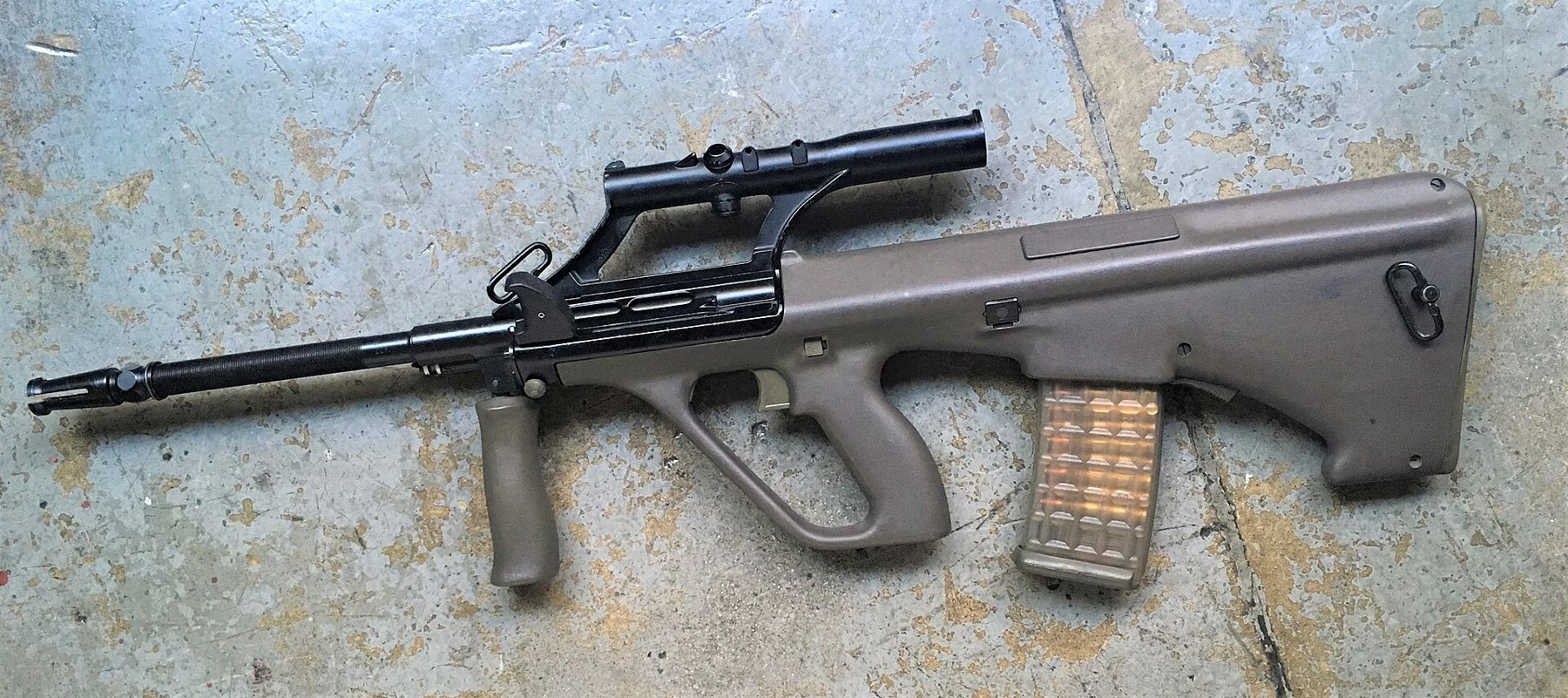
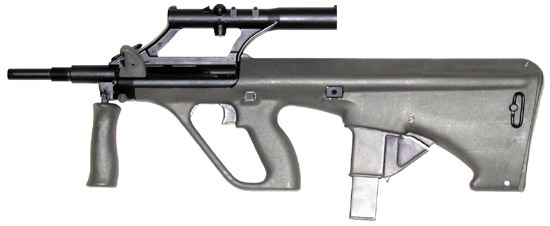
The original pattern is the one most people picture: an olive or black one-piece stock, a quick-change barrel with a folding forward grip, and a receiver whose carrying handle is also the housing of a 1.5× telescopic sight, with an “emergency sight” — a simple notch and blade — cast into its top. Steyr’s c. 2009 product sheet for the A1 and A2 lists “Stock: Synthetic, olive or black,” a bolt “with seven locking lugs,” a two-position gas regulator, and a “1.5x optical sight with ring reticule, integrated in the carrying handle.”3 Its captions distinguish the “AUG A1 Assault Rifle with 508 mm barrel” from the “AUG A1 Machine Carbine with 407 mm barrel.”3
Two details distinguish an A1-pattern rifle in the hand from later ones:
- No external bolt-release lever. The A1 rifle does hold its bolt open on an empty magazine (Vol 5 §5.7); it releases it by the cocking handle. The A3 stock adds the lever on the left behind the magazine well.4
- The cocking handle. Ulrich Zedrosser’s patent for a folding cocking handle was filed in 1986 (Vol 1 §1.4). Steyr’s c. 2009 A3 SF sheet lists a “foldable cocking handle”; its A1/A2 sheet does not mention one. A fixed handle is therefore an early-pattern cue, though not a proof.
Before 1997, Watters’s chronology records, a rail instead of the optic meant a different receiver: “Instead of requiring two separate receivers, one with the integrated carry handle/optic and a second with a sight rail,” the A2 would use one.5
4.3 The A2
Watters dates the A2 to August 1997: “Instead of requiring two separate receivers … the AUG A2 features a single receiver that can be equipped in either configuration, interchangeably.”5 Steyr’s c. 2009 sheet pictures an “AUG A2 with Mil. Std. 1913 rail and red dot sight.”3 The optic on an A2 is a detachable module, not part of the receiver casting.
From a photograph, an A2 with its optic fitted looks very like an A1. The reliable cue is the joint between the optic housing and the receiver; the stock and barrel are the same.
4.4 The A3, the A3 SF, and the US A3 M1 and M2
The A3. Watters records that “Steyr Mannlicher (M) Sdn Bhd introduces the AUG A3” in April 2004, with accessory rails, an optional integrated 40 mm grenade launcher and, reportedly, a magazine well able to take either magazine type.5 Steyr’s c. 2009 sheet describes a “Mil. Std. 1913 flat top rail with attached optical sight 1.5x,” a “Bottom integrated Picatinny rail,” a “Left side mounted rail,” an “External bolt release,” barrels of 365, 407, 455 and 508 mm, and an optional three-round burst on the military rifle.6
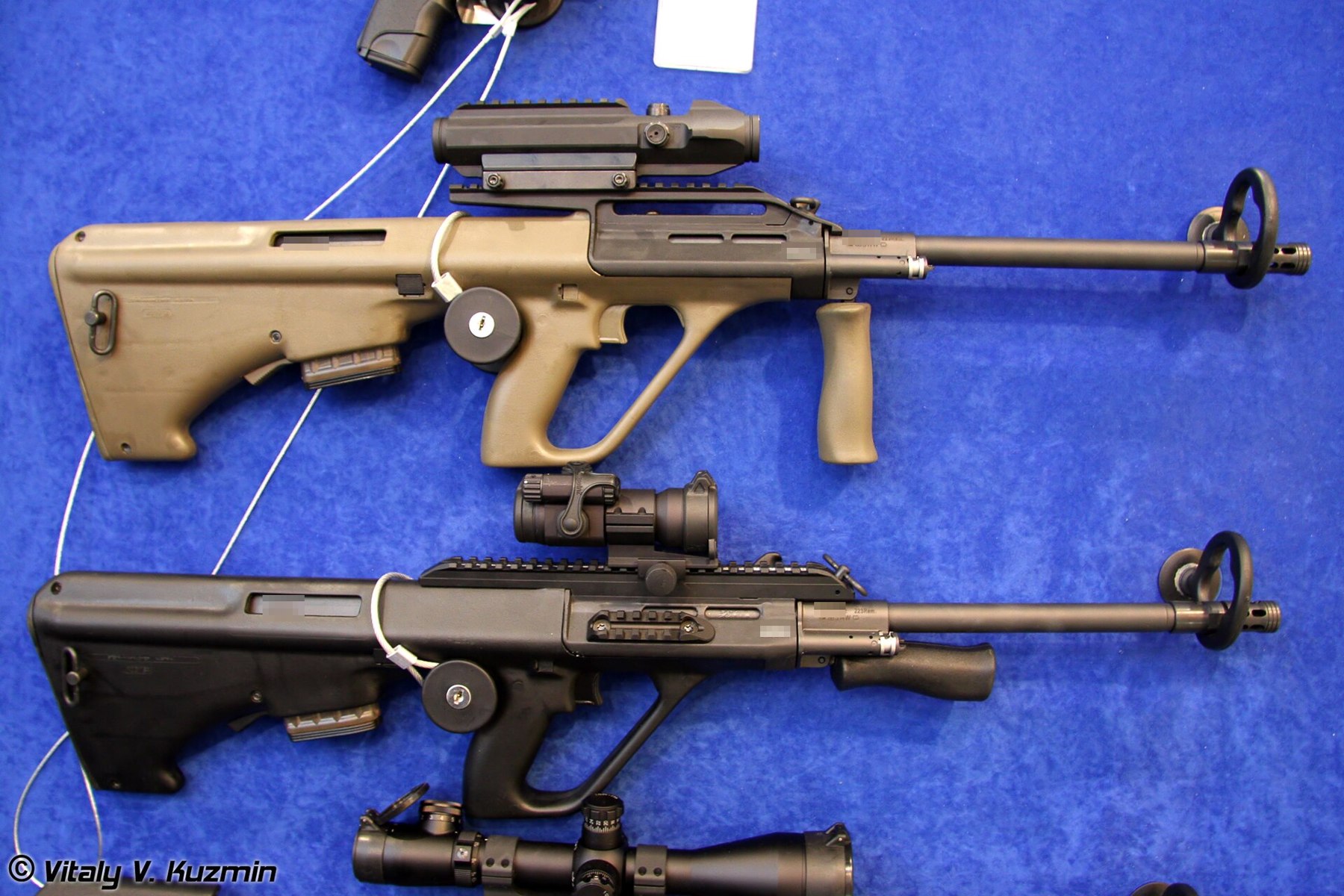
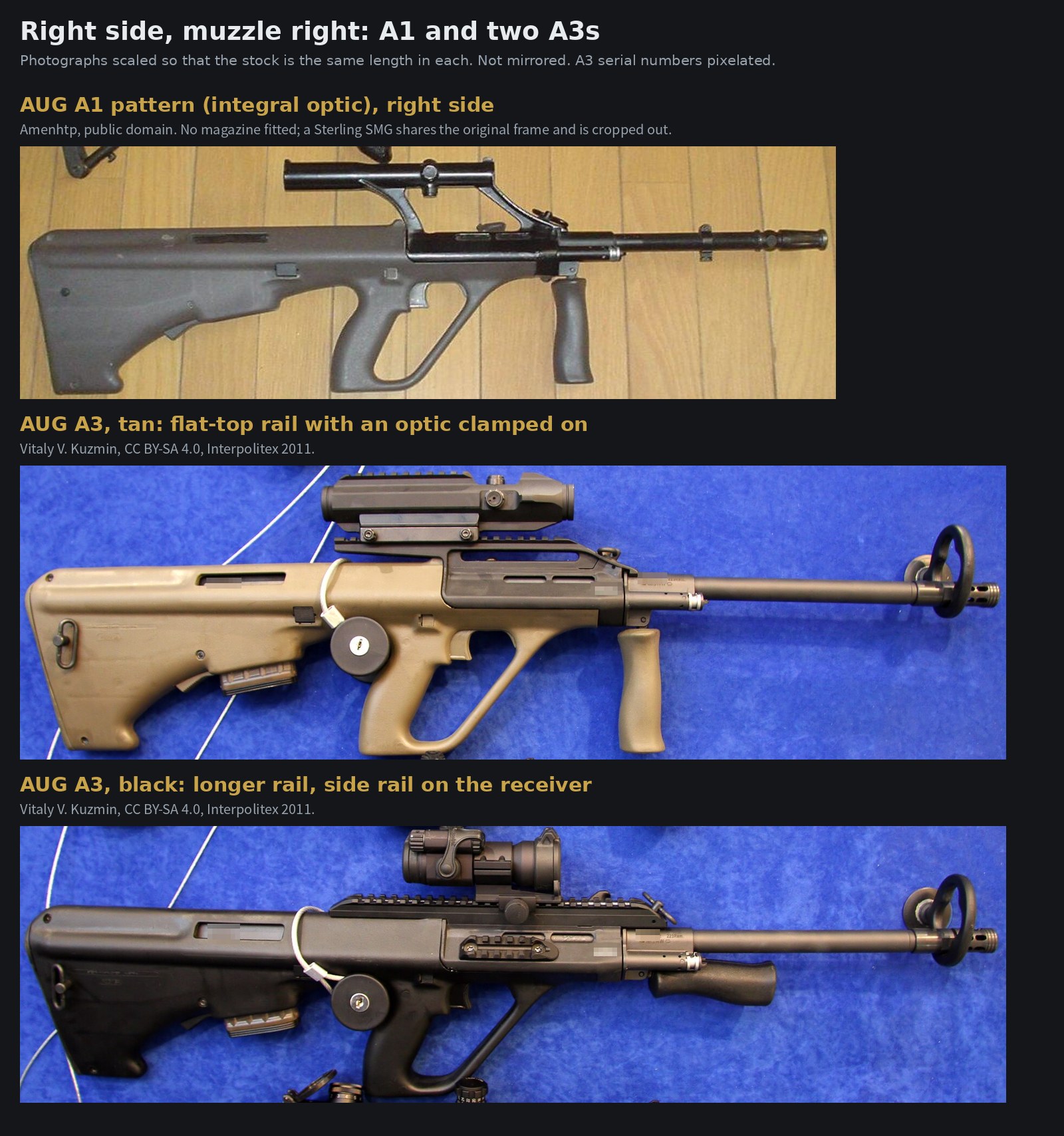
The A3 SF. The same generation of sheets describes a different top: an “integrated 1.5x optical sight, ring reticule, optics-housing with Mil.Std.1913 accessory rails left/right/top, additional short rail above trigger/right side, foldable cocking handle,” with a 407 mm standard barrel.7 The distinction is easy to miss: the A3 carries an optic clamped onto a flat-top rail; the A3 SF keeps an integral optic housing and puts rails on the housing. An introduction year of 2007 for the A3 SF appears only in encyclopaedic sources.
The US A3 M1 and M2. Steyr Arms USA shipped the A3 M1 from Bessemer, Alabama, from October 2014, with either of two rails or a 1.5× or 3× optic (Vol 3 §3.9). Its successor, the A3 M2, is offered as “NATO or standard variants” and is “Not sold with rail and handguard.”8 Steyr Arms USA’s own product titles make the generation boundary explicit: its A3SF optic housing “will not fit the A3 SA,” and its factory 1.5× optic for the A3 M1 “integrates onto the A3 M1 receiver ONLY.”9
4.5 Civilian Europe: the AUG Z and the AUG SA
The European civilian rifles are designed to be different from the military ones, and the differences matter to anyone buying parts on the international market.
In 2005 the Austrian Interior Minister answered a parliamentary question about the AUG Z with the official firearms expert’s findings. The Z’s hammer mechanism permits single shots only; its stock is shaped so that automatic mechanisms cannot be installed, with two steel pins moulded into it; its barrel and bolt “are not compatible with military ones”; its receiver has “a modified seat for the barrel and bolt head, so military barrels do not fit”; its bolt head has “only 6 locking lugs”; and it has no push-button quick-change barrel, but a pin that needs a tool.10 Steyr later sold a kit to convert the Z to the tool-free barrel change (Vol 9 §9.2).
The current AUG SA is sold in versions Steyr calls MP Flat Top, ARMY (with the 1.5× optic), SE 60 mm and SE 70 mm (two sight-line heights, the latter “with original carrying handle”), POLICE, SWAT and M II. Its manual gives barrels of 382, 417, 508 and 550 mm, measured “without a muzzle device,” a 1:9 twist, and “6 supporting” locking lugs.411
The rule for a US builder: a six-lug bolt is a European civilian bolt, and it is built not to go with military barrels. US Steyr rifles, like military ones, have seven (Vol 5 §5.5).
4.6 Stocks: Steyr Magazine or NATO
Steyr’s European manual puts it simply: the rifle takes “original STEYR AUG magazines or … STANAG magazines, depending on the design of the stock group.”4 The stock, not an adapter, decides the magazine. Steyr’s c. 2009 sheet lists “Optional stock group for NATO magazines.”3 When the NATO stock was introduced was not established.
The NATO stock is not a drop-in change. Steyr Arms USA sells a “NATO STOCK CONVERSION BUNDLE” — “NATO stock, trigger pack, butt plate, retaining pin” — because the trigger pack differs too; and it warns that its A3 NATO pack “WILL NOT WORK WITH ORIGINAL A2 NATO STOCKS.”9 There are therefore at least three stock-and-pack families: standard (Steyr magazine), original A2 NATO, and A3 NATO with the bolt catch and release.
Colours are a weak identifier. Steyr’s sheets give olive or black; Steyr Arms USA’s store offers green, “mud,” white and black; the Australian rifles run from green through two-tone to black (§4.11).39
4.7 Barrels, and a Length Set That Changed Three Times
Barrel lengths are the most confused numbers in the AUG literature, because Steyr has changed its standard set at least three times. They should be read by generation and never combined into one table as though they were offered together.
Table 1 — 4.7 Barrels, and a Length Set That Changed Three Times
| Generation | Barrel lengths, 5.56 | Source |
|---|---|---|
| Legacy (military manual; Austrian designations) | 350 (commando), 407 (carbine), 508 (standard), 621 or 610 (heavy) mm | Steyr maintenance manual gives 417/508/621; Doppeladler gives 350/407/508/610 |
| c. 2009 A1/A2 sheet | 407 and 508 mm | Steyr product sheet |
| c. 2009 A3 sheet | 365, 407, 455 and 508 mm | Steyr product sheet |
| Current Steyr (military pages) | 382, 417 and 508 mm | Steyr Arms GmbH, A1 and A3 pages |
| Current European civilian (AUG SA) | 382, 417, 508 and 550 mm, “always given without a muzzle device” | AUG SA manual |
| US (Steyr Arms USA, 2026) | 14.5, 16, 20 and 24 in (5.56); 16 in (.300 BLK) | Steyr Arms USA |
Sources for each row are in the footnotes.121361348 The heavy barrel appears as 621 mm in the Steyr maintenance manual and as 610 mm on Doppeladler; both are given.
Twist is steadier: 1 in 9 inches (228.6 mm), six grooves, right-hand, on the standard barrels, with 1 in 7 inches as an option on current A3 and US barrels. The 9 mm barrels are 1 in 10.4149
For a US builder the table has one legal consequence. A barrel under 16 inches makes a short-barrelled rifle, and a “16-inch” barrel measured without its muzzle device in one catalogue may be a different length in another. The barrel in hand is measured (Vol 6 §6.9).
4.8 The Heavy Barrel
The AUG-HBAR, a heavy-barrelled light support version with a bipod, was in the British light-support-weapon trials of 1984 (Vol 2 §2.11).5 In Austria it is the lMG 77. Luxembourg’s army lists a heavy-barrel version on its equipment pages.15 Steyr Arms USA sells a “24″ HBAR with Bipod 1:7 Twist Rate” at $699.00 (19 September 2026).9 The HBAR-T and LMG-T scope-mounted variants that appear in lists were not confirmed from any maker’s document.
4.9 The 9 mm AUG
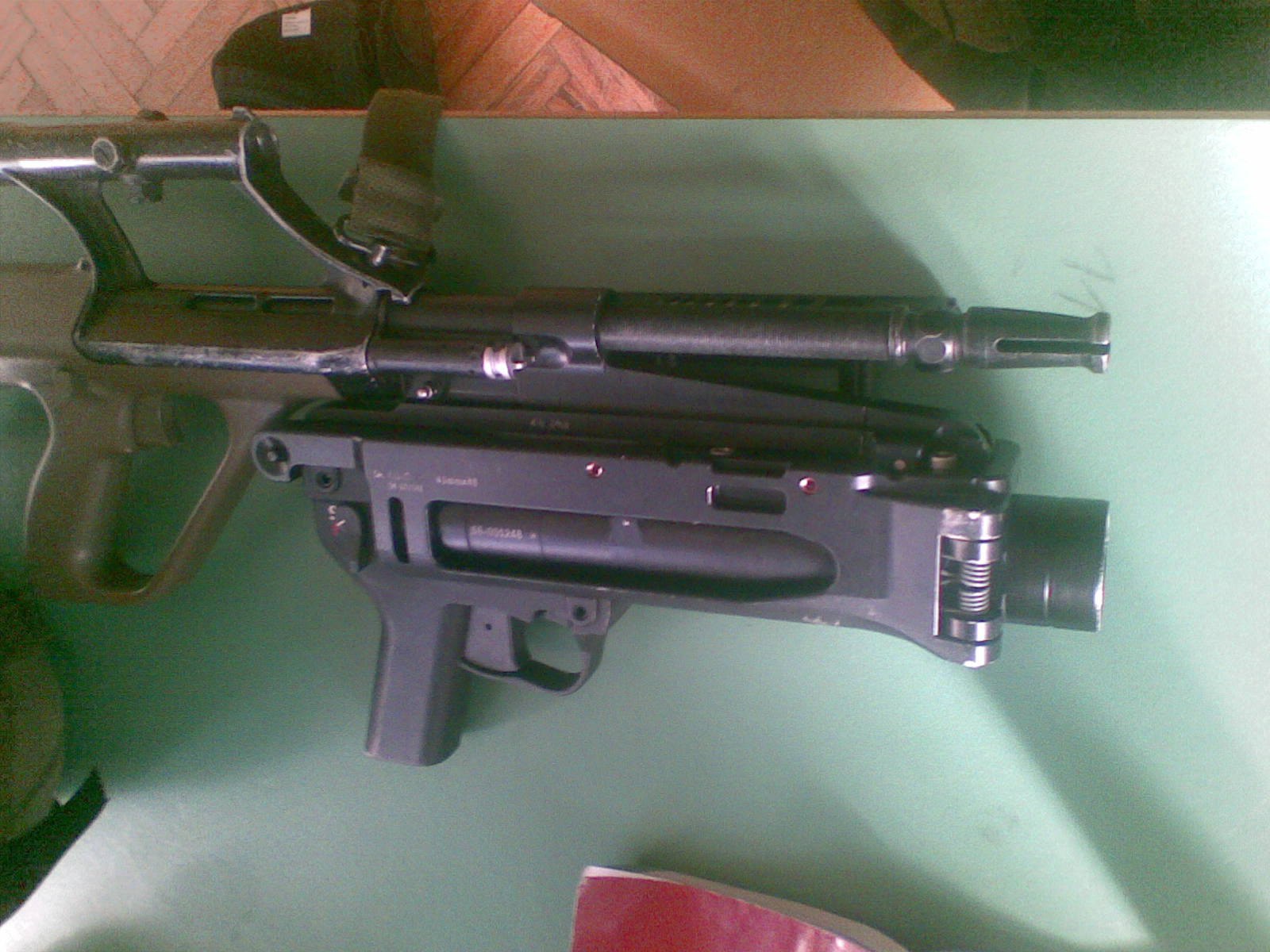
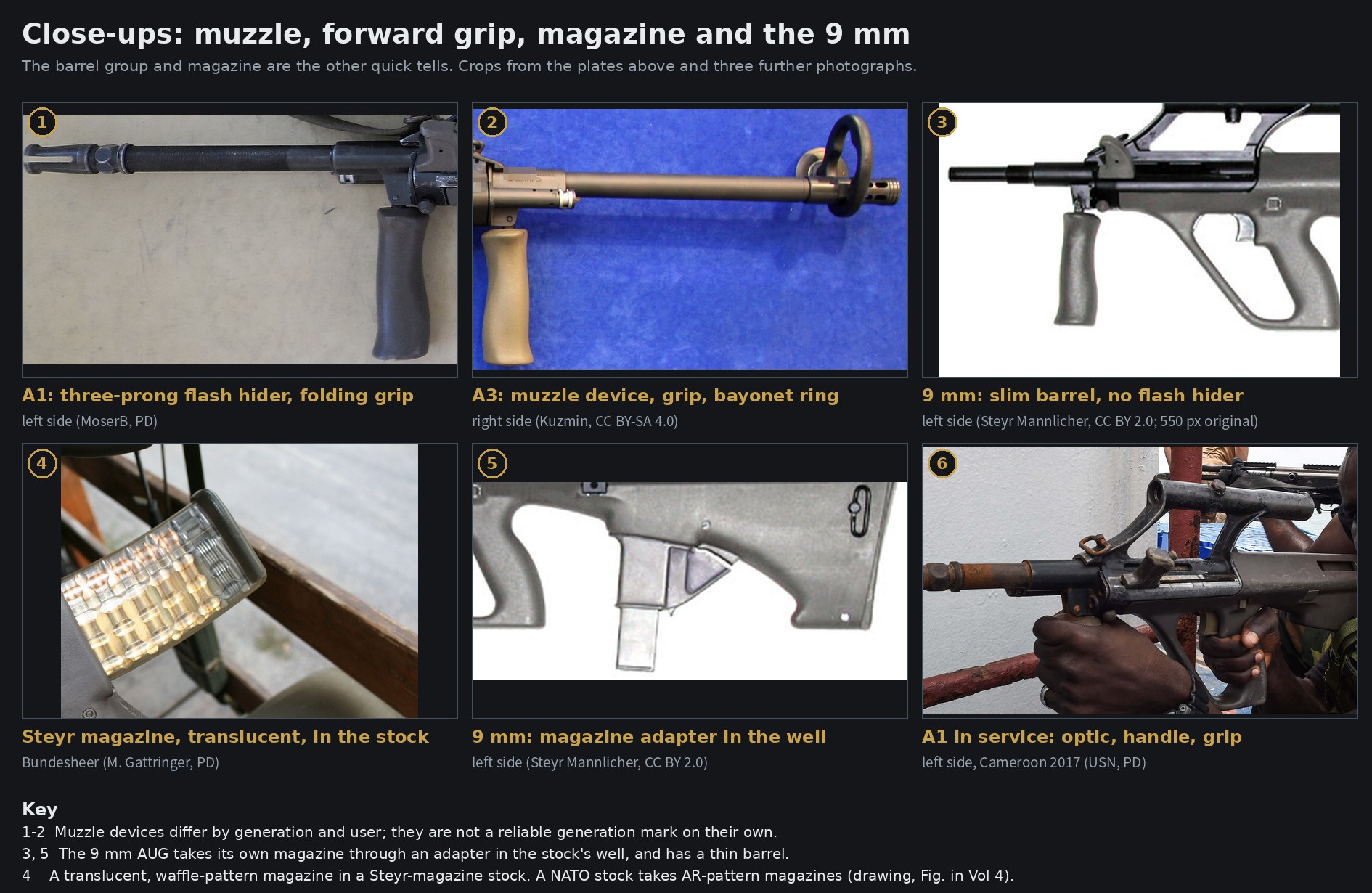
The 9 mm AUG is not a 5.56 rifle with a different barrel. Steyr’s c. 2009 sheet for the AUG 9mm describes a “Blow back system” firing from a closed bolt, 420 and 508 mm barrels, a cyclic rate of 650–720 rounds a minute, an “integrated firing-pin safety,” and a magazine that is its own: “steel, staggered, 25 rounds, 0.2 kg empty.”16 Austria’s designation for it is the MP 88, whose 420 mm barrel matches.1 A compact AUG A3 9mm XS with a 325 mm barrel followed.17 Steyr’s current A3 page gives 350, 365 and 420 mm barrels with a 1 in 10 twist.14
A frequently repeated claim — that the 9 mm AUG uses magazines from another Steyr submachine gun through an adapter — is not what Steyr’s own sheet says, which describes a dedicated steel magazine. In 2025, according to the Austrian defence magazine Militär Aktuell, Steyr showed an adapter for Glock-pattern 9 mm magazines, for authorities only.18
In the United States, Steyr Arms USA sells an “AUG 9x19mm Police Training Kit” with a 1 in 10 barrel at $799.00 and a separate 9 mm stock, which it says takes “Steyr MP88 adapters or waffle pattern magazines only” and has a larger ejection port — confirmation that the 9 mm conversion needs its own stock as well as its own barrel and bolt.9
4.10 .300 Blackout and 7.62 × 39
A .300 Blackout AUG was shown at the IDEX exhibition in February 2019. Steyr Arms USA sells it as a 16-inch barrel with a 1 in 8 twist ($399.00, 19 September 2026) and a six-position gas regulator with “LV” and “OFF” settings, and its manual addendum warns that .300 Blackout will chamber in a 5.56 barrel and vice versa (Vol 5 §5.3).919 In February 2025 Steyr launched an AUG in 7.62 × 39 at the Enforce Tac exhibition, for government customers, according to Militär Aktuell.18
4.11 The Australian Family
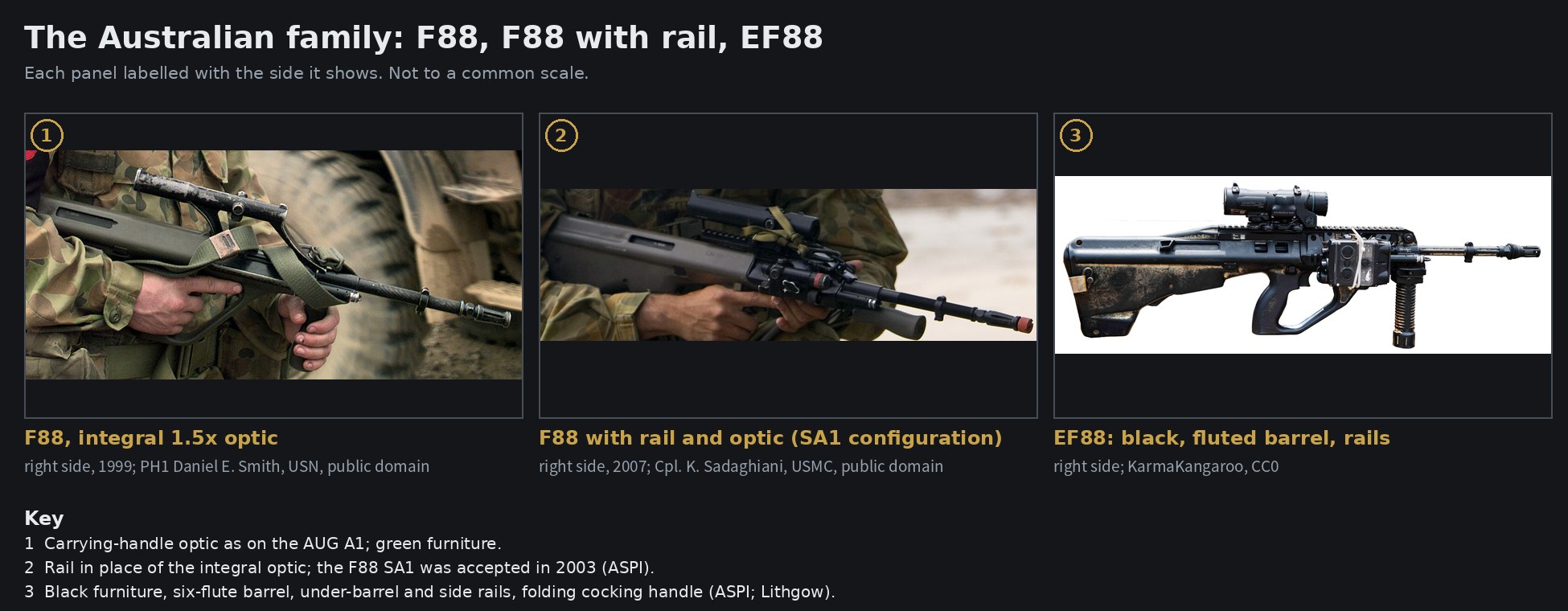
Vol 2 tells the Australian history. For identification, the ASPI study and the Australian Army’s pages give these cues.20
Table 2 — 4.11 The Australian Family
| Rifle | Years | How to tell it |
|---|---|---|
| F88 | from 1988 | green or dark-khaki furniture; integral 1.5× optic with ring reticle; 508 mm rifle or 407 mm carbine |
| F88S (“Special”) | 1998 to c. 2003 | 508 mm; an Accuracy International mounting rail in place of the optic |
| F88 SA1 | accepted 2003 | a Picatinny rail in place of the integral optic |
| F88 GLA | — | bayonet lug and foregrip removed for a launcher interface; M203PI |
| F88 SA2 | from 2009 | two-tone: dark khaki below, light brown above; longer top rail and a side bracket |
| EF88 / F90 | contract 2011; issue from 2015 | black; six-flute barrel; under-barrel and right-side rails; relocated bolt release; folding cocking handle; side-loading SL40 launcher |
New Zealand’s IW Steyr is an F88 made at Lithgow, with a crosshair reticle rather than Australia’s ring, by one soldier’s recollection (Vol 2 §2.7).

4.12 Clones and Look-Alikes
- MSAR STG-556 and STG-E4. The American AUG-pattern rifles of 2007 and 2012 (Vol 3 §3.7). The STG-556 takes “most of AUG magazines”; the E4 takes AR-15 magazines. MSAR never claimed interchange of its barrels, bolts or packs with Steyr’s.21
- Steyr STM-556. Despite the name, not an AUG: a short-stroke piston AR-15 with an AUG-style quick-change barrel, introduced in 2012.
- Steyr ACR. The Advanced Combat Rifle entry of 1986–90 resembled an AUG outwardly but fired flechettes from a rising chamber (Vol 3 §3.10).
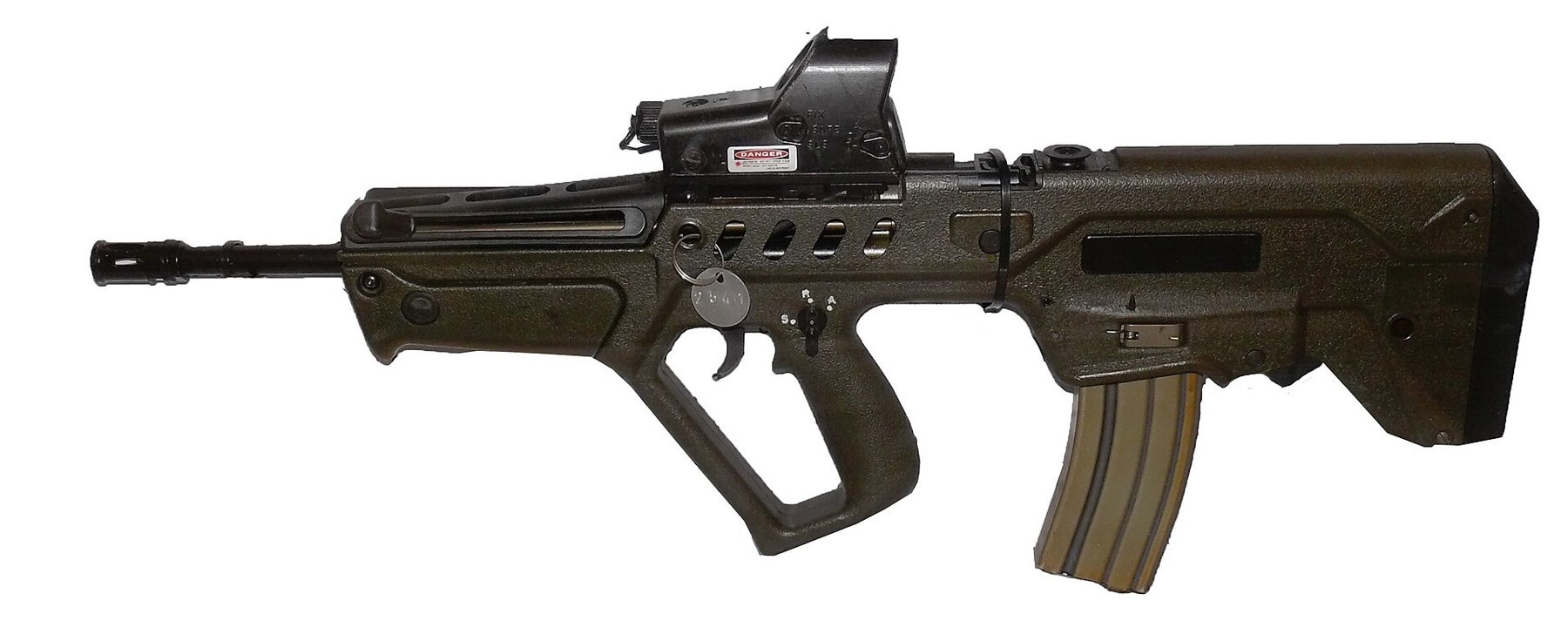
- IWI Tavor, FAMAS, L85. Other bullpups, commonly confused with the AUG in photographs. The cues are in §4.13.
4.13 Identification Guide: the Whole Rifle
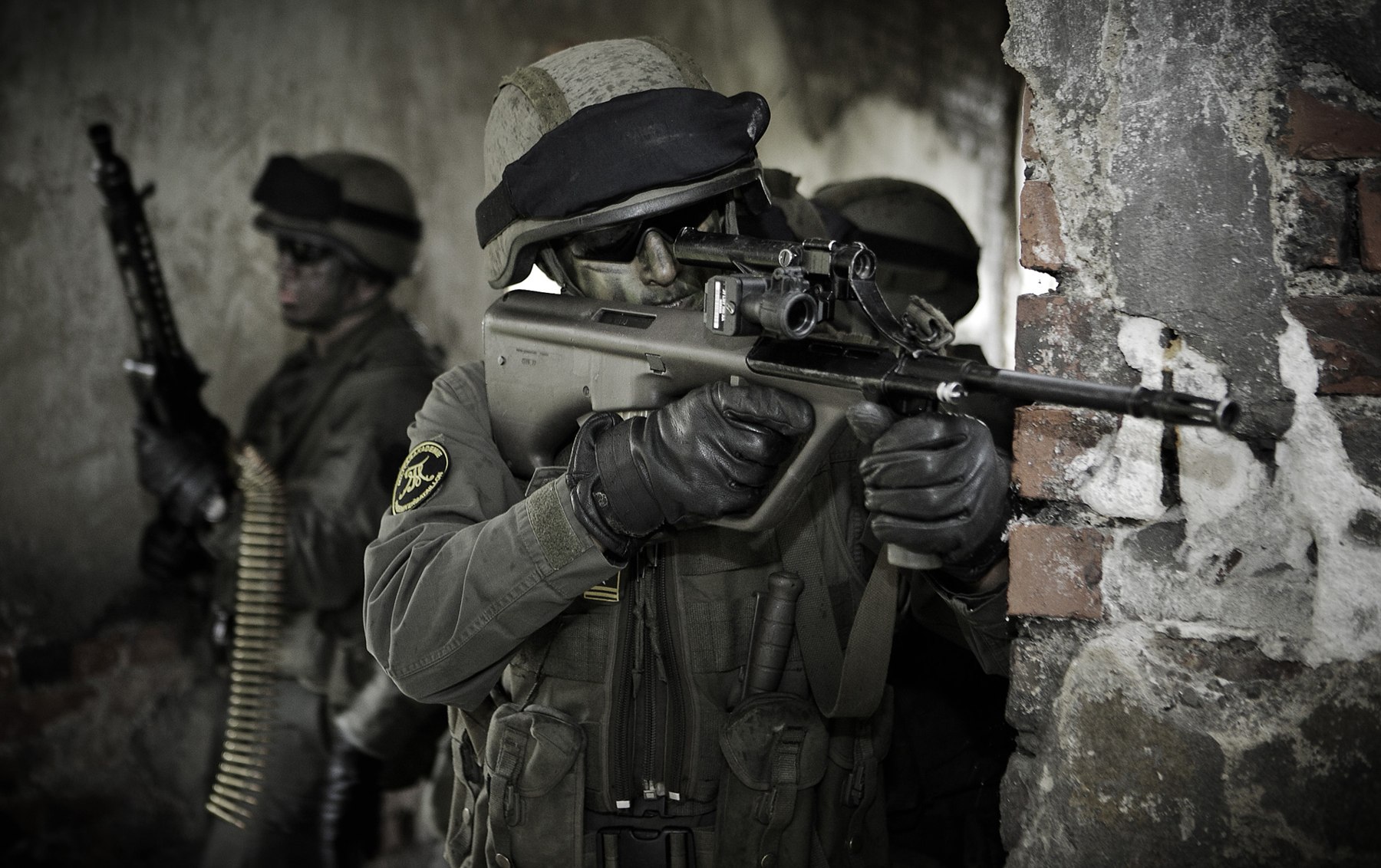
This section and the next two are for a reader holding an AUG, or a photograph of one, and trying to say which it is. The photographs are Wikimedia Commons files; the drawing is this dive’s own. Two rules governed how the plates were built, and they matter to anyone comparing their own rifle against them.
- No photograph is mirrored. Every A3 photograph found under a free licence shows the rifle’s right side, and the only A2 photograph shows its left. Rather than flip an image and show a rifle that does not exist, the plates are split by side: a left-side plate and a right-side plate. The drawing then shows all four patterns from the same side.
- Scale is matched on the stock. Within each plate, every rifle is scaled so that its stock, from butt plate to the front of the trigger guard, is the same length. The stock is common to every 5.56 AUG; barrel lengths differ (§4.7), so matching overall length would mislead.
The rule applied to every photograph in this dive: a rifle was identified as an AUG-family rifle only if it showed the AUG’s combination of a one-piece stock with the magazine behind the pistol grip and a trigger guard that encloses the whole hand, an exposed barrel carrying a folding vertical grip, and a translucent or waffle-pattern Steyr magazine or a NATO-stock magazine well. A rifle with a full-length polymer handguard around the barrel, no folding grip, or a separate lever selector above the trigger was rejected as not an AUG. Generation was then read from the top of the receiver, and the Australian rifles from their colour and barrel.
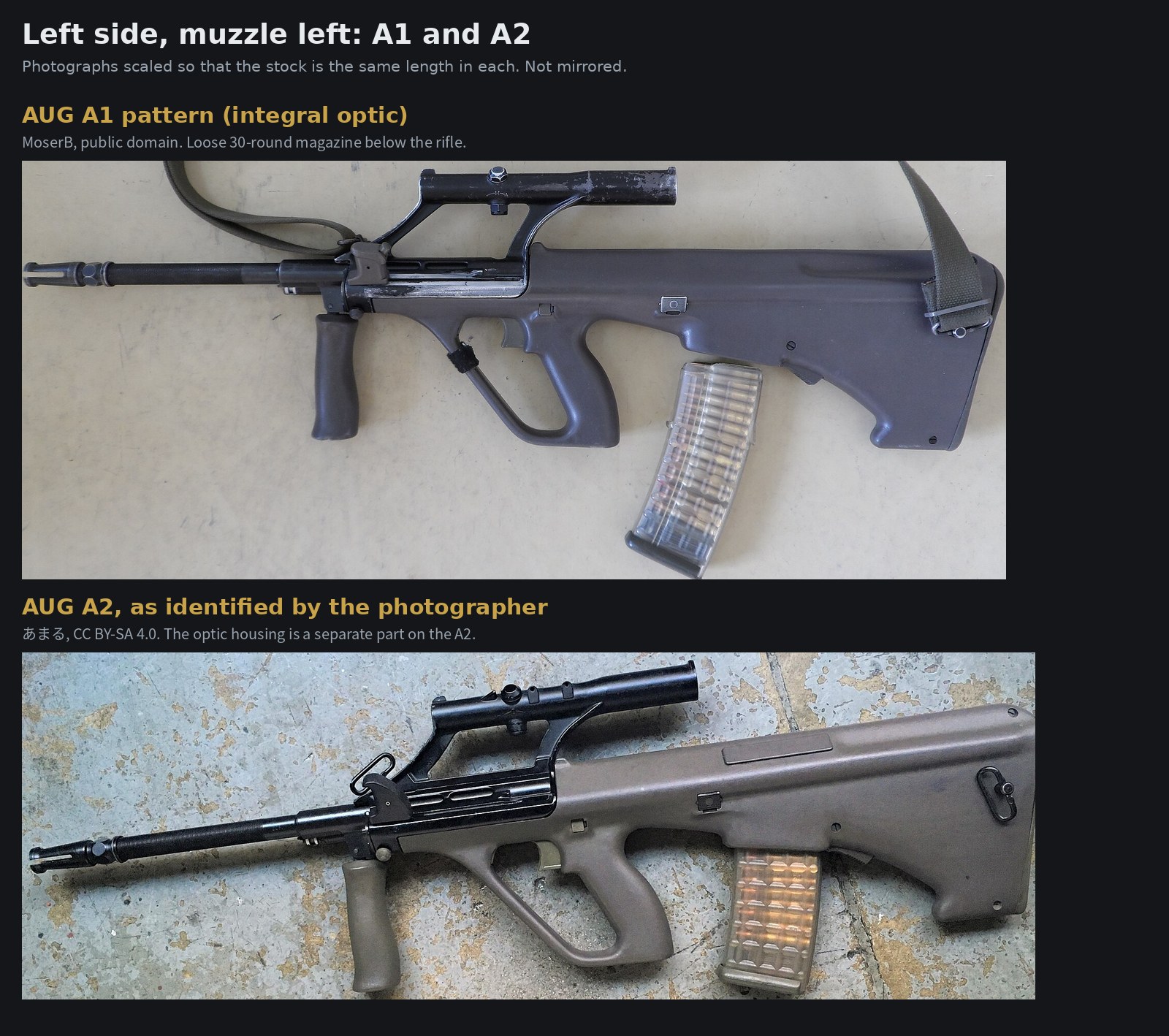
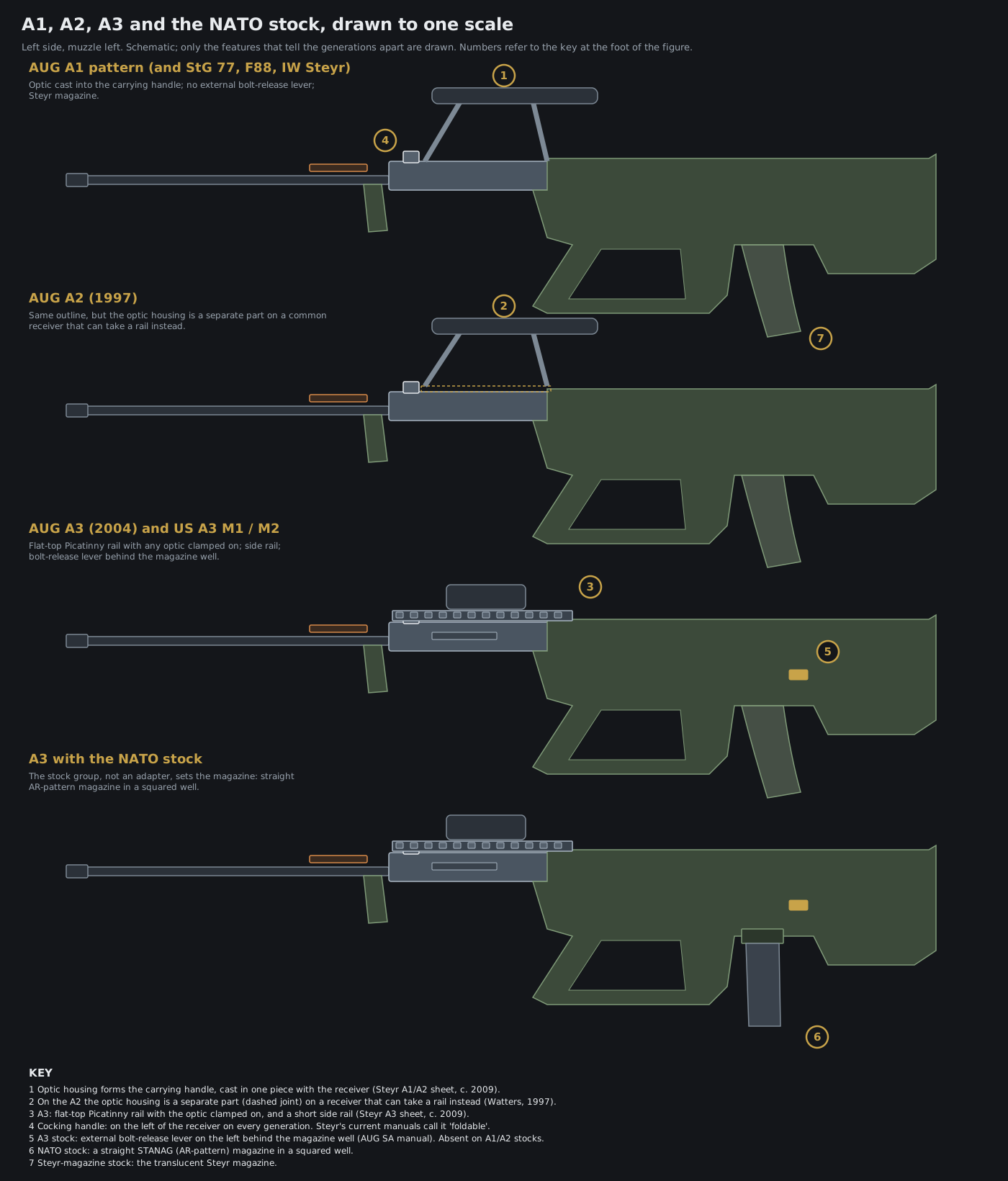
The A2 is the hard one. From the side an A2 carrying its 1.5× optic has the A1’s silhouette, because the optic housing was designed to the same outline. What changed, by Watters’s account, is that the A2’s receiver takes either the optic housing or a rail, where the A1 needed a different receiver for each (§4.3). The identification of the A2 in the left-side plate is its photographer’s; it is consistent with what the photograph shows, and it is labelled as the photographer’s.
The Australian family is best told by colour and barrel (§4.11). Its photographs are shown from the sides they were taken from.
Variants with no licensed photograph. No freely licensed photograph was found of the US-built A3 M1 or M2 as an object, of an AUG with the NATO stock, of an AUG-HBAR, of the A3 SF, or of the MSAR STG-556 or STG-E4. The drawing above stands in for the NATO stock. The A3 M1 and M2 share the A3’s receiver pattern (Vol 3 §3.9); the HBAR is identified by its heavy barrel and bipod (§4.8); the A3 SF by its railed optic housing (§4.4). The MSAR rifles are outwardly AUG-like, and their own manuals give only one external tell: the STG-E4 takes AR-15 magazines (§4.12). None of these is illustrated with a photograph of another variant standing in for it.
4.14 Close-Ups of the Identifying Features
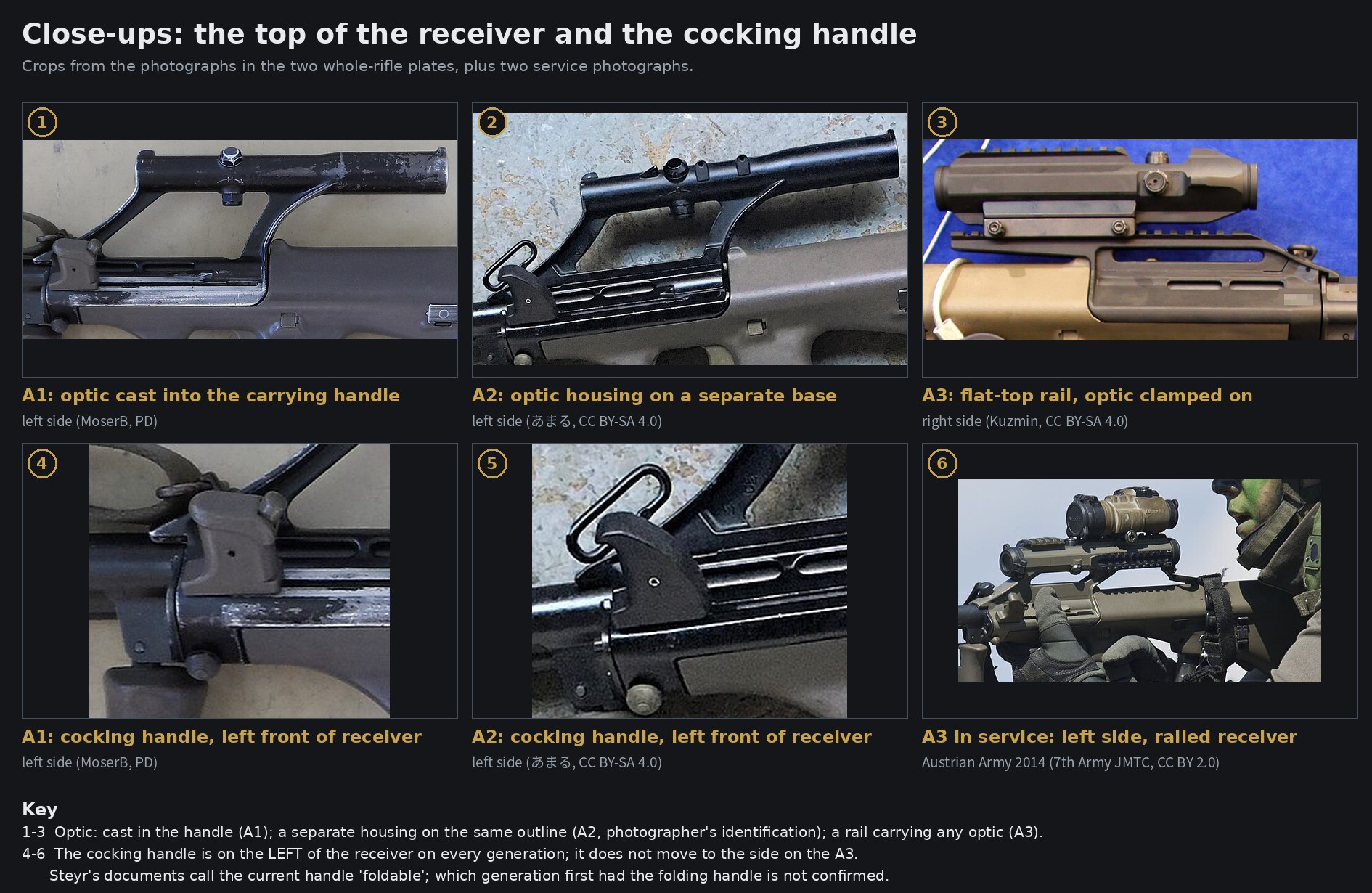
What the sources say about the cocking handle, and what they do not. A tidy rule circulates — fixed handle on the A1, folding on the A2, “side-mounted” on the A3 — and only part of it survives the documents.
- Every generation’s handle is on the left side of the receiver. It does not move on the A3. Every photograph in this dive that shows the left side shows it there, and Steyr’s manuals — the military maintenance manual, the US A3 M1 manual and the European AUG SA manual — all have it worked with the left hand, coupled to the left thrust piece for the forward assist, and turned to lock it back.
- A folding handle is documented, but not its first generation. Ulrich Zedrosser’s patent for a folding cocking handle was filed in June 1986 (Vol 1 §1.4). Steyr’s c. 2009 A3 SF sheet lists a “foldable cocking handle,” and the current AUG SA manual says “The foldable cocking handle can be used as a forward assist.” Steyr’s A1/A2 sheet does not mention one. That the A2 introduced the folding handle appears only in encyclopaedic sources.
- The photographs show two different handles. The A1-pattern rifle in the plates has a squared block; the rifle identified as an A2 has a hooked lever. That is consistent with a redesign between them; it is evidence from two rifles, not a rule.
The bolt-release lever is the A3 stock’s most reliable tell in the hand, and it is on the side no licensed A3 photograph shows. Steyr’s European manual: “Compared to the A1 stock, the STEYR AUG A3 stock has an external bolt release lever on the left side behind the magazine well.”4 The drawing marks it. On the right-side A3 photographs it cannot be seen.
4.15 Tell Them Apart
Table 3 — 4.15 Tell Them Apart
| Feature | A1 (and StG 77, F88, IW Steyr) | A2 | A3, A3 M1, A3 M2 | Others | Where to look |
|---|---|---|---|---|---|
| Top of receiver | carrying handle with the 1.5× optic, cast with the receiver | the same outline, but the optic housing is a separate part; a rail can replace it | flat-top Picatinny rail; any optic clamped on | A3 SF: optic housing with rails on it; StG 77 A1 MOD: railed receiver | the joint between the optic and the receiver |
| Side rail | none | none | short rail on the side of the receiver (black A3 in the plate; A3 sheet) | EF88: side and under-barrel rails | the receiver’s flank |
| Bolt-release lever | none (the rifle still holds open; released by the cocking handle) | none | on the left, behind the magazine well | EF88: relocated release (ASPI) | left side of the stock, behind the magazine |
| Cocking handle | left front of receiver; squared block in the photographs | left front; hooked lever in the photographs | left front; Steyr calls the current one “foldable” | — | left side, just behind the barrel joint |
| Magazine well | Steyr magazine | Steyr magazine | Steyr magazine or NATO (STANAG), by stock | 9 mm: insert and narrow magazine; MSAR STG-E4: AR magazines | the well behind the pistol grip |
| Furniture colour | olive or black (Steyr); green or dark khaki (F88) | olive or black | olive, black, tan, “mud”, white (Steyr USA) | F88 SA2 two-tone; EF88 black | the stock |
| Barrel | 508 or 407 mm, three-prong flash hider on the rifles shown | as A1 | various lengths and muzzle devices | EF88: fluted; 9 mm: slim, no flash hider; HBAR: heavy, bipod | the barrel ahead of the receiver |
| Bolt face (parts in hand) | seven lugs | seven | seven | European civilian AUG Z / SA: six | the bolt head |
The last row is the one to check on a kit. It does not tell the generations apart, but it tells a military or US bolt from a European civilian one, which is the difference that decides whether a barrel will fit (§4.5).
Sources
Footnotes
-
Doppeladler.com, “StG 77 (Steyr AUG),” http://www.doppeladler.com/oebh/infanterie/stg77.htm, accessed 2026-09-19. A reference site on the Austrian Army, not an official source. ↩ ↩2 ↩3
-
Steyr Arms GmbH, “History,” https://www.steyr-arms.com/en/company/history, accessed 2026-09-19. ↩
-
Steyr Mannlicher, AUG A1/A2 product sheet (“STM_Produktblatt_AUG_A1_A2_press_01”), Wayback Machine capture of 30 April 2012 from steyr-mannlicher.com, retrieved 2026-09-19. ↩ ↩2 ↩3 ↩4 ↩5 ↩6
-
Steyr Arms GmbH, Instructions for use STEYR AUG SA, 1-BA-1726, EU-03, 2023, pp. 18–32, https://www.steyr-arms.com/wp-content/uploads/2023/03/BA-STEYR-AUG-SA_ende_1-BA-1726_EU-03.pdf, retrieved 2026-09-19. ↩ ↩2 ↩3 ↩4 ↩5 ↩6
-
Daniel E. Watters, “A 5.56 X 45mm ‘Timeline’,” The Gun Zone, entries for 1984, August 1997 and April 2004, Wayback Machine captures of http://www.thegunzone.com/556dw-8.html, -11.html and -14.html, retrieved 2026-09-19. ↩ ↩2 ↩3 ↩4
-
Steyr Mannlicher, AUG A3 product sheet, c. 2009, Wayback Machine capture from steyr-mannlicher.com, retrieved 2026-09-19. ↩ ↩2
-
Steyr Mannlicher, AUG A3 SF product sheet, c. 2009, Wayback Machine capture from steyr-mannlicher.com, retrieved 2026-09-19. ↩
-
Steyr Arms, Inc., “AUG,” https://steyr-arms.us/firearms/tactical-rifles/aug/, read 2026-09-19. ↩ ↩2
-
Steyr Arms, Inc., online store, https://steyr-arms.us/shop/category/tactical/aug/, product data read 2026-09-19. ↩ ↩2 ↩3 ↩4 ↩5 ↩6 ↩7
-
Republik Österreich, Parlament, Anfragebeantwortung 3599/AB, XXII. GP (answer to question 3647/J of 30 November 2005), https://www.parlament.gv.at/PAKT/VHG/XXII/AB/AB_03599/fnameorig_056189.html, accessed 2026-09-19. Translation for this dive. ↩
-
Steyr Arms GmbH, “AUG SA,” https://www.steyr-arms.com/en/sporting-rifles/aug-sa/, accessed 2026-09-19. ↩
-
Steyr Mannlicher AG, Maintenance Manual, Army Universal Assault Rifle, Steyr AUG, undated, fo. 5 (technical data). Internet Archive, retrieved 2026-09-19. ↩
-
Steyr Arms GmbH, “AUG A1,” https://www.steyr-arms.com/en/military-law-enforcement/assault-rifles/aug-a1/, accessed 2026-09-19. ↩
-
Steyr Arms GmbH, “AUG A3,” https://www.steyr-arms.com/en/military-law-enforcement/assault-rifles/aug-a3/, accessed 2026-09-19. ↩ ↩2
-
Lëtzebuerger Arméi, equipment pages, Wayback Machine capture of 13 September 2009 of http://www.armee.lu/chap07/c070102.htm, retrieved 2026-09-19. ↩
-
Steyr Mannlicher, AUG 9mm product sheet, c. 2009, Wayback Machine capture from steyr-mannlicher.com, retrieved 2026-09-19. ↩
-
Steyr Mannlicher, AUG A3 9mm XS product sheet, c. 2009–2012, Wayback Machine capture, retrieved 2026-09-19. ↩
-
Christian Bendl, “Enforce Tac 2025: Neues zum Steyr AUG in 7,62×39 und 9×19,” Militär Aktuell, 28 February 2025, https://militaeraktuell.at/enforce-tac-2025-neues-zum-steyr-aug-in-762x39-und-9x19/, retrieved 2026-09-19. ↩ ↩2
-
Steyr Arms, Inc., AUG A3 M1 .300 Blackout addendum, 2024, retrieved 2026-09-19. ↩
-
Chris Masters, Sticking to Our Guns, Australian Strategic Policy Institute, October 2019, pp. 17–72, retrieved 2026-09-19; Australian Army, “F88 AUSteyr,” defence.gov.au, 2009, Wayback Machine capture, retrieved 2026-09-19. ↩
-
Microtech Small Arms Research, STG-556 Operator’s Manual, Wayback Machine capture of 14 July 2011, retrieved 2026-09-19. ↩
Comments (0)