E-11 Stormtrooper Blaster · Volume 10
Legal & Regulatory Posture
NFA / Class III for A3, semi-auto clone legality for A1, 922(r) for A2, orange-tip rule, state imitation-firearm laws, the constructive-intent trap, manufacture-for-self
10.1 Contents
(Generated by build/inject_toc.py at build time. Section headers below are the source of truth.)
Correction (2026-10-24): § 10.5 cited the federal marking rule as 15 CFR part 272. That part was superseded by the Consumer Product Safety Commission’s 16 CFR part 1272 (direct final rule, 88 FR 30226, effective 2023-06-26) and removed from Title 15 on 2026-02-19 (NIST, 91 FR 7824). The four approved markings are unchanged in substance; the orange is now specified as AMS STD 595A-17 colour 12199. The § 10.5.2 state table was also wrong in five rows and short one state: California has no § 20166; New York’s imitation-weapon law is General Business Law §§ 870–873, not Penal Law § 265.01; Massachusetts c. 269 § 12B governs air rifles and minors, not imitations; Hawaii’s § 134-16 has been repealed; D.C. § 22-4504 is the concealed-carry section, whose subsection (b) reaches imitation firearms only during a crime of violence; Connecticut’s sale ban (§ 53-206c) was missing; and New Jersey’s sale law (C.56:17-1) was missing. The table and § 10.5.3 are rewritten from the statute texts.
This is the heaviest legal volume in this hub so far. The Sterling SMG donor — across its three legally-distinct US donor flavors plus the Path B / Path C non-firing variants — touches more federal and state legal pivot points than any prior build in this hub. The DL-44 (Mauser C96 donor) is a pistol — different posture. The Sterling is an SMG — categorically different.
This volume is not legal advice. Firearms law is jurisdiction-dependent and changes frequently; the state-of-residence rules override federal-only framings repeatedly throughout. Cite the primary sources (27 CFR, 18 USC, ATF Determination Letters, state statutes) before acting on any specific posture. The hub-wide framing is in the hub’s legal-posture notes; this volume is the build-specific tail-end.
The volume is organized by the legal pivot points an E-11 build can cross, in order of regulatory weight:
- § 10.1 — Foundation: what’s a firearm, what isn’t.
- § 10.2 — Path A1 (semi-auto Sterling clone) — Title I rifle posture; state assault-weapon and magazine-capacity rules.
- § 10.3 — Path A3 (Class III registered transferable) — NFA / Hughes Amendment / Form 4 transfer / state machine-gun rules.
- § 10.4 — Path A2 (parts-kit / 80% receiver) — 922(r) parts-count compliance.
- § 10.5 — Paths B / C non-firing — 15 USC § 5001 orange-tip rule and state imitation-firearm laws.
- § 10.6 — Path C from-scratch — manufacture-for-self posture; semi-auto-only rule.
- § 10.7 — The constructive-intent trap.
- § 10.8 — Transport across state lines.
- § 10.9 — What this volume is not.
- § 10.10 — References.
10.2 Foundation — what is a firearm in this context
Under 18 USC § 921 and 27 CFR § 478.11, a firearm is defined as “any weapon (including a starter gun) which will or is designed to or may readily be converted to expel a projectile by the action of an explosive” — plus the frame or receiver of any such weapon. The frame or receiver is the legal handle of the firearm; modifying it (or possessing one in certain configurations) triggers the rules.
For E-11 builds:
- Path A1 (Wise Lite / IO semi-auto Sterling clone): a finished semi-auto rifle is a firearm. A US-made Sterling-pattern receiver is the firearm; everything else is parts.
- Path A2 (parts-kit + 80%-receiver): the US-made receiver (when finished to functional) is the firearm. The imported parts-kit components are not firearms (the original imported receiver was demilled).
- Path A3 (Class III registered Sterling): the original Sterling receiver with its NFA registration is the firearm — and an NFA item (machine gun).
- Path B (Doopydoo resin / airsoft / replica): not a firearm under federal law. It is a “look-alike firearm” under 15 USC § 5001, which names replica nonguns and airsoft guns.
- Path C from-scratch (semi-auto firing): a finished semi-auto rifle is a firearm; the from-scratch receiver is the firearm.
- Path C from-scratch (non-firing): not a firearm; imitation-firearm rules may apply.
Every E-11 build’s legal posture starts here. Identify which category the build falls into before proceeding.
10.3 Path A1 — Semi-auto Sterling clone (Title I rifle)
A semi-auto Sterling clone from Wise Lite or Indianapolis Ordnance is a Title I rifle under federal law: a semi-auto 9×19 carbine. Not NFA. Not regulated beyond standard GCA Title I.
10.3.1 Federal posture
- GCA Title I — purchase via FFL transfer; 4473 form; standard background check.
- No NFA registration required.
- No tax stamp.
- No magazine-capacity restriction at federal level — the 34-round Sterling mag is federally legal.
- No state-of-residence pre-approval at federal level (some states have permit-to-purchase requirements that override).
10.3.2 State-level — the load-bearing question
State law overrides federal-only assumptions. Eight states + DC impose substantial restrictions on Sterling-pattern semi-auto rifles:
Table 1 — State law overrides federal-only assumptions. Eight states + DC impose substantial restrictions on Sterling-pattern semi-auto rifles
| State | Restriction | E-11 build implication |
|---|---|---|
| California | Assault Weapons Control Act (Penal Code § 30515); feature-list bans (folding stock + pistol grip + threaded barrel + detachable mag = AW) | Wise Lite or IO Sterling clone is likely a regulated AW. Likely prohibited for new acquisition unless featureless-compliant build (no folding stock, no detachable mag, etc. — would not be E-11 spec) |
| New York | SAFE Act (Penal Law § 265.00); feature-list bans, 10-round mag limit | Similar to CA — Sterling clone is likely an AW; mag limit makes 34-rd Sterling mag illegal. Featureless workarounds available but break E-11 spec |
| New Jersey | Assault Firearms Act (N.J.S.A. § 2C:39-1); feature-list bans; 10-round mag limit | Similar to NY |
| Massachusetts | Chapter 140 § 121; specific make/model bans + feature-list bans; 10-round mag limit | Sterling-clone availability variable; check specific models |
| Connecticut | Connecticut General Statutes § 53-202; feature-list bans + post-2013 AW restrictions; 10-round mag limit | Similar to MA |
| Maryland | Maryland Code § 4-301 etc.; Tier-based restrictions | Sterling-clone status depends on specific list inclusion |
| Hawaii | Hawaii Revised Statutes § 134; magazine and feature restrictions | Mag limit + feature list affect build |
| Washington DC | DC Code § 7-2501; semi-auto rifle restrictions | Sterling-clone availability restricted |
For builders in any of these jurisdictions: clear with state law before purchase. The build paths that work in Texas / Indiana / Wyoming may not work in California / New York.
10.3.3 Magazine capacity
The Sterling factory mag is 34-round. State limits:
- 10-round limit: CA, CO (purchase only), CT, HI, MA, NJ, NY, VT, WA.
- 15-round limit: DC.
- 20-round limit: OR.
- No limit: most other states.
Path A1 builders in limited states use lower-capacity magazines (10 or 15 round factory or aftermarket); the build still reads as E-11 visually but the magazine is non-canonical.
10.3.4 Permit / license / waiting periods
State-specific:
- Permit to purchase: NJ, MA, IL, MA, NY, others — purchase requires a state permit.
- Waiting period: CA (10 days), DC (10 days), HI (14 days), MD (7 days), RI (7 days), others.
- Universal background check: most states + federal.
Verify state-of-residence requirements at purchase time.
10.4 Path A3 — Class III registered transferable Sterling
A real registered transferable Sterling SMG — registered with ATF before May 19, 1986 — is the most legally-heavy donor in the E-11 builder world.
10.4.1 Federal posture — National Firearms Act
The Sterling SMG in full-auto configuration is a machine gun under 26 USC § 5845(b): a firearm that fires more than one round per trigger pull. NFA machine guns are regulated by 26 USC § 5841 (registration), § 5811 (transfer tax), § 5821 (making tax), § 5861 (prohibited acts).
Key features of NFA machine-gun posture:
- Registration with ATF in the National Firearms Registration and Transfer Record (NFRTR) is mandatory. Any unregistered machine gun is unlawful to possess; possession of an unregistered MG is a federal felony (26 USC § 5861(d)).
- Hughes Amendment (Firearm Owners Protection Act, 1986): machine guns registered before May 19, 1986 can be transferred between qualified civilians; machine guns made or registered after that date cannot be transferred to civilians (only to military / law enforcement / SOT-licensed dealers).
- A transferable Sterling is one that was registered before May 1986 and has a clean chain of title.
- Transfer tax: $200 per transfer under 26 USC § 5811. Paid by the transferee.
10.4.2 ATF Form 4 — the transfer process
To transfer a registered machine gun to an individual (or trust):
- Buyer and seller agree on transfer. Typical brokerage: Class III dealer mediates.
- Form 4 (ATF Form 5320.4) — Application for Tax Paid Transfer and Registration of a Firearm.
- Form 4 submission: seller + buyer + dealer complete the form; buyer pays the $200 transfer tax; buyer provides fingerprints and photographs (or sends them through the dealer).
- ATF review: 6–12 months for individual transfers (faster — 60–90 days — for trust transfers); ATF runs background and verifies registration chain.
- Form 4 approval: tax stamp issued; transfer documented in NFRTR.
- Possession transfer: once stamp is issued, the firearm can be physically transferred.
10.4.3 State-level rules
State law overrides federal on machine guns. Several states completely prohibit civilian machine-gun ownership:
Table 2 — State law overrides federal on machine guns. Several states completely prohibit civilian machine-gun ownership
| State | Posture |
|---|---|
| California | Prohibited (some pre-existing registered MGs grandfathered with permits) |
| New York | Prohibited |
| New Jersey | Prohibited |
| Massachusetts | Prohibited |
| Hawaii | Prohibited |
| Illinois | Prohibited (some pre-existing registered MGs grandfathered) |
| Iowa | Prohibited |
| Kansas | Prohibited |
| Washington DC | Prohibited |
| Most other states | Permitted with federal NFA approval; some require state permit / SOT |
A Class III Sterling in a prohibited state is not possessible regardless of federal NFA registration. Check state law before any Form 4 transfer.
10.4.4 Trust ownership
NFA trusts have become common for individual NFA collectors. Benefits:
- Faster Form 4 approval (60–90 days vs 6–12 months for individuals).
- Multi-person possession within trust beneficiaries.
- Succession planning — trust survives the trustor.
Trust setup is its own legal process; consult an NFA-specialty attorney.
10.4.5 Build implications for Path A3
A registered transferable Sterling’s value is in its registration. Any modification that obscures the registration tag, alters the receiver markings, or changes the configuration substantially can:
- Affect future resale value.
- In edge cases, affect the registration validity (the firearm is registered as it was configured at last NFA modification).
For an E-11 build on a transferable Sterling:
- Use reversible greeblie mounts (clamp-on, magnet, non-permanent fasteners) where possible.
- Don’t drill new mounting holes through the receiver.
- Don’t refinish the receiver in a way that obscures the registration markings.
- Document modifications for future reference.
Vol 4 § 4.4 covers the build details; this section is the legal-posture context.
10.5 Path A2 — Sterling parts-kit on US-made 80% receiver: 922(r) compliance
A US-made semi-auto rifle assembled from imported parts is regulated by 18 USC § 922(r) and the implementing regulation 27 CFR § 478.39. The rule: a US-made semi-auto rifle assembled from imported parts must contain no more than 10 imported “regulated parts” from the implementing list.
10.5.1 The regulated parts list (27 CFR § 478.39)
The complete list of regulated parts:
- Frame, receiver, receiver castings, forgings or stampings
- Barrels
- Barrel extensions
- Mounting blocks (trunnions)
- Muzzle attachments
- Bolts
- Bolt carriers
- Operating rods
- Gas pistons
- Trigger housings
- Triggers
- Hammers
- Sears
- Disconnectors
- Buttstocks
- Pistol grips
- Forearms, hand guards
- Magazine bodies
- Followers
- Floor plates
A US-made semi-auto rifle is in compliance if it contains 10 or fewer imported parts from the above list.
10.5.2 Sterling parts-kit count
A typical Sterling parts-kit + Wise Lite receiver assembly contains:
Table 3 — A typical Sterling parts-kit + Wise Lite receiver assembly contains
| Part | Source | Count toward limit |
|---|---|---|
| Receiver | US-made (Wise Lite) | Not counted |
| Bolt | Imported (kit) | 1 |
| Trigger housing (fire-control housing) | Imported (kit) | 1 |
| Trigger | Imported (kit) | 1 |
| Hammer | Imported (kit) | 1 |
| Sear | Imported (kit) | 1 |
| Disconnector | Imported (kit) | 1 |
| Buttstock (folding wire stock) | Imported (kit) | 1 |
| Pistol grip | Imported (kit) | 1 |
| Magazine body | Imported (kit) | 1 |
| Magazine follower | Imported (kit) | 1 |
| Magazine floorplate | Imported (kit) | 1 |
| Subtotal | 11 imported parts — over limit by 1 |
The build is non-compliant as assembled. At least one US-made substitution is needed.
10.5.3 US-made substitutions to achieve compliance
Common approaches:
Substitution A — US-made magazine. Replaces three regulated parts (body + follower + floorplate) at once. Count drops to 8. The cleanest single substitution.
Substitution B — US-made fire-control housing. Replaces one regulated part (trigger housing). Count drops to 10. Requires sourcing a US-made Sterling-pattern housing (Wise Lite has sold these).
Substitution C — US-made trigger / hammer / sear / disconnector set. Replaces four regulated parts. Count drops to 7. The most-conservative substitution; ensures legal buffer.
Substitution D — US-made folding stock + pistol grip. Replaces two regulated parts. Count drops to 9.
Most Path A2 builds use Substitution A (US-made magazine) as the simplest path. The 34-round Sterling magazine is the visible E-11 component, so the substitution should match the canonical silhouette.
10.5.4 Documentation responsibility
The builder is responsible for the 922(r) count and the substitution documentation. ATF does not pre-approve specific builds. Keep records of:
- Each part’s source (imported or US-made).
- Vendor and date of purchase for US-made substitutions.
- Receipts and invoices documenting the substitution.
Store this documentation with the build’s parts list; it is critical legal documentation that may be requested in any future enforcement action.
10.5.5 Federal posture for a compliant Path A2 build
If 922(r) compliance is satisfied:
- Title I semi-auto rifle. Same as Path A1.
- No NFA registration required.
- Same state-level rules apply (CA / NY / NJ / etc. — see § 10.2.2).
A 922(r)-compliant Path A2 build is legally indistinguishable from a Path A1 Wise Lite clone for ownership and trooping purposes.
10.6 Paths B / C non-firing — orange-tip rule and state imitation-firearm laws
A non-firing E-11 (Doopydoo resin, airsoft Sterling, community 3D-print, deact-shell, Path C non-firing) is not a firearm under federal law. It is a look-alike firearm under 15 USC § 5001 and may also fall under state imitation-firearm laws.
10.6.1 Federal — 15 USC § 5001 (Toy Gun Marking Act)
The statute’s operative words are broad: “It shall be unlawful for any person to manufacture, enter into commerce, ship, transport, or receive any toy, look-alike, or imitation firearm” unless it carries an approved marking (15 U.S.C. § 5001(a)). A “look-alike firearm” is “any imitation of any original firearm which was manufactured, designed, and produced since 1898”, and the definition expressly includes replica nonguns and air-soft guns (§ 5001(c)). Every E-11 build path that does not fire is therefore a look-alike: the Sterling was designed long after 1898.
The statute now gives the approving role to the Consumer Product Safety Commission, and the approved markings are set out in 16 CFR § 1272.3 (CPSC direct final rule, 88 FR 30226, 2023-05-11, effective 2023-06-26). The older Commerce Department copy of the rule at 15 CFR part 272 was removed on 2026-02-19 (91 FR 7824) and is no longer law. Any one of the four markings satisfies the rule:
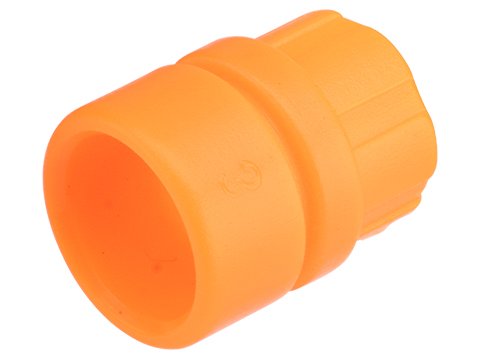
- a blaze orange (AMS STD 595A-17 colour 12199, or brighter) solid plug, permanently affixed to the muzzle end of the barrel as an integral part of the device and recessed no more than 6 mm from the muzzle end (§ 5001(b)(1); 16 CFR § 1272.3(a));
- a blaze orange marking permanently affixed to the outside of the barrel, covering the circumference of the barrel from the muzzle end for a depth of at least 6 mm (§ 1272.3(b));
- construction entirely of transparent or translucent materials that shows the device’s complete contents (§ 1272.3(c));
- colouring of the entire exterior surface white, bright red, bright orange, bright yellow, bright green, bright blue, bright pink or bright purple, singly or as the predominant colour (§ 1272.3(d)).
Neither the statute nor the regulation defines “permanently affixed”. The CPSC’s own FAQ gives one example of what fails: “a plastic, orange plug that has threading” so that it can be removed. A screw-in or screw-on orange tip is therefore not a compliant marking for a maker or seller. The same FAQ says the rule “does not affect products already owned by consumers”.
Correction (2026-10-18): earlier versions of this section described the plug as having “a thickness of not less than 6 mm”. The 6 mm figure is the maximum recess from the muzzle, not a minimum thickness. They also stated that § 5001 is a commerce-only statute that does not reach personal manufacture. The statute’s text does not say that: “manufacture” and “transport” are listed for “any person”, with no commerce qualifier on those words. No source located here settles how the statute is applied to a single build made for personal display, so that question is left open rather than answered either way.
What the text does not list is plain possession. Removing a marking from a purchased replica and keeping it at home is not one of the listed acts; carrying or shipping it afterwards (“transport”, “ship”) may be. State and local laws are separate and often stricter (§ 10.5.2). § 5001(g) preempts state and local marking rules, not state laws on carrying or brandishing an imitation firearm.
The same statute is worked through for a realistic replica in the Light Guns MP7 donor build, Vol 3, which quotes the regulation in full.
10.6.2 State imitation-firearm laws
State laws on imitation firearms vary substantially, and most of the strict ones are sale laws aimed at sellers, not rules about owning or carrying. Each row below was read from the statute text (sources and dates in § 10.10). The states and cities listed are the ones checked, not an exhaustive survey.
Table 4 — 10.5.2 State imitation-firearm laws
| Jurisdiction | Statute | What the text says |
|---|---|---|
| California | Penal Code § 16700 (definition); Division 4, §§ 20150–20180 | § 20165 makes it a civil violation (fine up to $10,000 each) to purchase, sell, manufacture, ship, transport, distribute or receive an imitation firearm for commercial purposes, except solely for export, theatrical use, a certified sporting event, military or ceremonial use, or school displays. § 16700(b)(5) takes a device out of § 20165 if its entire exterior is white or one of seven bright colours, or it is transparent or translucent. § 20170 bars openly displaying or exposing an imitation firearm in a public place, which includes a street, a parking lot and an automobile; § 20175(a) exempts one packaged or concealed from public view. A black-finished E-11 built on the Sterling silhouette would very likely meet the § 16700(a) test (“so substantially similar in coloration and overall appearance to an existing firearm as to lead a reasonable person to perceive that the device is a firearm”), so it should not be openly displayed in a California public place; § 16700(b)‘s colour exclusions apply to § 20165 only. There is no § 20166. |
| New York | General Business Law Art. 39-B, §§ 870–873 | § 872 bars importing, manufacturing, selling, holding for sale or distributing an “imitation weapon” within the state, except solely for interstate shipment or theatrical use. § 871(2) defines it as anything that can reasonably be perceived to be an actual firearm unless it is (a) bright-coloured all over or transparent, and (b) has a barrel closed for at least ½ in with the same material, and (c) carries the maker’s name, and (d) has no laser pointer. An orange tip alone does not qualify. Civil penalty up to $1,000 a violation (§ 873). |
| New York City | Administrative Code § 10-131(g) | Makes it unlawful to sell, offer, possess, use or give away a toy or imitation firearm that can reasonably be perceived to be real unless it meets the same four conditions as the state law (bright or transparent exterior, barrel closed ½ in, maker’s mark, no laser). The city’s inspection checklist says guns with orange tips “are illegal if the rest of the gun is dark-colored”. Outside the code’s exemptions (dealers shipping out of the city, film and theatre with a waiver), a black E-11 may not be possessed in the city. |
| New Jersey | N.J.S. 2C:39-1(v) (definition); C.56:17-1 (P.L. 2019, c. 481) | C.56:17-1 bars selling, transferring or assigning a toy gun or imitation firearm unless it is (1) a colour other than black, blue, silver or aluminium, (2) marked with a non-removable orange stripe at least 1 in wide along the full length of each side of the barrel, and (3) has a barrel at least 1 in in diameter closed ½ in from the front, or (4) “conforms with the provisions of 15 CFR 272.1 et seq.” Route (4) points at the federal rule now at 16 CFR part 1272; how a New Jersey court reads the stale cross-reference is unsettled. The 2C:39-1(v) definition (“reasonably capable of being mistaken for a firearm”) was read in the state’s model jury charge, not on the legislature’s site. |
| Connecticut | General Statutes § 53-206c | ”No person shall give, offer for sale or sell any facsimile of a firearm”, unless its “distinct color, exaggerated size or other design feature” means it cannot reasonably be perceived to be real. Also bars carrying or brandishing one in a threatening manner. Class B misdemeanor. The ban covers giving as well as selling. |
| Massachusetts | none found statewide; Boston Code § 16-5B | Chapter 269 § 12B, cited here before, governs air rifles and BB guns held by minors, not imitations. No statewide imitation-firearm sale or colour statute was found. Boston’s ordinance bars selling, possessing, using, displaying or giving away a replica firearm on public property unless it is bright-coloured or transparent, has a blaze orange plug closing the barrel for ½ in, carries the maker’s name and has no laser pointer. |
| Hawaii | HRS § 134-16 repealed | The legislature’s HRS page shows § 134-16 as “REPEALED. L 2021, c 183, § 8.” No Hawaii statute on imitation firearms was confirmed here. |
| District of Columbia | D.C. Code § 22-4504(b) | § 22-4504 is the concealed-carry section. Subsection (b) makes it a crime to possess a firearm “or imitation firearm” while committing a crime of violence or dangerous crime (up to 15 years, 5-year mandatory minimum). It is not a public-display or sale rule. No D.C. sale or display rule for imitations was confirmed here. |
The practical point for a builder: in California, New York City and on Boston’s public property, a black-finished E-11 in public view is the problem, with or without an orange tip. In New York State, New Jersey and Connecticut the laws bite on selling or giving one, which matters when a finished prop or kit changes hands. Whether a convention or a charity troop falls inside any of the statutory exceptions was not confirmed in any text read; none of the statutes above names costume or convention use.
10.6.3 Practical posture for non-firing E-11 builders
- In-state, in-private: lawful in most states. New York City is the exception found: § 10-131(g) bars possession of a non-compliant imitation firearm, not only its sale.
- In-state, in-public (outside trooping context): posture depends on state and city; California (§ 20170), New York City and Boston restrict public display, and CA / NY / NJ / CT restrict sale or transfer (§ 10.5.2).
- 501st-approved trooping context (conventions, charity events): the event’s organizers and venue set the prop rules on site. No statute read here exempts costume or convention use, so the state and city rules above still apply on the way there and back.
- Photographing at remote outdoor locations: legal in most states; the LE-encounter rule applies (Vol 11 § 11.3).
10.7 Path C from-scratch — manufacture-for-self
A from-scratch firing E-11 (semi-auto) is a manufactured-for-self Title I rifle. Federal posture:
10.7.1 Federal — manufacturing a rifle for personal use
- No registration required for personal manufacture of a Title I semi-auto rifle under federal law.
- The receiver must be marked per ATF regulation. For home-built firearms, the maker is the “manufacturer” and must apply a unique mark to the receiver identifying the manufacturer and a serial number.
- The rifle must be semi-auto. Manufacturing a machine gun for personal use is prohibited by the Hughes Amendment (since 1986) — federal felony.
- The rifle must not be readily convertible to full-auto. Open-bolt operation is “readily convertible” under post-1982 ATF guidance and is prohibited for new manufacture.
- Sales / transfer: a home-built rifle cannot be sold without prior FFL transfer under federal law (some states permit private sales; verify state-of-residence rules).
10.7.2 State-level — manufacture-for-self
State law varies on home-built firearms:
- California: Penal Code § 29180; state serial-number requirement, must register the manufactured firearm with the state.
- New Jersey: AB-A6418 / similar; restrictions on home-built firearms.
- Washington: HB 1240; serial number requirement; permit to manufacture.
- Most other states: no specific manufacture-for-self regulation; federal posture controls.
10.7.3 Non-firing Path C build
A non-firing Path C build is not a firearm; manufacture-for-self regulation doesn’t apply. The imitation-firearm rules (§ 10.5) do.
10.8 The constructive-intent trap
Constructive possession of an NFA item: under federal law and ATF guidance, possessing both the parts to assemble an NFA item and the host firearm that the parts would convert can constitute possession of the NFA item itself, even without actual assembly.
Most-cited example: possessing a vertical foregrip and a pistol creates constructive possession of an Any Other Weapon (AOW) — a category of NFA firearm — even if the foregrip is in a drawer and never installed on the pistol.
E-11-specific risk: possessing full-auto Sterling parts (auto-sear, full-auto bolt, full-auto fire-control components) and a semi-auto Sterling clone (Wise Lite) or 80%-receiver build (Path A2) host could constitute constructive possession of an unregistered machine gun. This is a federal felony with mandatory minimums.
Practical rule:
- Don’t possess full-auto Sterling parts alongside a semi-auto Sterling clone or a Path A2 build in progress.
- Don’t possess a vertical foregrip alongside a Sterling clone configured as a pistol.
- Sell or destroy full-auto parts before building a semi-auto host.
For Path A3 (registered transferable) builders: this rule doesn’t apply because the Sterling is already a registered machine gun; the full-auto parts are inherent to the registration.
10.9 Transport across state lines
10.9.1 Path A1 (Title I rifle) transport
Federal posture (FOPA, 18 USC § 926A — “safe passage”):
- A Title I firearm may be transported through any state, even one where it would be unlawful to possess, if:
- The firearm is unloaded.
- The firearm is in a locked container (not the passenger compartment if the vehicle has a trunk).
- The transport is from a place where the firearm may be lawfully possessed to a place where it may be lawfully possessed.
For E-11 Path A1 transport across multiple states: pack the rifle and magazine separately, in locked cases, in the trunk; carry the route’s documentation (showing source and destination); do not stop in regulated states beyond what’s necessary.
10.9.2 Path A3 (NFA / Class III) transport
ATF Form 5320.20 is required to transport a registered NFA item across state lines:
- Submit the form to ATF in advance (typical processing: 30–60 days).
- Form 5320.20 specifies origin, destination, dates, and route.
- The form must be in the transporter’s possession during transport.
Forgetting Form 5320.20 for a Class III Sterling transport is a federal violation. Plan transport at least 30 days in advance.
10.9.3 Path B / Path C non-firing transport
Non-firing imitation E-11 transports under state imitation-firearm rules in each state crossed; some states are restrictive. For convention transport, the convention’s event-context typically applies (state-permitted exceptions for licensed events).
10.10 What this volume is not
- Not legal advice. Firearms law is jurisdiction-dependent and changes; consult a licensed firearms attorney in the relevant state for specific situations.
- Not exhaustive of state law. Only the most-restrictive states are detailed; check state-of-residence rules for any state not covered.
- Not a guide to converting a semi-auto to full-auto. Such conversion is a federal felony under the Hughes Amendment. Categorically out of scope.
- Not a guide to building an unregistered NFA item. Manufacturing an unregistered machine gun, SBR, SBS, suppressor, or AOW is a federal felony with mandatory minimums.
- Not a 922(r) parts-list-builder. Vol 4 § 4.3.4 has the specific Sterling parts-kit count; this section covers the rule itself.
10.11 References (Vol 10)
- the hub’s legal-posture notes — hub-wide legal posture. This volume is the build-specific tail-end.
- 18 USC § 921 — federal firearms definitions.
- 18 USC § 922 — federal prohibited-person rules and § 922(r) parts-count rule.
- 18 USC § 926A — FOPA safe-passage rule for Title I firearm transport.
- 26 USC § 5841 — NFA registration.
- 26 USC § 5811 — NFA transfer tax.
- 26 USC § 5845(b) — machine-gun definition.
- 26 USC § 5861 — NFA prohibited acts.
- 27 CFR § 478 — GCA Title I implementation.
- 27 CFR § 478.11 — firearm definition.
- 27 CFR § 478.39 — § 922(r) regulated-parts list.
- 27 CFR § 479 — NFA Title II implementation.
- 15 USC § 5001 — Toy Gun Marking Act / imitation firearm rules. Read at law.cornell.edu/uscode/text/15/5001 (2026-10-20).
- 16 CFR part 1272 — CPSC marking rule; approved markings § 1272.3. eCFR, read 2026-10-24. Direct final rule 88 FR 30226 (2023-05-11, effective 2023-06-26), federalregister.gov document 2023-09999, read 2026-10-24.
- 15 CFR part 272 — former Commerce Department rule, removed 2026-02-19 by 91 FR 7824 (federalregister.gov document 2026-03307, read 2026-10-24); eCFR shows the part as reserved (read 2026-10-24).
- CPSC, “Toy, Look-Alike, and Imitation Firearms” FAQ — cpsc.gov/FAQ/Toy-Look-Alike-and-Imitation-Firearms, read 2026-10-24 (threaded orange plug as a non-permanent fixture).
- California Penal Code §§ 16700, 20150–20180 — leginfo.legislature.ca.gov; § 20165 read 2026-10-24 (Internet Archive copy of the legislature’s page, captured 2025-08-29); §§ 16700, 20170, 20175 read 2026-10-20.
- New York General Business Law §§ 870–873 — nysenate.gov; § 872 read 2026-10-24, §§ 871 and 873 read 2026-10-20.
- New York City Administrative Code § 10-131(g) — codelibrary.amlegal.com, read 2026-10-20; DCWP “Inspection Checklist: Fake, Toy, or Imitation Guns” (updated 08/2022; Library copy), nyc.gov, read 2026-10-24.
- New Jersey P.L. 2019, c. 481 (C.56:17-1) — pub.njleg.gov/Bills/2018/PL19/481_.HTM, read 2026-10-24.
- Connecticut General Statutes § 53-206c — cga.ct.gov/current/pub/chap_943.htm, read 2026-10-24 (Internet Archive copy).
- Massachusetts General Laws c. 269 § 12B — malegislature.gov, read 2026-10-24. Boston Code § 16-5B — codelibrary.amlegal.com, read 2026-10-20.
- Hawaii Revised Statutes § 134-16 (repealed) — capitol.hawaii.gov, read 2026-10-24.
- D.C. Code § 22-4504 — code.dccouncil.gov, read 2026-10-24.
- ATF Form 4 (5320.4) — Application for Tax Paid Transfer and Registration of a Firearm.
- ATF Form 5320.20 — Application to Transport NFA Item Across State Lines.
- ATF Open Letters and Determination Letters — searchable on
atf.gov. Cited by letter number when available. - Hughes Amendment (Firearm Owners Protection Act of 1986, P.L. 99-308) — May 19, 1986 machine-gun closure.
- New York Penal Law § 265.00 etc. — New York firearms law (SAFE Act).
- Other state statutes per § 10.2.2 and § 10.5.2.
- Vol 3 — Donor Firearm Provenance — Sterling Mk 4 / L2A3 — context for the donor’s legal status.
- Vol 4 — Build Path A — per-flavor build context for the legal posture in this volume.
- Vol 6 — Build Path C — From Scratch — context for the manufacture-for-self posture in § 10.6.
- Full bibliography consolidated in Vol 12.
Comments (0)