EMG TTI Combat Master (John Wick) · Volume 2
Specs & Internals
2.1 The spec sheet
The EMG TTI Combat Master ships in several SKUs, and the numbers drift between retailer listings, so the table below presents the standard green-gas GBB as it appears across EMG Arms and RedWolf, with conflicting figures flagged as typical/approx rather than collapsed into a single false-precision number.
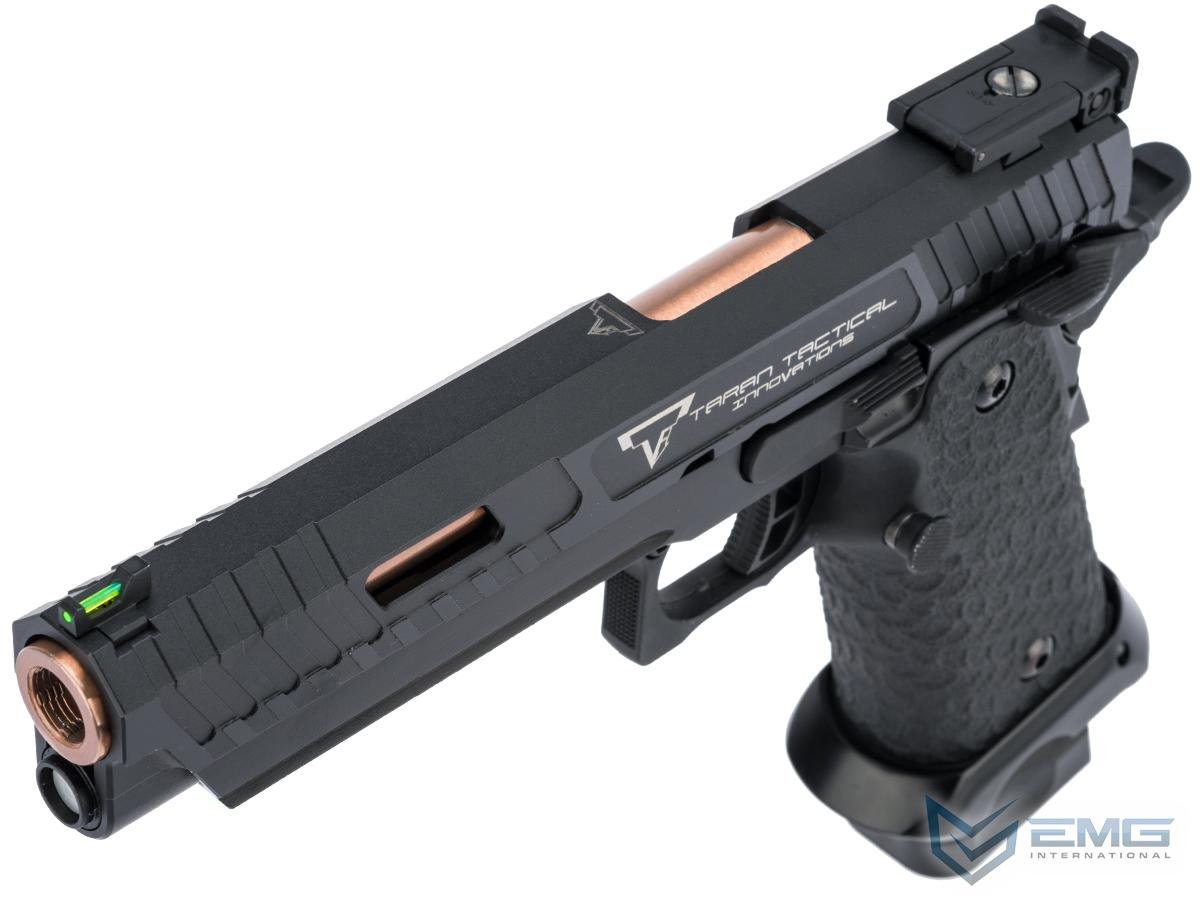
Table 1 — The spec sheet
| Spec | Value |
|---|---|
| Action | Gas blowback (GBB), semi-automatic |
| Gas | Green gas / top gas / propane (CO₂ magazines sold separately) |
| Muzzle velocity | ~300–390 FPS on 0.20 g — a genuine spread (see below) |
| Magazine capacity | ~25–31 rounds (25+1 per EMG Arms; ~28 per RedWolf; 30–31 cited elsewhere) — typical/approx |
| Slide | CNC-machined aluminum, full metal |
| Frame | CNC-machined aluminum with reinforced molded polymer grip panels |
| Inner barrel | CNC precision inner barrel |
| Outer barrel | Threaded/island barrel with rose-gold / imitation-bronze (“BLC”) coating |
| Hop-up | Adjustable |
| Length | ~230–240 mm — typical/approx (sources disagree) |
| Weight | ~1.07 kg / ~2.4 lb — typical/approx |
| Color | Black slide and frame, rose-gold barrel accent |
| Magazine compatibility | EMG TTI pistol mags + AW Hi-Capa-style mags |
| Package | Pistol, one magazine, manual |
A word on the FPS figure, because it is the one number people fixate on. RedWolf’s listing quotes roughly 300 FPS on a 0.20 g BB; EMG Arms’ own page lists 370–390 FPS on the same weight. That is a wide enough gap that it cannot be reconciled into a single value, and it should not be. The honest reading is that muzzle velocity here is gas- and temperature-dependent and varies by SKU — a green-gas GBB chronos differently on a warm range than a cold one, and the CO₂ variant will read higher again. Treat ~300–390 FPS as the operating envelope, not “390 FPS, full stop.” Volume 3 unpacks why the spread exists and how to think about it for field limits.
Magazine capacity is similarly soft. EMG advertises 25+1, RedWolf lists about 28, and other retailers print 30 or 31. The prompt for this build mentioned a 34-round extended magazine; that is plausible given the Hi-Capa ecosystem supports extended sticks, but it is not confirmed on a current product page, so treat 34 as aspirational rather than stock. The safe planning number is ~25–31 rounds in the magazine that comes in the box.
2.2 The gas-blowback system
Mechanically this is a conventional GBB pistol. The magazine is the heart of the system: it holds both the BBs and the liquid green gas, and a fill valve at the base takes the gas charge. On the trigger pull, a hammer releases stored gas through the magazine’s output valve. That gas does two jobs at once — it drives the BB down the inner barrel through the hop-up, and it pushes the metal slide rearward against its recoil spring. The slide travel is what gives the gun its recoil impulse, cocks the hammer for the next shot, and strips and chambers the next BB on the return stroke.
Because the slide is CNC aluminum rather than the heavier zinc or pot-metal of cheaper guns, it cycles fast and snappy. The reciprocating mass is the felt-recoil and the realism: a GBB’s appeal over an electric or spring pistol is precisely that the slide moves and the gun bucks in the hand and locks back on an empty magazine. The trade-off — covered in Vol 3 — is that all of that energy comes from the gas, and gas behavior is temperature-sensitive.
The hop-up is adjustable, applying backspin to the BB to flatten its trajectory and extend usable range. It is accessed in the usual GBB way, with the slide locked back exposing the hop unit at the rear of the inner barrel.
2.3 The licensed features
This is where the gun earns its name. Walking the slide and frame, the features that matter are:
- STI rollmarks on the slide plus TTI laser engravings — the licensed markings that distinguish this from a generic clone. Without them, it is just another 2011; with them, it is the Combat Master.
- TTI slide lightening cuts — the “professional” cuts milled into the slide. Functionally they reduce reciprocating mass for a faster cycle and less felt muzzle flip; visually they are the single most recognizable feature of the screen gun.
- Flared / enlarged magwell — funnels the magazine in for fast reloads, mirroring the race-gun original.
- Extended magazine release — a larger, easier-to-hit button, again carried over from the competition build.
- Fiber-optic front sight — a hi-viz green pipe up front, paired with a target-style adjustable rear.
- DVC-pattern molded stippling on the grip for purchase.
- Rose-gold / imitation-bronze coated outer barrel — the “BLC” finish that matches the screen gun’s barrel accent, visible through the slide cuts and ejection port.
2.4 The no-compensator clarification
One feature that is not on the standard gun, despite frequently being assumed: a muzzle compensator. The screen JW3 Combat Master and the standard EMG replica use a clean threaded/island barrel — the recoil-management story here is the slide lightening cuts, not a comp. A compensator is associated with other TTI race builds, not the JW3 Combat Master, and presenting one as standard equipment would misrepresent both the screen gun and the replica. The threads on the outer barrel exist for mounting a tracer unit or a mock suppressor if the owner wants one, but nothing of that sort ships in the box, and the screen-accurate configuration is bare.
That distinction matters for buyers chasing fidelity: if a listing shows the Combat Master wearing a comp as “stock,” it is either a different model or an added accessory, not the screen configuration. Vol 4 treats the comp question as the central screen-accuracy issue.
Comments (0)