EMG TTI Combat Master (John Wick) · Volume 3
Gas, FPS & Cold Weather
3.1 Green gas is the default propellant
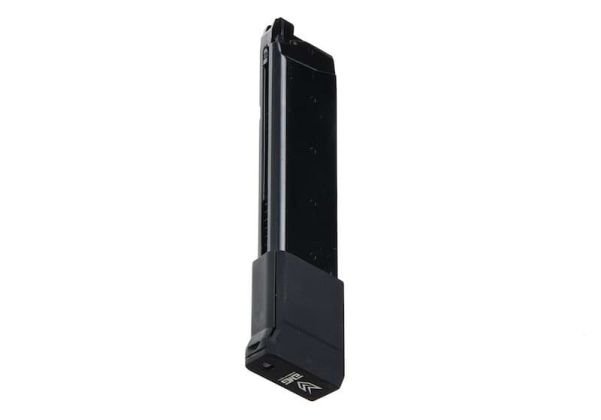
The standard EMG TTI Combat Master is a green-gas pistol. Green gas — functionally propane with a little silicone oil added for seal lubrication — is the everyday propellant for this class of GBB. The magazine doubles as the gas reservoir: a fill valve in the baseplate takes the charge, the liquid gas sits in the magazine body, and its vapor pressure both launches the BB and drives the slide. A single fill is generally good for one to two magazines of BBs before the pressure drops enough to need a top-up, depending on temperature and how hard the gun is being run.
Green gas, top gas, and propane are all interchangeable here in the sense that they are the same chemistry at similar pressures; the differences are branding and the amount of added lubricant. The practical guidance is unchanged from any other green-gas GBB: keep the seals oiled, do not overfill, and do not leave the magazine fully charged in long-term storage, which stresses the seals.
For the full treatment of propellant chemistry, pressure curves, fill technique, and the green-gas-versus-CO₂ trade study, see the Airsoft Gas deep dive. This volume covers only what is specific to running the Combat Master.
3.2 CO₂ magazines exist
EMG also offers CO₂ magazines (and a CO₂-specific variant in the wider Hi-Capa line). CO₂ sits at a much higher pressure than green gas, which buys two things: a higher and more stable muzzle velocity, and far better performance when it is cold. The cost is a harder slap on the internals — CO₂’s pressure spike accelerates wear on the slide, valves, and seals — and a sharper, sometimes over-driven recoil impulse. For a pistol that a buyer cares about keeping screen-pristine, that wear matters. The usual posture is green gas for everyday use and CO₂ reserved for cold days or when the extra consistency is worth the accelerated wear. Confirm a given magazine is rated for the gas going into it; do not put CO₂ through a green-gas-only magazine.
3.3 FPS is a range, not a number
The single most important thing to understand about this gun’s muzzle velocity is that it is a range — and the published figures genuinely conflict.
Table 1 — FPS is a range, not a number
| Source | Quoted FPS (0.20 g) |
|---|---|
| RedWolf | ~300 FPS |
| EMG Arms | 370–390 FPS |
That is not a rounding disagreement; it is roughly a 30 percent spread. The realistic interpretation is that muzzle velocity on a green-gas GBB is governed by variables the spec sheet cannot pin down: ambient temperature, the specific gas used, the fill state of the magazine, how many shots into the string the chrono reading was taken, and which SKU was tested. A warm magazine pushing the first shot of a fresh fill will read high; the tenth shot of a cooling magazine on a cold morning will read low. So the honest envelope is ~300–390 FPS on 0.20 g, gas and temperature dependent — and any single number quoted without those caveats is a snapshot, not a constant.
This matters for fields. Many skirmish sites cap sidearm FPS (commonly around 350 FPS on 0.20 g, with engagement-distance rules), and a gun that can touch 390 on a warm day may sit above a limit it cleared in the morning. Anyone fielding this pistol should chrono it on the day, with the gas and BBs they are actually using, rather than trusting a listing. A heavier BB lowers the FPS reading while improving stability, which is one lever for staying under a cap.
3.4 Blowback and recoil
The appeal of this platform over a spring or electric pistol is the blowback: the CNC aluminum slide reciprocates, the gun kicks, the hammer re-cocks, and the slide locks back on an empty magazine. The lightening cuts reduce the slide’s mass, so it cycles quickly and the felt muzzle flip is modest — that is the race-gun behavior the screen build was tuned for, reproduced here in gas form. The recoil is satisfying without being violent on green gas; on CO₂ it is noticeably harder.
That reciprocating mass is also where the energy budget goes. Every joule spent slamming the slide is a joule not behind the BB, which is part of why GBB pistols sit lower on FPS than a comparable spring gun and why velocity sags as the gas cools — there is less pressure available to do both jobs at once.
3.5 Cold-weather sag
Green gas’s defining weakness is temperature, and the Combat Master inherits it. Green gas works by vapor pressure, and vapor pressure falls as the magazine gets cold. Two things drive the cold: ambient temperature, and the gas’s own evaporative cooling as it discharges — a rapidly emptied magazine chills itself.
The symptoms, in order of onset, are: dropping FPS as the day cools or as a magazine is run fast; a slide that short-strokes and fails to lock back or fully chamber the next BB; and, in genuine cold, a gun that will not cycle at all. This is not a defect — it is the physics of green gas, and it is why CO₂ magazines exist as a cold-weather option. Mitigations are the standard ones: keep spare magazines warm in a pocket until needed, do not dump a magazine in rapid fire when it is cold, accept reduced performance below roughly 50 °F (10 °C), or switch to CO₂ for winter play. For deeper coverage of the temperature curves and the gas trade-offs behind all of this, see the Airsoft Gas deep dive.
Comments (0)