Tokyo Marui Hi-Capa 5.1 · Volume 3
Gas, FPS & Cold Weather
3.1 Green-Gas Native
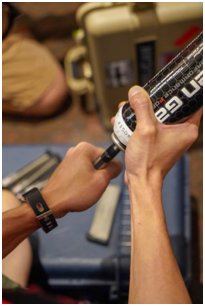
The Hi-Capa was engineered around low-pressure propellant from the start, and understanding that design intent is the key to running the gun without breaking it. Tokyo Marui is a Japanese maker, and the domestic standard there is HFC134a — the same low-pressure refrigerant sold as “duster” gas, roughly 70–90 psi at room temperature. The whole gun is tuned to that pressure: the ABS slide is light enough to cycle crisply on 134a, and the rails see modest stress as a result. Tokyo Marui officially recommends 134a specifically to minimize wear.
Outside Japan, the mainstream propellant is green gas — filtered propane with a little silicone oil added to lubricate the seals on every fill (lab analysis confirms green gas is, chemically, propane). Green gas runs higher, around 109 psig at 70 °F, which is why it produces the snappier blowback and slightly higher FPS most Western shooters experience. The Hi-Capa tolerates green gas — it is the de facto default for the platform in the US and Europe — but it runs the gun harder than its design point, and that has consequences for the ABS slide discussed below. For the full propellant chemistry, the vapor-pressure curves, and the plastic-versus-metal question in depth, see the Airsoft Gas deep dive.
3.2 Stock FPS
Out of the box on 0.20 g BBs, the Hi-Capa 5.1 chronographs around 290–300 FPS — Airsoft Station lists “300 FPS with 0.20 g,” and that is the best single-number estimate on HFC134a. Across vendors and conditions the reported spread is wider: Evike lists 250–300, others cite 280–320 “varies with gas and temperature.” The pattern behind the spread is consistent and physical — green gas trends to the higher end of the range and 134a to the lower, because output FPS tracks the propellant’s pressure, which in turn tracks temperature.
Table 1 — Stock FPS
| BB weight | Approx FPS | Approx energy |
|---|---|---|
| 0.20 g | ~290–300 (typical, 134a) | ≈0.84 J (derived) |
| 0.25 g | lower FPS, similar energy | — |
The energy figure of roughly 0.84 J is derived from 300 FPS at 0.20 g, not a vendor-stated number — useful for checking the gun against a field’s joule limit, but always chronograph to the local rules rather than trusting a spec sheet. Heavier BBs (0.25 g) trade muzzle velocity for momentum and tend to fly more stably; the gun is rated for 0.20–0.25 g.
3.3 Why CO₂ Is Not Recommended on the Genuine TM
This is the single most important operational warning for the platform, and it follows directly from the ABS slide. CO₂ runs at roughly 830 psia at 70 °F — about seven to eight times the pressure of green gas. Tokyo Marui’s magazines are built for green gas and 134a, and the gun’s ABS slide is not engineered to absorb CO₂’s pressure spike.
The failure mode is well documented. Even on green gas alone, regular use produces hairline cracks in the ABS slide rails after roughly six to twelve months — the slide is the platform’s known wear-out part. CO₂ accelerates that failure dramatically, and running it in a genuine Tokyo Marui Hi-Capa is a reliable way to crack the stock slide. The correct path for anyone who wants CO₂ is an aftermarket metal slide built for the pressure (see Volume 4); CO₂ in the stock ABS slide is a when-not-if proposition.
Clone CO₂ magazines do exist and will physically fit the Tokyo Marui — WE and Armorer Works / AW Custom both sell CO₂ mags (28- and 30-round) marketed as compatible with Marui/WE/AW Hi-Capa 5.1 frames. They function, but using them in a stock TM is at the owner’s own risk for exactly the slide-cracking reason above. They make sense in a metal-slide build or in a CO₂-native clone gun — not in a box-stock Marui. (Full clone guidance is in Volume 5.)
3.4 Cold-Weather Sag
The Hi-Capa shares the universal gas-gun weakness: output falls as temperature drops, and falls further the faster the gun is fired. The mechanism is the propellant’s vapor-pressure curve. Liquefied gas in the magazine sits at its saturation pressure for the current temperature; cool the magazine and that pressure slides down its P–T curve, so each shot launches with less energy. FPS sags, and below some threshold the gun begins to short-stroke — the slide no longer cycles fully and the action stalls.
There are two compounding effects. The first is ambient cold: a winter game with the magazine at, say, 40 °F simply has less pressure available than the same gun at 70 °F. The second is per-shot cool-down: vaporizing liquid propellant is endothermic, so rapid fire chills the magazine from the inside, and FPS drops shot-over-shot until the gun goes limp — then recovers after a rest as ambient heat re-warms the reservoir. This is physics, not a malfunction.
For the Hi-Capa specifically, green gas holds up somewhat better than 134a in the cold (higher base pressure means more margin before short-stroking), and CO₂ holds up better still — which is exactly why cold-weather shooters are tempted by it. But on a genuine Tokyo Marui the slide-cracking risk overrides that temptation: the right answer for serious cold-weather use is a metal slide plus green gas or, if the climate is severe, a CO₂-rated metal-slide build. The deeper treatment of vapor pressure, cool-down, and how to manage them across the whole gas family lives in the Airsoft Gas deep dive.
Comments (0)