Tokyo Marui Hi-Capa 5.1 · Volume 4
Upgrades & Maintenance
4.1 The Deepest Aftermarket in Airsoft
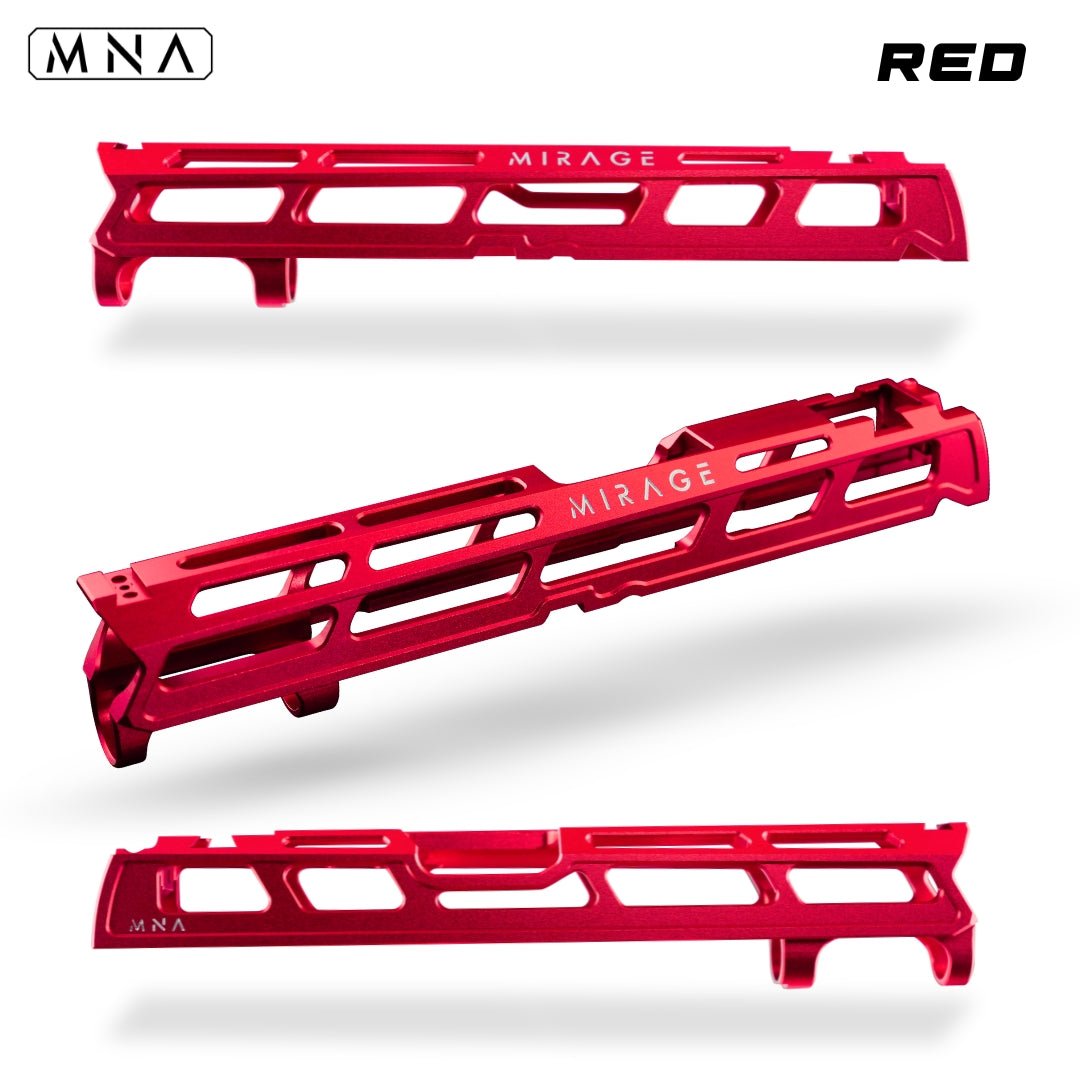
No other airsoft gun has a parts ecosystem like the Hi-Capa’s. Dozens of brands and thousands of components worldwide are engineered to Tokyo Marui’s dimensions, which means that almost every part of the gun has multiple drop-in replacements and — crucially — that parts from different makers interchange because they are all cut to the same spec. The named tuning houses are the platform’s center of gravity: Airsoft Masterpiece, CowCow Technology, Maple Leaf, Nine Ball/Laylax, Gunsmith Bros, AIP, and Dr. Black, among many others. For a builder, this is the appeal of the whole platform: a stock Marui is a base from which a tuned competition pistol is assembled, part by part, on the bench.
The upgradable systems break down cleanly:
Table 1 — The upgradable systems break down cleanly
| System | Common upgrade parts | What it buys |
|---|---|---|
| Slide | Aftermarket ABS or CNC aluminum (e.g. Dr. Black 6063, anodized) | Durability, CO₂ capability, aesthetics |
| Barrel / hop | Precision 6.0x mm inner barrel + soft bucking (Maple Leaf) | Accuracy, consistency, range |
| Nozzle | Polymer loading nozzles + return springs (ZCI, etc.) | Reliability — replaces a known weak part |
| Fire-control | Hammer, sear, disconnector, triggers (CowCow, AMP) | Crisp single-action break, faster reset |
| Springs / valves | Recoil springs, hammer springs, high-flow valves | Tuned blowback, FPS, gas efficiency |
| Frame / grip | Full frames, grip tape, magwells | Ergonomics, weight, speedsoft handling |
4.2 Common First Upgrades
The community’s well-trodden upgrade order reflects best return-per-dollar. The precision barrel and bucking is the usual first move — a tighter-bore inner barrel plus a quality hop rubber, for roughly $30–50, is the cheapest meaningful accuracy gain on the gun. A short-stroke kit (which alters the slide’s travel to speed up the cycle) is the speedsoft-oriented next step for a faster rate of fire. The big-ticket upgrade is a metal slide, roughly $120–200 — the durability fix that also unlocks CO₂, exemplified by Dr. Black’s CNC 6063 aluminum slide (anodized, machined to a 0.02 mm tight fit).
Costs scale predictably. A precision-barrel-and-bucking refresh is well under $50. A solid mid-range build — metal slide, precision barrel, tuned fire-control, better springs — lands around $350–450 all in. A full competition setup runs $600 and up. Worth noting: with a CNC mill and a 3D printer on hand, several of these “buy it” parts (grips, magwells, fitting fixtures, even prototype slides) are bench-makeable, and the platform’s open dimensional standard makes it an unusually good candidate for shop-fabricated parts.
4.3 Maintenance Cadence
The Hi-Capa is routine-GBB to maintain, and doing so is what delivers its documented 10,000-plus-round service life. The regular tasks are unglamorous: clean the inner barrel and wipe the slide rails after sessions; lubricate the moving parts and slide rails with silicone oil (never petroleum-based oil, which attacks rubber seals); and store the gun cool and dry. The magazines need their own discipline — keep them lightly gassed in storage (a small charge keeps the seals seated and supple rather than letting them dry out and leak), and add a drop of silicone oil periodically via the fill valve so every fill re-lubricates the internals. Green gas does some of this automatically because it carries silicone oil; 134a and raw CO₂ do not, so manual oiling matters more with those.
A sensible cadence for a regularly-used gun: silicone oil on the rails and a barrel pull-through every few sessions; a fill-valve oil drop every several fills; and a full strip-and-inspect once or twice a season, paying attention to the wear points below.
4.4 Weak Points
Two failure points define the platform, and both are well-documented and cheaply fixed — which is precisely why the gun dominates competition.
The ABS slide is the headline weakness. Regular green-gas use produces hairline cracks in the slide rails after roughly six to twelve months, and CO₂ accelerates the failure sharply. This is the single biggest reason builders move to a metal slide. It is not a defect so much as a designed-in consequence of running a 134a-tuned plastic slide on higher-pressure gas — but for any high-round-count or CO₂ use, the metal slide is effectively mandatory.
The loading nozzle is the other recognized weak point. Jammed or worn nozzles are a common complaint, and the part is widely replaced with aftermarket polymer nozzles and fresh return springs. Because the nozzle strips and chambers each BB, a worn one shows up as feeding and chambering hiccups; it is an inexpensive, high-value preventive swap.
The encouraging through-line is that every Hi-Capa failure has a known, cheap, well-documented fix — when a part wears, the community already knows the replacement and the procedure. That is the real reason the platform is trusted for competition, and the reason it remains the most-upgraded GBB pistol in the sport.
Comments (0)