CYMA AK (CM.040) · Volume 2
Specs & Internals
2.1 The Specification Sheet
The CM.040 is a full-metal Kalashnikov replica sold under several variant suffixes, and the headline figures shift with the variant and the production lot. The table below is drawn from current retailer listings (Evike, RedWolf, Airsoft GI, and the EU AirsoftZone listing for the AK105 variant); where the figures spread, the spread is noted and the working number is labeled typical/approx. The “CM.040” designation is used loosely across retailers and covers AK74M, AK105, and AKS-74M-style guns, so treat every length, weight, and velocity figure as variant-dependent.
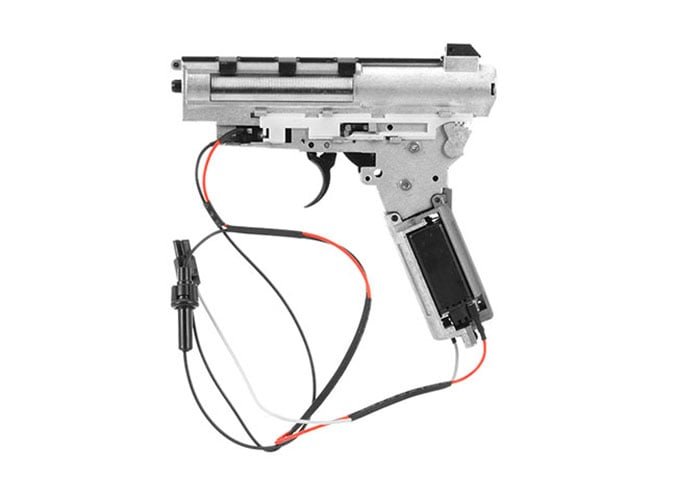
Table 1 — The Specification Sheet
| Specification | Value |
|---|---|
| Action | AEG (battery / electric), 6 mm BB |
| Replica of | Kalashnikov AK family (AK-74M / AK-105 / AKS-74M pattern) |
| Stock FPS (0.20 g) | ~380–430 fps (typical/approx; CM040B AK105 measured ~417 fps) |
| Muzzle energy | ~1.6 J (CM040B AK105; not stated by US retailers for other variants) |
| Gearbox | Version 3, full metal, 7 mm bushings (18:1 gears cited on AKS101) |
| Motor | Short-type (newer lots reported to use neodymium-magnet motors) |
| Hop-up | Rotary adjustable, Tokyo Marui-spec |
| Inner barrel | ~470–500 mm (full-length AK74M); ~363 mm (CM040B AK105) |
| Magazine | 400–600 rd AK hi-cap (~500 rd most commonly cited) |
| Magazine type | Standard AK AEG (cross-compatible w/ LCT, DBoy, CYMA, Arcturus) |
| Length | ~940 mm fixed; ~610–840 mm folding (variant-dependent) |
| Weight | ~3.0–3.2 kg (~6.6–7.0 lb) |
| Receiver / furniture | Stamped + riveted steel receiver; steel outer barrel + flash hider; polymer grip/handguard; steel or polymer stock |
| Wiring / connector | Small (Mini) Tamiya, wired to top of gearbox |
| MOSFET / ETU | None stock — bare trigger contacts |
| Muzzle thread | 24 mm CW (AK74M) / 14 mm CCW (AK105) |
| Fire modes | Safe / Semi / Full-auto |
A few entries deserve comment. The velocity is the most variant-sensitive number in the table: current full-metal CM.040 guns cluster around 380–430 fps on 0.20 g, with the AK105 measured at roughly 417 fps and 1.6 joules, while older or region-locked units run lower (~330–370 fps). Some retailer pages even contradict themselves — one lists 420–430 fps in the description but 350–375 fps in the spec table — so a buyer should treat the FPS as a range to confirm at purchase, not a guarantee. The magazine figure is similarly soft: 400, 500, and 600 rounds all appear across listings; ~500 rd is the most common claim. What is solid is the construction: stamped-and-riveted steel receiver, steel barrel, and a full-metal Version 3 gearbox.
2.2 The Version 3 Gearbox — and Why It Isn’t a V2
Everything mechanical in the CM.040 hangs off a Version 3 (V3) gearbox. The internal cycle is identical in principle to the M4’s V2: an electric motor spins a pinion that drives the bevel, spur, and sector gears in sequence; the sector gear pulls a rack on the piston rearward to compress the main spring; the last sector tooth releases the piston, the spring drives it forward in the cylinder, and the piston head shoves a slug of air through the cylinder head and air nozzle into the hop-up chamber and barrel to launch one BB. On full-auto the gears simply keep turning and the cycle repeats. The V3 uses the same gear train, the same anti-reversal latch, the same tappet plate, and (on this gun) 7 mm bushings holding the axles.
The differences are structural, and they are the whole reason an AK comes apart differently than an M4 — this is the V2-versus-V3 teaching point worth internalizing before any upgrade work:
- Shell shape. The V2 is a clamshell whose motor lives in the pistol grip, hanging off the bottom of the gearbox. The V3 is a different casting whose motor mounts at the rear, inside the grip but oriented along the receiver. The V3 shell is widely regarded as the stronger of the two — the V2’s notorious weak spot, the cylinder-window area at the front of the shell, is not the V3’s defining failure mode.
- Gearbox removal. This is the practical divide. Pulling an M4 V2 means separating the upper and lower receiver and dealing with the buffer-tube spring guide. Pulling an AK V3 means lifting the dust cover, releasing the recoil spring, and dropping the gearbox out the top/rear — for many builders a simpler, faster teardown once learned.
- Trigger contacts. The V3’s trigger contacts sit externally, accessible without splitting the shell. That single fact is why a MOSFET can be wired onto a V3 without opening the gearbox — covered below and in Volume 4.
Neither version is “better” in the abstract; they are simply the two standards, the V2 owning the M4 world and the V3 owning the AK. A player who learns both can service most AEGs in the sport.
2.3 Motor, Hop-Up, and Wiring
The CM.040 runs a short-type motor seated in the pistol grip, with motor height adjustable from the base screw as on any AK. Newer production lots have been reported to ship neodymium-magnet motors, a genuine improvement in torque and efficiency over the older budget motor — but this is lot-dependent (typical/approx) and worth confirming rather than assuming.
The hop-up is a rotary adjustable unit on Tokyo Marui spec, which is the good news for upgraders: TM-spec means the broad universe of aftermarket buckings, nubs, and tightbore barrels drops straight in.
The wiring is the gun’s clearest budget compromise. It runs to a Small (Mini) Tamiya connector at the top of the gearbox, and there is no MOSFET or ETU anywhere in the stock gun — the trigger fires through bare metal contacts. That is fine on a modest battery, but it is the single most important thing to understand before powering the gun: the contacts arc and erode under load, and an aggressive 11.1 V LiPo will burn them quickly. Because the V3’s contacts are external, adding a MOSFET is a bolt-on job — it does not require splitting the gearbox — which is exactly why it tops the upgrade list in Volume 4. Volume 3 turns to the batteries that drive all of this.
Comments (0)