CYMA AK (CM.040) · Volume 3
Battery, FPS & Rate of Fire
3.1 What Powers the Gun
An AEG is only as good as the battery feeding it, and the CM.040’s AK body imposes one constraint the M4 does not: space. There is no buffer tube to slide a stick battery into and no roomy cylindrical stock cavity. The battery rides in the receiver under the dust cover, in the top/front area around the gearbox, which means the gun takes a small stick or nunchuck pack and not a large brick. A buyer ordering a battery should size it to that pocket first and worry about capacity second.
On chemistry and voltage, the guidance is straightforward and it pivots entirely on the missing MOSFET (see Volume 2):
Table 1 — On chemistry and voltage, the guidance is straightforward and it pivots entirely on the missing MOSFET (see Volume 2)
| Battery | Verdict |
|---|---|
| 8.4 V NiMH small stick (~1600 mAh) | Stock-recommended, safe, period-correct for the gun’s wiring |
| 7.4 V LiPo (small stick / nunchuck) | The safe, sensible default — runs fine on bare contacts |
| 11.1 V LiPo | Only with an added MOSFET — will burn the stock trigger contacts otherwise |
The reason 7.4 V is the recommended LiPo and 11.1 V carries a warning comes straight back to the wiring: the stock gun fires through bare Mini-Tamiya-connected trigger contacts with no MOSFET to switch the load. A 7.4 V LiPo draws gently enough that the contacts survive; an 11.1 V pack roughly triples the electrical stress at the contacts and arcs them away in short order. The first thing many owners do is swap the Mini-Tamiya for a Deans / T-plug (lower resistance, more secure) and add a MOSFET — at which point 11.1 V becomes a reasonable option. Until then, run 7.4 V and the gun will be happy.
3.2 The Hot Stock FPS — and Why It Matters at the Field
The CM.040’s stock velocity is one of its selling points and, paradoxically, one of the things a buyer most needs to check. Across current full-metal variants the figure clusters around 380–430 fps on 0.20 g BBs (typical/approx), with the AK105 (CM040B) measured at roughly 417 fps / 1.6 J. That is meaningfully hotter than a typical entry M4, which is part of the AK’s outdoor appeal — but it has direct field-legal consequences.
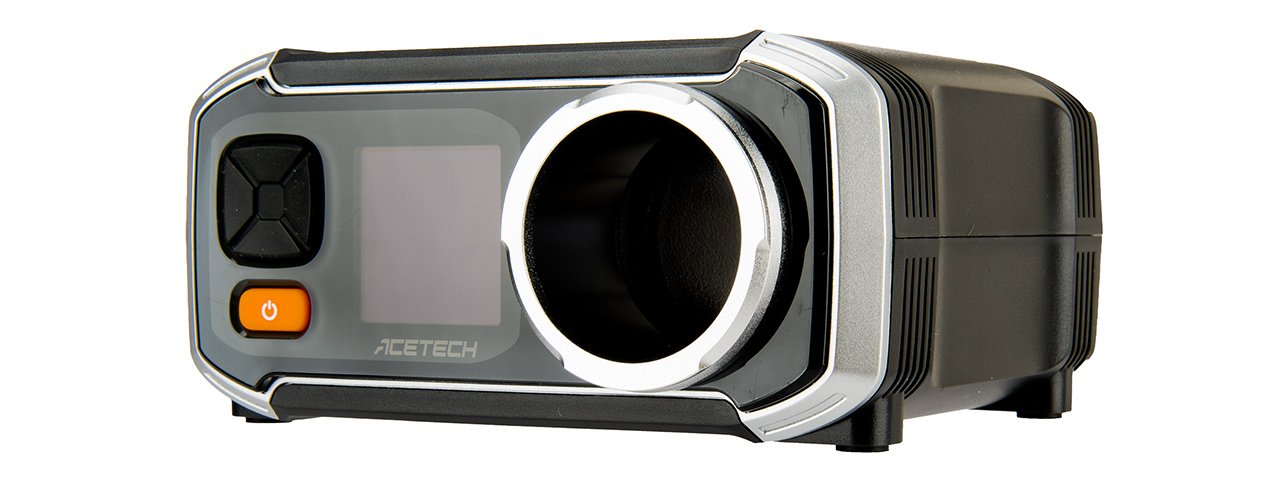
Most outdoor fields cap AEGs somewhere around 400–450 fps on 0.20 g for full-auto/standard play, often with a joule limit rather than a raw FPS limit, and CQB/indoor fields run far lower — frequently 350 fps and under, sometimes with minimum-engagement-distance rules layered on top. A gun that chronos at 417 fps is fine on many outdoor fields and over the limit at most CQB sites. The practical upshot: a buyer who plans to play indoors should expect to drop the spring (an easy V3 job, Volume 4) or accept that the gun is an outdoor rifle. Because the field measures muzzle energy in joules off a chronograph — not the number on the box — the relationship between BB weight, FPS, and joules is the thing that actually governs legality, and that subject is treated in full in the Airsoft Gas deep dive, whose FPS/joule discussion applies identically to AEGs.
One related caution: joule creep. Raising the joule output by feeding a gun heavier BBs is a known phenomenon — a gun set up with a longer barrel and a fresh hop can put more energy into a heavy BB than a light one, so a rifle that chronos legal on 0.20 g can exceed the limit on 0.30 g or 0.40 g. It is more pronounced on high-volume air setups than a stock short-stroke AEG, but on a hot gun like the CM.040 it is worth knowing before loading heavy ammo for a field that chronos on 0.20 g and plays on 0.30 g. The Gas dive covers the mechanism; the takeaway here is simply to chrono with the BB weight actually being used.
3.3 Rate of Fire
Retailers do not publish a rate-of-fire figure for the CM.040, so any number is an estimate rather than a vendor spec. A full-metal AK V3 of this type, on a 7.4 V LiPo with the stock short-type motor, lands in the rough neighborhood of 13–18 rounds per second (typical/approx, unconfirmed for this specific gun) — brisk and entirely usable, if not the eye-watering trigger response of a high-speed build.
ROF is set by the interplay of three things: the spring (a heavier spring slows the cycle), the motor (torque and RPM), and the battery (voltage and current delivery). The stock CM.040 is geared and sprung for FPS and reliability rather than raw speed, so its out-of-box ROF is moderate. The levers a builder can pull to raise it — a higher-voltage LiPo behind a MOSFET, a higher-speed motor, lighter-weight internals — are exactly the upgrade path Volume 4 lays out. For a stock gun on the recommended 7.4 V battery, the ROF is “more than enough for field play” rather than a competition figure, and that is the right place for a value AK to sit.
Comments (0)