Umarex GLOCK 17 Gen3 · Volume 2
Specs & Internals
2.1 The Specification Sheet
The numbers below are aggregated across Elite Force’s own listing and the major retailers (Evike, Amped, Airsoft Extreme, Airsoft GI). Because the gun ships as two distinct SKUs — green gas and CO₂ — several figures fork by variant, and where listings disagree the value is given as typical/approx. The most common source of disagreement is product-versus-packaging dimensions: a couple of listings quote what looks like the box, not the gun.
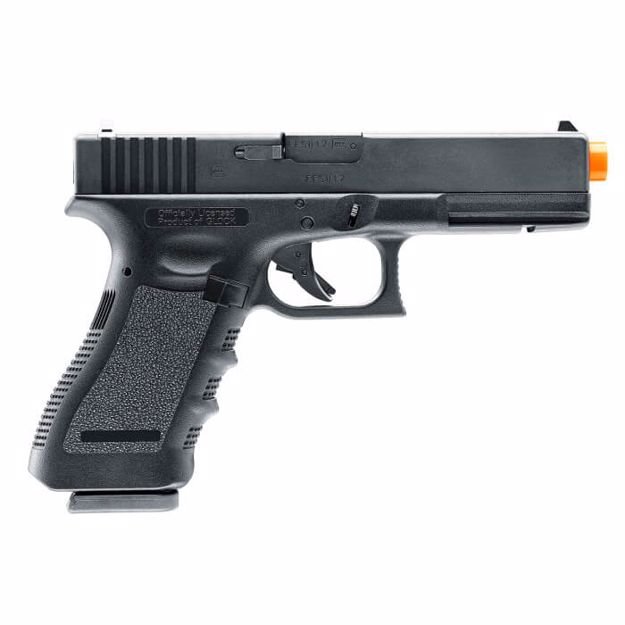
Table 1 — The Specification Sheet
| Spec | Green-gas SKU | CO₂ SKU |
|---|---|---|
| Propellant | Green gas / propane (“Elite Force Fuel”) | One 12 g CO₂ capsule (in magazine) |
| Stock FPS (0.20 g) | ~290–300 (typical) | ~320–330 (typical) |
| Blowback | Full gas blowback | ”Realistic”/often half-blowback (NBB) — verify SKU |
| Magazine capacity | ~20–22 rds (typical) | 14 rds |
| Mags in box | 1 (typical) | 2 |
| Slide | Aluminum-alloy / metal | Aluminum-alloy / metal |
| Frame | Injection-molded polymer | Injection-molded polymer |
| Inner barrel | 97 mm | ~97 mm (typical) |
| Hop-up | Adjustable | Adjustable |
| Overall length | ~8.0 in (typical; real G17 ≈ 8.03 in) | ~8.0 in (typical) |
| Weight | ~1.5 lb (typical) | ~1.5 lb (typical) |
A few of those entries deserve a note. The FPS spread across listings is real, not sloppy: the green-gas gun is quoted anywhere from 280 to 310 fps depending on retailer, temperature, and whether the chrono was run on fresh gas — ~290–300 is the honest center. Muzzle energy in joules is not published by any retailer; a ~290–300 fps figure on a 0.20 g BB implies roughly 0.8–0.9 J, but that is a derived number, not a vendor spec — chronograph to the local field limit rather than trusting it. Magazine capacity on the green-gas gun is listed as 20, 22, or 23 rounds depending on the page; the true figure is most likely ~20–22. The CO₂ mag holds only 14 because the 12 g capsule eats the space that would otherwise hold BBs and gas.
2.2 The Gas-Blowback System
Mechanically this is a conventional self-contained-magazine GBB, built by VFC. The propellant and the BBs both live in the magazine; there is no external gas line and no battery. Each trigger pull releases a metered charge of high-pressure gas that does two jobs at once: it launches the BB down the inner barrel, and it drives the slide rearward against its recoil spring. The returning slide strips the next BB from the magazine, recocks the action, and the cycle repeats — the same dwell-and-cycle logic as a real semi-auto, with gas pressure standing in for cartridge combustion.
On the green-gas SKU that cycle is a full blowback: the metal slide travels its full stroke, locks back on an empty magazine, and delivers the snappy recoil pulse the platform is known for. The CO₂ SKU is the asterisk. Several listings describe it as “realistic blowback,” but it is widely and consistently sold elsewhere as half-blowback or non-blowback (NBB) — the slide does not fully cycle. The reason is the propellant: CO₂’s far higher pressure (covered in Volume 3) is harder on the gun, and a reduced or partial blowback is one way to keep a CO₂ variant durable. The practical takeaway is to verify the exact SKU before claiming full blowback for a CO₂ gun — the box and the listing wording both matter here.
2.3 The Licensed GLOCK Markings
What separates this gun from every Glock-style airsoft pistol before it is the trademark package, and it is comprehensive. The slide carries the full GLOCK rollmarks — the genuine model and maker markings, not a sanitized placeholder. The GLOCK logos are molded into the polymer frame, the trigger wears the signature GLOCK trigger-safety blade, and the frame reproduces the Gen3 rough-textured grip with its finger grooves and thumb rests. The standard GLOCK accessory rail is present on the dust cover, and the gun ships with GLOCK-pattern sights. None of this is cosmetic license-stretching: it is there because GLOCK licensed it, which is the entire reason the gun commands its price and its following.
2.4 Slide, Frame, and Barrel
The construction mirrors the real pistol’s material strategy. The slide is aluminum alloy — a true metal slide on the Gen3, with rear serrations for racking — riding on a frame of injection-molded polymer, exactly as a real Glock pairs a steel slide with a polymer lower. The outer barrel is metal (explicit on the CO₂ listing). Inside, a 97 mm inner barrel with an adjustable hop-up does the precision work: the hop bucking puts backspin on the BB to flatten its trajectory, and the adjuster lets the shooter dial lift to match BB weight and range. The metal slide is the single biggest contributor to the gun’s realistic heft and cycle feel, and it is the component the aftermarket most often replaces — both to upgrade and, on the CO₂ side, to survive the pressure. That is the subject of Volume 4. One internal weak point is worth flagging now: the stock trigger is the gun’s poorest feature — users report long creep and a heavy pull (around 7 lb, per forum reports — user-reported, not a spec).
Comments (0)