Umarex GLOCK 17 Gen3 · Volume 4
Upgrades & Maintenance
4.1 The Glock Aftermarket — With a Caveat
The airsoft Glock aftermarket is large, but it is not the seamless, mix-and-match ecosystem that surrounds the Hi-Capa, and a builder needs to understand why before buying parts. Most of the deep airsoft-Glock catalog grew up around the Tokyo Marui Glock pattern, which is the de facto dimensional standard the way TM’s Hi-Capa is for 2011s. The Umarex/Elite Force gun is VFC/Umarex-spec, not TM-spec — so while a great deal of Glock-pattern hardware exists, it is not a clean drop-in for all TM-spec parts, and North American aftermarket support for the VFC platform specifically is somewhat thinner than for a pure-TM gun. The single hard rule that follows from this: magazines are VFC/Umarex-spec and are not Tokyo Marui compatible (more on mag cross-compatibility in Volume 5). Verify the fitment of any external or internal part against the VFC/Umarex Glock before buying, rather than assuming “airsoft Glock” means universal.
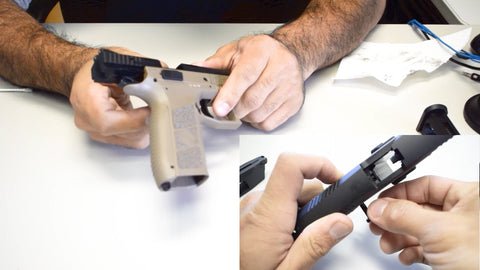
With that caveat stated, the categories of upgrade are the familiar ones: slides, outer barrels, sights on the cosmetic/external side, and inner barrels, hop-up units, nozzles, and fire-control parts on the performance/internal side. Some Glock-pattern externals will fit with minor fitting; others will not. The reliable wins are the internal precision parts, which is where most builders spend first.
4.2 Common Upgrades
The most useful reference point is a documented user build of this exact gun, which is worth reading as a menu rather than a prescription. Its upgrade list maps cleanly onto the standard GBB tuning playbook:
Table 1 — The most useful reference point is a documented user build of this exact gun, which is worth reading as a menu rather than a prescription. Its upgrade list maps cleanly onto the standard GBB tuning playbook
| Upgrade | Example part | What it buys |
|---|---|---|
| Tightbore inner barrel | Nineball 6.00 mm × 97 mm | Tighter shot grouping; matches the stock 97 mm length |
| Hop-up bucking | Maple Leaf MR Hop, 60° silicone | Better, more consistent backspin and range |
| Striker / hop unit | Poseidon | More consistent hop and air seal |
| Loading nozzle | Guarder enhanced nozzle | Feed and gas-routing reliability |
| Guide rod | CowCow short-stroke | Tunable recoil/cycle behavior |
| Blowback unit | CowCow | Cycle tuning, durability |
| Hammer + sear | CowCow steel hammer + steel sear | Durability and a better trigger break |
| Trigger | RWA Agency Arms | Fixes the poor stock trigger |
The single highest-value change for most owners is the inner barrel + bucking pair: matching a 6.00 mm tightbore to the stock 97 mm length and fitting a quality hop bucking is the cheapest, most reliable accuracy gain, and it does not depend on the platform’s spottier external fitment. The steel hammer and sear are the durability play — replacing wear-prone fire-control parts with steel — and the aftermarket trigger addresses the gun’s worst stock feature directly.
4.3 Maintenance
This is a conventional self-contained-mag GBB, so it takes conventional GBB care — none of it is exotic for a maker with a real-steel background:
- Lubricate the magazine. Put a drop of silicone oil on the fill valve periodically (and a light film on the seals); this keeps the valve and gas-route seals supple and is the single most important longevity habit. Green gas carries some oil with every fill, but it does not replace deliberate seal care.
- Keep the slide rails lubed. A light film of the correct lubricant on the rails keeps the metal slide cycling smoothly and reduces wear; avoid over-oiling, which attracts grit.
- Do not store magazines fully gassed long-term. Leaving a mag under full pressure for months stresses the seals and is a common cause of slow leaks. Store with a small residual charge, not packed full.
- CO₂ specifically: do not leave a 12 g capsule pierced and installed for long periods — it keeps the seals under high pressure continuously. Treat CO₂ mags as use-and-vent.
(The lubrication cadence above is general GBB best practice rather than a SKU-specific published schedule — treat it as the standard maintenance rhythm, not a manufacturer spec.)
4.4 Weak Points
Two weak points are worth planning around. The first is the stock trigger — the gun’s most-criticized feature, reported with long creep/drag and a heavy pull on the order of 7 lb (user-reported, not a published spec). It is the most common reason owners reach into the fire-control group, and an aftermarket trigger plus a steel hammer/sear is the standard fix. The second is the loading nozzle, a frequent reliability and upgrade target on this platform — an enhanced nozzle (e.g. Guarder) is a common early replacement to firm up feeding and gas routing. Beyond those, the CO₂ variant works the gun harder (see Volume 3); if a CO₂ gun is run hard, the slide and seals are the parts to watch, and a metal-slide-rated build is the right answer for sustained CO₂ use. Note that the specific aftermarket list above comes from a single documented user build — treat the named brands as proven examples, not as the only validated options for this VFC/Umarex-spec gun.
Comments (0)