STEN Gun · Volume 1
Overview & Decision Tree
What the STEN is, the three build paths, and how to read this series
Contents
(Generated by build/inject_toc.py at build time. Section headers below are the source of truth.)
The STEN Gun is the British 9×19 mm submachine gun designed by Major Reginald V. Shepherd and Harold J. Turpin at the Royal Small Arms Factory Enfield in 1941, in direct response to the British Army’s wartime need to replace the expensive Lanchester (itself a licensed copy of the German MP 28) with something an Allied industrial base under air-raid pressure could actually mass-produce. The name is the initials of its designers and its factory: Shepherd, Turpin, ENfield. By the time the war ended in 1945, roughly four million STENs had been built at RSAF Enfield, the Birmingham Small Arms factory (BSA), Royal Ordnance Factory Fazakerley, Royal Ordnance Factory Theale, Lines Brothers Tunbridge (the toy-maker — they made the Mk III), Canadian Arsenals Limited at Long Branch outside Toronto, and Lithgow Small Arms Factory in New South Wales, plus a deeply distributed network of subcontracted parts shops across the British Isles. Production cost at peak was approximately £2.50 per unit with about ten man-hours of labor per gun — for context, a Thompson M1928A1 cost the US Army roughly $200 and sixty man-hours in the same period. The STEN was the most-produced Allied submachine gun of the war by an order of magnitude, and the gun that put a 9 mm full-auto weapon in the hands of every airdropped resistance fighter from the Polish Underground State to the Norwegian Hjemmestyrkene.
It is, fundamentally, a deliberate exercise in design for production: a wrapped-and-welded sheet-steel receiver tube, a simple blowback action with a fixed firing pin (no separate firing-pin spring, no firing-pin retainer — the firing pin is a nub machined into the bolt face), a 32-round side-feed magazine derived directly from the Lanchester (which in turn was derived from the German MP 28), and a fire-control group simple enough to be made on a drill press and a lathe. The 1941 brief was explicit: anyone with a few light machine tools and an arc welder should be able to make this gun. The brief was met. The Polish Underground State copied the design in clandestine workshops to produce the Błyskawica (“lightning”) for the Warsaw Uprising; the Norwegian and Danish resistance groups repaired and modified airdropped STENs in basement shops; in modern times, Professor Parabellum’s Practical Scrap Metal Small Arms Vol III: The DIY STEN Gun uses the STEN as its lead example of a garage-fabricable submachine gun. This engineering reality — that the STEN was designed to be made in shops far more constrained than Jeff’s — is the load-bearing fact behind this series. Vol 7 (Build Path C — from scratch) is genuinely the most-tractable from-scratch path in the entire Firearms hub.
1.1 What the STEN actually is
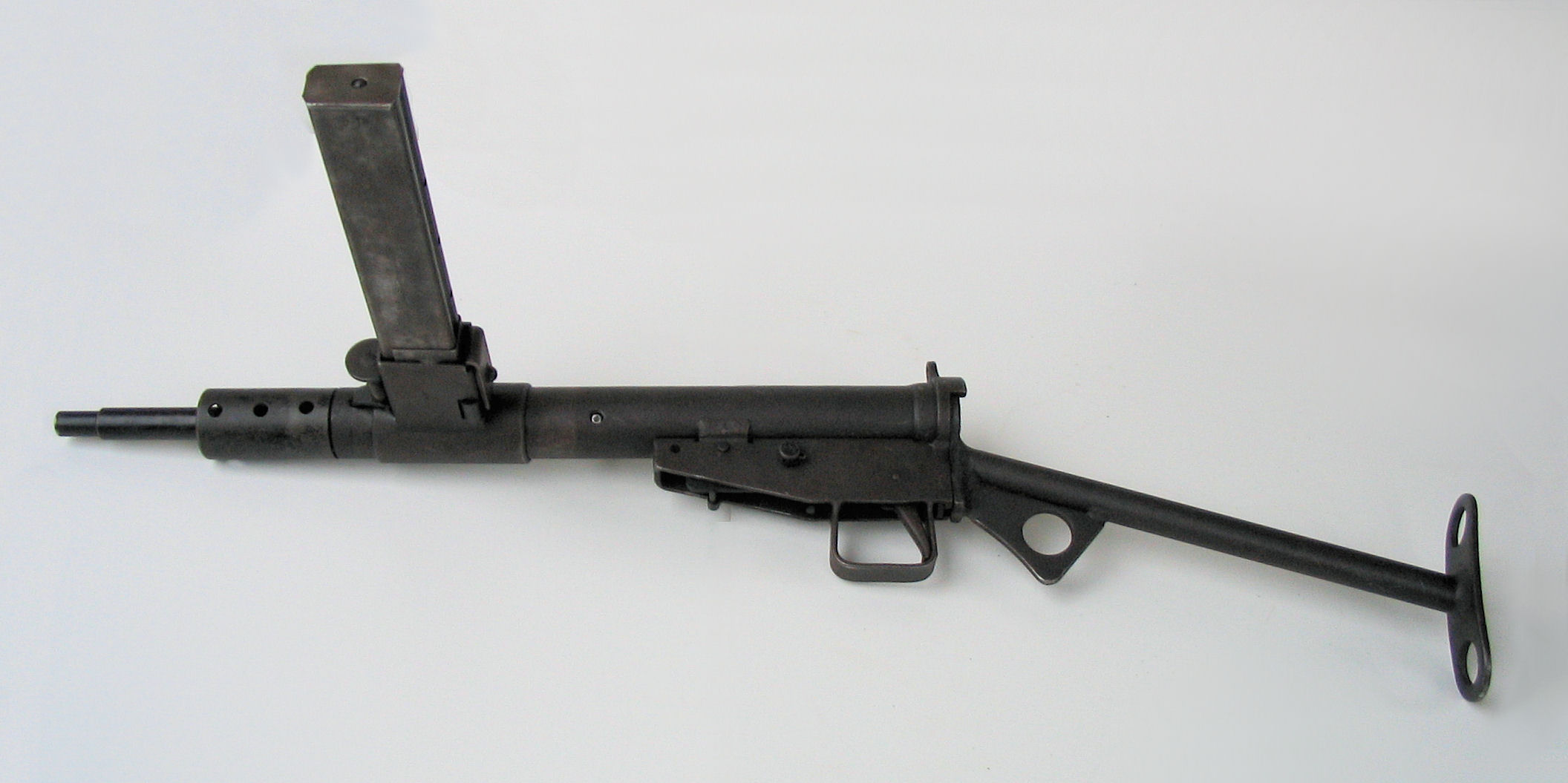
The STEN’s defining engineering features:
- a wrapped-and-welded sheet-steel receiver tube — approximately 38 mm (1.5″) outside diameter, formed from cold-rolled sheet, with a longitudinal seam weld and a series of machined cutouts (ejection port, cocking-handle slot, magazine well attachment) — not a bored seamless tube;
- a bottom-mounted trigger group housing — pistol grip + trigger + sear + magazine well — bolted (or in early Mk Is, riveted) to the underside of the receiver tube;
- a simple blowback action with a fixed firing pin — the firing pin is a nub of the bolt face itself, not a separate part; there is no firing-pin spring; on early Mk Is the bolt also serves as the safety by manual bolt-rotation;
- a 32-round curved side-feed magazine projecting horizontally from the left side of the gun, with the gunner’s left hand customarily grasping the magazine well housing (never the magazine itself — grasping the magazine causes the feed-lip pathology Vol 11 § 11.3 covers in detail);
- a simple barrel and barrel-retention scheme — the barrel is a short, low-pressure 9×19 pistol-class barrel held in the receiver by a barrel collar that threads or pins to the receiver tube;
- a 9×19 mm Parabellum chamber from the factory — no caliber-conversion gymnastics for the lab build (unlike the Mauser C96, which was historically 7.63×25 and must be re-engineered for 9×19);
- a stock that varies by Mk — Mk I has a wooden foregrip and a complex sliding rod, Mk II has either a skeleton T or a simple wire-loop, Mk III has the same wire-loop as the Mk II, Mk V has a proper wooden stock + foregrip, Mk VI has the Mk V stock plus an integral suppressor sleeve.
It is, mechanically, a 1941 design that has not been meaningfully improved in 85 years — the post-war Sterling Mk 4 / L2A3 (documented in ../E-11/ Vol 3) replaced it in British service in 1953 by being better-finished, not by being mechanically different in any important way. The Sterling is what the STEN should have been if Britain hadn’t been at war when it was designed; the STEN is what was actually possible in 1941.
1.2 The role of this series
This deep dive serves three audiences:
| Audience | What they take from this series |
|---|---|
| You, the lab fabricator | Vol 4 (engineering archive + drawings) + Vol 7 (the from-scratch step-by-step) + Vol 9 (materials & finishing) — the manual a builder follows in the shop. Per Jeff’s explicit request, Vol 7 is the centerpiece deliverable. |
| You, the parts-kit assembler | Vol 6 (parts-kit + US-made semi-auto receiver + 922(r) compliance) + Vol 8 (sub-assemblies — what each part does and how to verify it) + Vol 10 (the 922(r) arithmetic and the 1982 closed-bolt rule). The canonical US “buy a kit and build” SMG project. |
| You, the NFA collector | Vol 5 (buying a pre-86 registered transferable) + Vol 3 (variant catalog — what you’re actually getting) + Vol 10 (NFA Class III posture). For the builder who wants a real select-fire STEN. |
All three audiences benefit from Vol 2 (manufacturing history — why the gun is the way it is) and Vol 11 (live-fire operation — including the famous STEN magazine pathology that all three paths share).
1.3 The three build paths
| Path | What you get | Approx cost (2026 USD) | Skills needed | Legal envelope |
|---|---|---|---|---|
| A — NFA Class III pre-86 transferable | A real, originally-registered, full-auto STEN with ATF Form 4 transfer paperwork | $10,000-25,000 depending on variant + condition + completeness of paperwork | Form 4 process; verifying the registry status; basic gunsmith hand-tool competence | NFA Class III; state-of-residence may prohibit; tax stamp ($200) per transfer |
| B — Parts kit + US-made semi-auto receiver | A semi-auto-only STEN built up from a surplus parts kit on a new US-made tube receiver, 922(r) compliant | $500-1,500 (kit $200-500, receiver $150-300, US-made compliance parts $50-150, magazines + ammo + finishing $100-500) | Bench gunsmithing; light welding (sometimes); 922(r) parts-count discipline; FCG re-work for closed-bolt semi-auto (post-1982 requirement) | 922(r) (Vol 10 § 10.3); semi-auto-only-closed-bolt since 1982 (Vol 10 § 10.4); state SBR rules if barrel <16″ (most Stens have 7.75″ barrels — federal SBR by definition unless permanently extended) |
| C — From scratch in 9×19 | A semi-auto-only STEN built from raw materials in the lab, every part fabricated in-house except (likely) the rifled barrel blank | $300-800 (materials: sheet steel, 4140 bar, barrel blank, chamber reamer, finishing supplies, magazines) | Sheet-metal forming + welding (receiver tube); CNC mill or lathe + hand machining (trigger group, bolt); chamber reaming; barrel finishing; semi-auto-only-closed-bolt FCG design | Federal “manufacture for personal use” statute (legal in most states; some states require an 80%-receiver dealer to ship a serialized blank); 922(r) does not apply (it’s a US-made gun); SBR considerations same as Path B |
The decisive considerations, in priority order:
- Is full-auto required? If yes → Path A is the only legal route. If no → Path B or C.
- Is the lab worth using? If yes (Jeff’s case) → Path C is the most-interesting and the engineering brief was designed for shops like yours. If you don’t have a lab → Path B.
- Is parts-kit availability still good? As of 2026, Apex Gun Parts, Sarco, and a half-dozen smaller suppliers still stock STEN parts kits. This may change as the WWII surplus supply finally runs out. Path B has a clock; Path C does not.
- Are you in a 922(r) hostile state? Some states have layered state-law restrictions on top of federal 922(r). Verify before committing to Path B.
1.4 Decision tree — which path
        START — do you want a STEN?
                    │
        ┌───────────┴───────────┐
       YES                       NO  → close this document
        │
        ▼
    Do you want it to be FULL-AUTO (select-fire)?
        │
    ┌───┴───┐
   YES      NO
    │       │
    ▼       ▼
  PATH A   Do you want to BUILD it, or BUY it ready-to-shoot?
  ($10-25K) │
            ▼
        ┌───┴───┐
       BUILD    BUY
        │       │
        ▼       └── PATH A is the only "buy ready-to-shoot" path; back to Path A.
            Or — for a non-full-auto ready-built semi-auto Sten, a handful
            of small US makers (IO Inc., Wise Lite) periodically catalog
            them; check Vol 5 § 5.3.

        DO YOU HAVE A LAB?
        (CNC, lathe, mill, welder, 3D printer, gunsmith bench)
            │
        ┌───┴───┐
       YES      NO
        │       │
        ▼       ▼
      PATH C  PATH B
      ($300-  ($500-
       800)   1500)
The default answer for the no-full-auto, no-lab, US builder is Path B — and Path B is the iconic US “buy a kit and build” SMG project, with a deep community of builders and a well-trodden 922(r) compliance recipe. The default answer for Jeff — given the lab and the explicit “step by step guide of how we will make ours” request — is Path C.
1.5 Chambering: 9×19 Parabellum
Unlike the Mauser C96 (where 9×19 is a deliberate departure from the original 7.63×25), the STEN was designed in 9×19 Parabellum from the start. The factory chamber is 9×19 NATO-equivalent (the 1941 chamber dimensions are slightly tighter than modern SAAMI but a modern SAAMI-cut chamber drops into a 1941 design with no consequences); the bolt face is sized for the 9×19 rim diameter (9.96 mm); the magazine geometry is the 9×19 double-stack-single-feed pattern that the German MP 28 → Lanchester → STEN lineage all share. For Path B and Path C builds, “9×19” is the only chambering decision — there is no historical caveat to manage.
The exception is the silenced Mk VI (Vol 3 § 3.6) — Mk VI suppressors are tuned for subsonic 9×19 loads (typically 147 grain at 1,050 fps or 158 grain at 950 fps), not for full-power NATO ball at 1,150 fps. A modern Mk VI replica fired with NATO ball will work but the suppression is meaningfully degraded.
1.6 Lab capability — and what it shifts
Jeff’s lab (multiple CNC machines, multiple 3D printers, 100 W laser cutter, full gunsmithing toolset) is, frankly, massively over-capable for a STEN build. The 1941 design brief assumed shops with a lathe, a drill press, an arc welder, and a few hand files. Jeff has all of those at higher precision plus CNC mills, CNC routers, photoresist-quality laser engraving, and FFF + resin 3D printing for fixture prototyping. The build that took the WWII Polish Underground State workshop several weeks of skilled labor to copy in clandestine conditions is a weekend project for this lab.
This shifts the build-path default. For most builders, Path B (parts-kit) is the obvious answer. For Jeff, Path C (from scratch) is genuinely more interesting and not meaningfully more difficult. The receiver-tube wrap-and-weld is a CNC-router-and-bend-brake job for sheet stock; the trigger group housing is an afternoon on the CNC mill; the bolt is two setups on the lathe; the firing pin is a feature of the bolt face geometry, not a separate part; the magazine well is a piece of welded sheet; the stock is steel rod (Mk II) or hardwood (Mk V). The only conventionally-hard part is the rifled barrel, and a 9×19 .355” barrel blank from a vendor (E.R. Shaw, Green Mountain, Bear Creek) drops in fine.
Vol 7 is written assuming Jeff’s full lab is available. Capabilities the deep dive will ask Jeff to confirm before Vol 7 locks in part-by-part procedures: lathe swing/length (need 10″ between centers for a Mk II barrel + bolt), CNC mill tolerance capability in 4140 (±0.001″ is sufficient — these tolerances are forgiving compared to a Mauser C96 lockwork), and weld preparation for thin-wall mild-steel longitudinal seam.
1.7 Volume-by-volume index
| Vol | Title | Why you might read it |
|---|---|---|
| 1 | Overview & Decision Tree | (You are here.) |
| 2 | Manufacturing History — Design for Production | Why the STEN is the way it is. Shepherd + Turpin’s 1941 design brief; the wartime production thicket; the resistance / clandestine fabrication footnote. |
| 3 | Variant Catalog — Mk I through Mk VI | Which STEN is which: Mk I machined → Mk II iconic crude → Mk III simplest → Mk IV paratrooper experimental → Mk V respectable → Mk VI suppressed. |
| 4 | Engineering & Reference Data | The load-bearing engineering volume: UK MoS drawings, US TM reproductions, community-reverse-engineered dim sheets, receiver geometry, bolt + firing pin, magazine, barrel + chamber. |
| 5 | Build Path A — NFA Class III Original | Market reality, Form 4 mechanics, what a matching-numbers STEN looks like. |
| 6 | Build Path B — Parts Kit + US Semi-Auto Receiver | The iconic US “buy a kit and build” project, with full 922(r) parts-count compliance. |
| 7 | Build Path C — From Scratch in 9×19 (Step-by-Step) | The centerpiece — Jeff’s lab manual. Op sequence per part. |
| 8 | Sub-Assemblies & Components | Per-part deep detail. |
| 9 | Materials & Finishing | Period-correct steels, parkerizing, oil-blacking, suncorite paint. |
| 10 | Legal & Regulatory Posture | NFA Class III, 922(r), 1982 closed-bolt rule, state SBR + imitation-firearm. |
| 11 | Live-Fire Operation & Use | Range procedure, magazine pathology, cleaning. |
| 12 | Cheatsheet | Laminate-ready synthesis. |
1.8 Reading order
A reader new to the STEN should read in numbered order — the volumes build on each other (the engineering archive in Vol 4 feeds Vols 6 + 7 + 8; the legal-posture Vol 10 references all three build paths).
A reader who already knows the STEN platform and just wants to build:
- For Path B (parts kit): skim Vols 1, 2, 3; read Vol 4 → 6 → 8 → 10 → 11 in order.
- For Path C (from scratch): skim Vols 1, 2, 3; read Vol 4 → 7 → 8 → 9 → 10 → 11 in order. Vol 7 is the manual.
- For Path A (NFA Class III): skim Vols 1, 2; read Vol 3 → 5 → 10 → 11 in order.
The Vol 12 cheatsheet is for the builder who is already in the shop or at the range and needs a quick reference; it consolidates the dim sheet, legal pivots, vendor list, and bibliography in one laminate-ready document.
1.9 What this series is not
- Not a Sterling reference. The Sterling Mk 4 / L2A3 (the post-war replacement and the E-11 prop donor) is covered in
../E-11/Vol 3. The Sterling is mechanically similar but materially refined; the relationship between the two is well-documented in Vol 2 § 2.7 and../_shared/comparison.md. - Not a Lanchester reference. The Lanchester (licensed-copy MP 28) is what the STEN was designed to replace; it is mentioned in passing in Vol 2 § 2.1 but is not the subject of the deep dive.
- Not a prop / Star Wars reference. Unlike
../E-11/(Sterling-as-prop), the STEN was never used as a major Star Wars prop. It does appear in many WWII war films and the Indiana Jones movies; that is a side note, not the focus. - Not a clandestine-fabrication manual disguised as a hobby project. The from-scratch path (Vol 7) is documented openly because it is documented openly everywhere — the engineering archive is public, the resistance literature is decades deep, and Professor Parabellum’s Practical Scrap Metal Small Arms Vol III: The DIY STEN Gun is a freely-available modern garage-fabrication treatment. Vol 10 explicitly addresses the federal “manufacture for personal use” posture under which Path C is lawful; Vol 7 is not a circumvention guide.
1.10 Sourcing & copyright note
The engineering archive Vol 4 draws on has unusual provenance: the bulk of the original drawings are UK Ministry of Supply material from 1941-1953, and UK Crown Copyright on WWII material has lapsed (Crown Copyright duration is 50 years from publication for unpublished material, lifetime + 50 for published — the relevant 1941-1944 drawings are out of copyright as of 1995 onward). The US Technical Manual reproductions (US Army captured-weapons documentation) are US federal-government work product, public domain by statute. The modern community work (Apex Gun Parts technical sheets, Bear Arms drawings, Professor Parabellum’s Practical Scrap Metal Small Arms Vol III: The DIY STEN Gun) is variously copyrighted; Vol 4 cites these by reference rather than reproducing their content directly.
Photos in this deep dive are sourced from Wikimedia Commons via the project Photo Helper, with creditLine attribution verbatim in each figure caption per the hub-wide _shared/deep_dive_protocol.md § 8 photo workflow. Commons coverage of the STEN is excellent — the gun is one of the most-photographed WWII small arms.
1.11 References (Vol 1)
- Skennerton, Ian. The Sten Machine Carbine. (The standard collector reference for the STEN family — variants, markings, dating, dimensions.)
- Hogg, Ian V. Submachine Guns: An Illustrated History. (General reference; STEN treated as the WWII Allied SMG.)
- Hogg, Ian V., and John Weeks. Military Small Arms of the 20th Century. (General reference; includes dim sheets.)
- Bishop, Chris. The Encyclopedia of Weapons of World War II. (Production-cost facts, factory thicket.)
- Professor Parabellum. Practical Scrap Metal Small Arms, Volume III: The DIY STEN Gun. (Wikimedia Commons, CC BY 1.0; the dedicated STEN modern garage-fabrication reverse-engineered drawing set + op-sequence treatment.)
- Wikimedia Commons. Sten gun category —
https://commons.wikimedia.org/wiki/Category:Sten— the canonical photo source for license-clean STEN imagery. - US War Department. TM 9-1985-3 and successors. Captured Weapons (German, Japanese, Italian, Allied non-US) — Submachine Guns. (US Army technical-manual reproductions of captured/borrowed STENs; public domain.)
- UK Ministry of Supply. Drawing list for Carbine, Machine, 9 mm STEN Mk II (and Mk I, III, V, VI). Imperial War Museum and National Archives Kew. (Crown Copyright lapsed.)
- Bear Arms. STEN engineering drawings and 922(r) compliance sheet. (Modern community reference; cited in Vols 4 + 6.)
- Apex Gun Parts. STEN parts kits and 922(r) parts-count sheet. (The canonical US parts-kit supplier; cited in Vol 6.)
- The Polish Institute of National Remembrance. Błyskawica submachine gun — Warsaw Uprising 1944. (Polish Underground State clandestine STEN copy; cited in Vol 2 § 2.6.)