STEN Gun · Volume 2
Manufacturing History — Design for Production
Why the STEN exists, how it was made, and what it cost
Contents
(Generated by build/inject_toc.py at build time. Section headers below are the source of truth.)
The STEN is, in industrial history, one of the cleanest documented examples of engineering driven explicitly by a manufacturing constraint rather than by a performance target. The British Army did not commission Shepherd and Turpin to design “a better submachine gun” in 1941; they commissioned them to design the cheapest, fastest-to-manufacture 9 mm submachine gun an Allied industrial base under air-raid pressure could actually produce, in volume, with the machine tools and skilled labor that existed. The result is a gun that the Encyclopædia Britannica described in 1947 as “perhaps the ugliest weapon ever issued in quantity to a regular army,” and that Britain, Canada, Australia, the Polish Underground State, the Danish and Norwegian resistance, the Free French, and Mao Zedong’s Eighth Route Army all gladly used. Performance was unhurried; production was the brief. This volume is the production story.
2.1 The 1940 problem — the Lanchester is too expensive
To understand the STEN’s design choices it helps to first understand the gun the STEN replaced. The Lanchester Mk 1 was a licensed near-clone of the German MP 28 (which the British had captured intact at Narvik in 1940), designed by George Lanchester at the Sterling Engineering Company in Dagenham and adopted by the Royal Navy in late 1940. It was — like the MP 28 — a beautifully-made gun, with a machined steel receiver, polished mahogany stock and forend, brass magazine well, Lee-Enfield rear sight, and a bayonet lug. It cost approximately £14 per unit to manufacture in 1941 (about £700 in 2026 GBP), required roughly forty machine-tool hours of skilled labor per gun, and used material grades and finishes inherited from peacetime small-arms manufacturing.
It was, by mid-1941, the wrong gun for the wrong war. The British Army needed submachine guns by the hundred thousand — for the Home Guard against an anticipated invasion, for the British Expeditionary Force’s remnants regrouping after Dunkirk, for the still-forming Special Operations Executive (SOE) clandestine-warfare teams, and for the airdrop supply of European resistance groups. The Lanchester production rate was an order of magnitude too slow and the per-unit cost was an order of magnitude too expensive. The interim solution was to import the Thompson M1928A1 from Auto-Ordnance in the United States under Lend-Lease — a gun the British Army respected mechanically but which cost $200 per unit in 1941 USD ($4,500 in 2026 USD) and which the US could not deliver in the volumes Britain needed. Britain needed a British answer, made by British industry, at a fraction of the Lanchester’s cost.
2.2 The Shepherd + Turpin design brief
The design brief is unusually well-documented because Shepherd and Turpin both wrote about it after the war and the relevant RSAF Enfield internal correspondence is now at the National Archives Kew (WO 185 series). The brief, in operational summary form:
- 9×19 mm Parabellum — chambering must match the captured German pistol ammunition Britain was capturing in volume on every front, and the Lanchester chambering (Britain would have a single SMG ammunition logistics chain).
- Open-bolt blowback — the simplest mechanical action that delivers acceptable cyclic rate and durability with the worst-case ammunition (resistance-airdropped 9×19 of mixed provenance and questionable storage).
- Sheet-metal or tubular receiver — not machined-from-solid. The receiver must be makeable with sheet-metal forming + welding, in shops that did not have small-arms machining heritage.
- No specialized parts — every part should be makeable on a lathe, a drill press, a basic shaper, and an arc welder. No specialized cutters, no specialized fixtures, no specialized inspection gauges.
- No special-grade steels — mild steel where possible; medium-carbon (4140-class equivalent) only for the bolt and chamber-area parts. No tool steel, no stainless, no specialty alloys.
- No part should cost more than 2 shillings (£0.10) to manufacture as a standalone unit.
- Total per-gun cost target: £2 10s (£2.50) at the factory gate.
- Total per-gun labor target: 10 man-hours at the factory.
- The gun should be assemblable by an unskilled operator in a fitting jig with go/no-go gauges only — no skilled hand-fitting between assemblies.
Items 6 and 7 are the load-bearing ones. The Lanchester at £14 was budgetarily impossible to scale; the Thompson at £45-equivalent was logistically impossible to import in volume. The STEN at £2 10s was both possible and producible at the rate of millions per year. Shepherd and Turpin met the target — peak factory cost was approximately £2 9d to £2 11d depending on Mark and factory (sources: Skennerton, Hogg, the Long Branch and ROF Fazakerley archives), with peak labor at approximately 9-10 man-hours per gun. The brief was met within the first two pre-production prototypes.
2.3 The design choices that fell out
Every visible STEN design choice traces directly to one of the nine brief items:
| Visible feature | Brief item driving it | Mechanical consequence |
|---|---|---|
| Wrapped-and-welded sheet-steel receiver tube | (3) sheet-metal receiver, (4) no specialized parts | Tube made on a sheet-roller + arc-welder; no boring operation; no rifling fixture needed for a smooth-bore receiver |
| Bottom-mounted trigger group housing | (4) no specialized parts | Trigger group is a separate sub-assembly on its own fixture, attached to the receiver with two bolts |
| Fixed firing pin (nub on bolt face) | (4) + (5) no specialized parts, no specialty steel | Bolt is a single lathe-turned part; no firing-pin spring, no retainer, no separate firing-pin |
| Left-side horizontal magazine | (4) + (9) no specialized parts, unskilled assembly | The Lanchester pattern Britain already had production geometry for; left-side feed allows the gun to be carried prone with the magazine clear of the ground |
| Skeleton wire stock (Mk II) | (4) + (5) | Stock is two pieces of welded steel rod; no machined attachment, no wood, no fitting |
| Simple barrel collar | (4) | Barrel is a short low-pressure pistol-class tube held by a threaded or pinned collar; no recoil-spring-housing complexity |
| Tool-marked / unpolished surfaces | (7) £2 10s cost target | Surface finishing operations were removed from the production sequence; the gun was issued with milling marks visible |
Crucially, the brief did not ask for safety. The Mk I and Mk II have notoriously crude safety mechanisms (a slot in the receiver that holds the cocking handle rearward; the cocking handle catches the bolt to keep it from running forward when dropped). The Mk II’s safety problem — that an unanticipated jar could release the bolt and cause an out-of-battery discharge — was the most-documented mechanical complaint about the STEN in service and was the principal reason for the Mk V’s redesigned safety. The brief was driven by manufacturability, full stop; usability concerns were addressed only when they impacted training-and-issue rates (Mk V) or when the original safety actually killed users (the post-1944 Mk II safety-bracket retrofit).
2.4 The production thicket — who made the STEN
By 1942 the STEN was being produced in parallel at roughly a dozen primary factories and a deeply distributed network of subcontracted parts shops:
| Factory | Country | Mks produced | Approx output |
|---|---|---|---|
| Royal Small Arms Factory Enfield | UK (London) | Mk I, Mk II, Mk V design | The original; relatively low volume (Enfield was the design shop, not the mass-production shop) |
| Birmingham Small Arms Co. (BSA) | UK (Birmingham) | Mk II, Mk V | Major Mk II / Mk V producer |
| Royal Ordnance Factory Fazakerley | UK (Liverpool) | Mk II, Mk V | The largest UK STEN producer by volume; ~1.5M Mk IIs estimated |
| Royal Ordnance Factory Theale | UK (Berkshire) | Mk II | Mid-volume Mk II producer |
| Lines Brothers Ltd. (Tri-ang Toys) | UK (Tunbridge) | Mk III | The Mk III was designed for Lines Brothers — they were the toymaker that needed the simplest sheet-metal-only version |
| Canadian Arsenals Limited, Long Branch | Canada (Toronto) | Mk II, Mk III | ~133,000 Mk II + 50,000 Mk III, supplying Canadian, British, and Soviet Lend-Lease orders |
| Lithgow Small Arms Factory | Australia | Mk II (Australian variant — minor differences in the cocking handle and the magazine well) | ~17,500 units |
| A.B. Carl Gustaf Stads Gevärsfaktori | Sweden (licensed post-war) | Swedish K (mechanically distinct but lineage-related) | Different gun, included here for cross-reference |
| Polish Underground State workshops | Poland (clandestine) | Błyskawica (Polish-modified copy, manufactured in basement shops in occupied Warsaw 1942-44) | Estimated ~700 units total |
The supply chain underneath the named factories was much broader. Parts subcontracting — the production model that the brief’s item (4) “no specialized parts” was designed to enable — meant that approximately 500 small UK shops (bicycle workshops, hardware factories, machine-tool businesses repurposed from civilian work) supplied individual STEN parts to the named factories. The largest single-factory output was at ROF Fazakerley, but the production system was deliberately decentralized: any one factory could be bombed without halting STEN production overall. The Coventry Blitz (November 1940) had targeted Birmingham; the dispersed-subcontracting STEN production model was a direct response to that bombing.
Total combined production across all factories and all Marks, 1941-1953, is estimated by Skennerton at ~4 million units, with some sources running as high as 4.5 million (the Long Branch and Lithgow output records are well-attested, but the small-subcontractor accounting was deliberately loose for wartime-security reasons and exact totals are not recoverable). For comparison, total Lanchester production was ~80,000 units. Total US Thompson M1928A1 + M1 + M1A1 production for WWII was approximately 1.7 million units. The STEN was the most-produced submachine gun of WWII by a factor of two.
2.5 The Mk II as the production benchmark
The Mk II (the iconic war-fighter) is the production-cost and production-rate benchmark. The peak production data, drawn from the ROF Fazakerley records (the largest STEN producer):
- Per-unit factory cost (1943-44): £2 9s 3d (approximately £2.46), against the brief target of £2 10s. Hit.
- Per-unit labor (1943-44): 8 man-hours of direct labor + ~2 man-hours of indirect overhead = 10 total man-hours per gun. Hit.
- Factory output peak (1943): ROF Fazakerley alone produced approximately 47,000 Mk IIs per week in mid-1943 — a rate of one Mk II every 12 seconds of factory operation.
- Reject rate: approximately 2-3% at the proof-house (functional test fire). The famously crude STEN safety was not a proof-house reject — only outright function failures (failed to fire, failed to extract, failed to feed) caught a reject.
- Direct material cost: approximately £0.42 per gun in 1943 — the STEN was about 17% direct material, 83% labor + overhead. This is the inverse of a precision firearm like the Mauser C96 (~80% material + machining time, 20% labor + overhead).
The reason the cost was hit was that the brief’s manufacturability requirements were respected absolutely. When the Mk III appeared (Lines Brothers, even cheaper than the Mk II — receiver welded from a single piece of stamped sheet rather than rolled-and-welded tube) the per-unit cost dropped further to approximately £2 5s. The brief was not just met; it was beaten.
2.6 The clandestine and resistance story
The STEN’s manufacturability brief had a consequence its designers did not initially intend: the gun was reproducible in shops the British Army did not control. Britain airdropped tens of thousands of STENs (Mk II primarily, with some Mk III and post-1944 Mk V) to European resistance groups via the Special Operations Executive (SOE). The resistance receiver was so often a STEN that the gun became iconic in resistance imagery — the silhouette in the right hand of every photograph of a French Maquis fighter or a Polish Home Army (Armia Krajowa) soldier or a Norwegian Hjemmestyrkene cell.
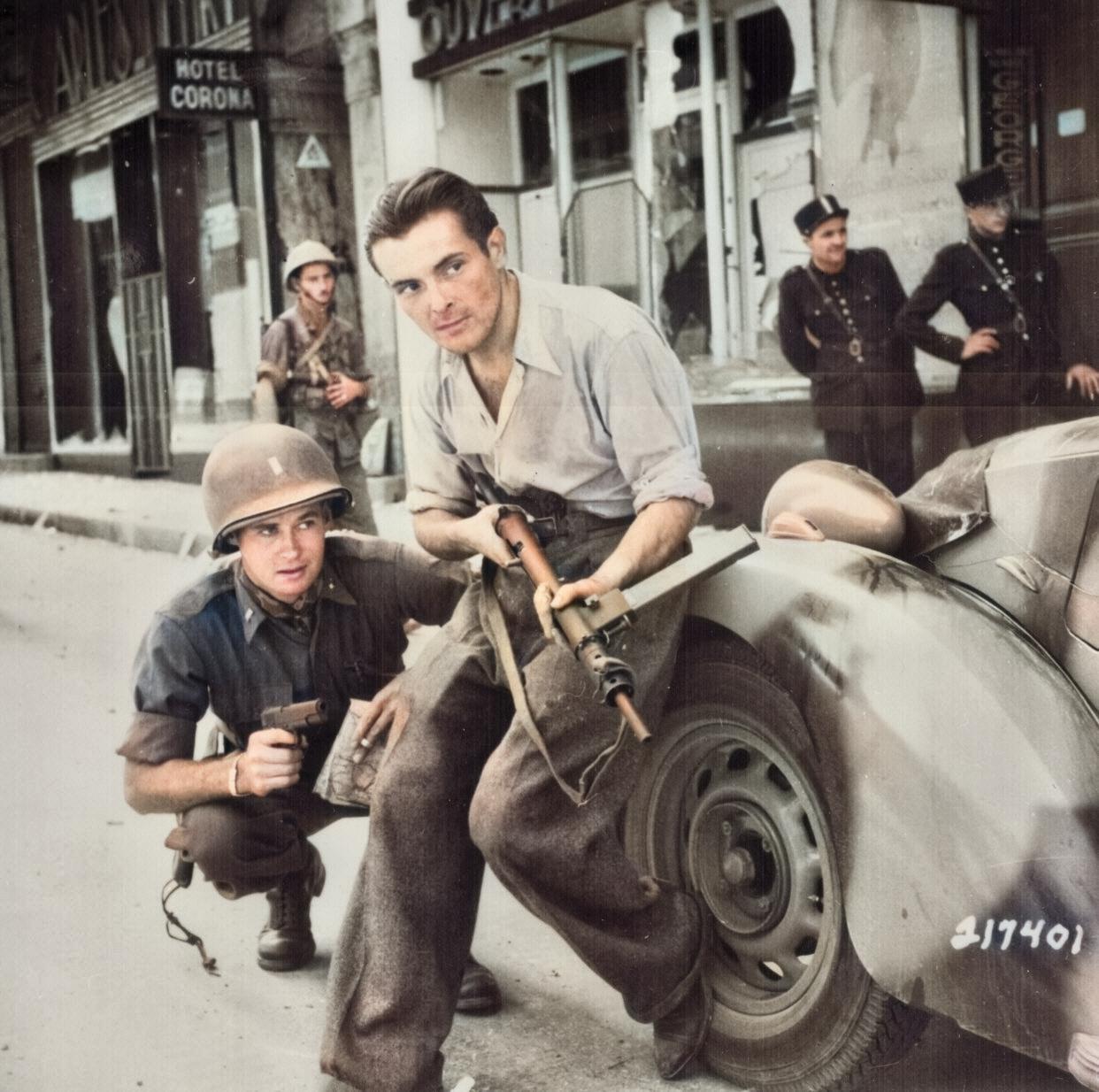
What the British did not initially anticipate was that the STEN’s brief-driven simplicity would let resistance workshops reproduce the gun in occupied territory. The most-documented case is the Błyskawica (“Lightning”) — a Polish Underground State copy of the STEN designed in clandestine conditions by engineers including Wacław Zawrotny and Seweryn Wielanier in 1942-43. The Błyskawica was manufactured in concealed basement workshops in occupied Warsaw and used in volume during the Warsaw Uprising of August-October 1944. Approximately 700 units were produced; surviving examples are in the Polish Institute of National Remembrance, the Warsaw Rising Museum, and a handful of private collections. The Błyskawica was mechanically identical to the Mk II in operating principle but used a top-mounted magazine (rotated 90° from the Mk II’s left-side feed, a deliberate visual choice to reduce confusion with airdropped Mk IIs) and Polish-sourced steel.
A similar story plays out across occupied Europe. Danish resistance workshops copied and repaired STENs through 1942-1945; Norwegian Hjemmestyrkene cells maintained airdropped Mk IIs in basement shops in Bergen, Oslo, and Trondheim; the French FTP and FFI maintained STENs at a regional-workshop level. After the war, the captured German MP 40 ammunition stockpiles in occupied territory and the airdropped STEN supply effectively meant that any resistance fighter who could get to a STEN could also keep one running.
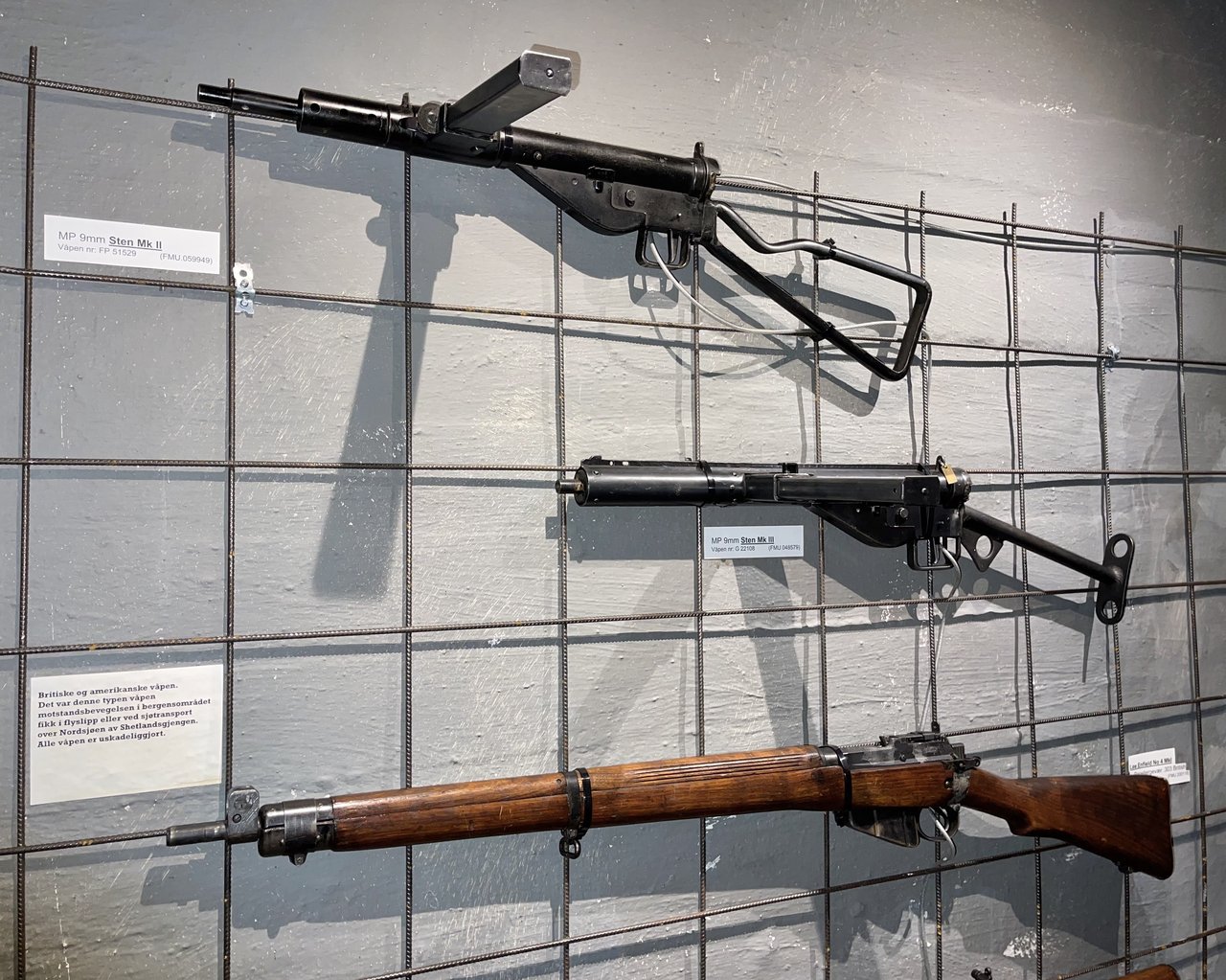
The resistance-fabrication story is not just historical curiosity: it is directly relevant to the modern Path C from-scratch build. The STEN was deliberately designed to be makeable in shops Jeff’s lab is far more capable than. The clandestine fabrication literature is a real engineering archive (most of it in Polish, Norwegian, Danish, and French rather than English — but the surviving Błyskawica drawings, the Polish Resistance fabrication notes, and the Norwegian basement-shop maintenance manuals are now in museum archives and available to researchers). Modern garage-fabrication treatments — most prominently Professor Parabellum’s Practical Scrap Metal Small Arms Vol III — explicitly cite this lineage. Vol 7 of this deep dive is the modern equivalent of the SOE-airdrop-supply field manual for a builder who has Jeff’s tools instead of the WWII Polish Underground State’s clandestine workshop.
2.7 The post-war story — Sterling replaces STEN
The STEN was always understood by the British Army as an interim wartime solution, and after the war ended a more-refined replacement program produced the Sterling Mk 4 / L2A3 (1953 adoption), which was the same Patchett-design lineage Shepherd and Turpin had also worked on. The Sterling is, mechanically, the STEN done right — same blowback principle, same 9×19 chambering, same left-side magazine, but with:
- a finished and parkerized receiver (no more visible tool marks);
- a machined trigger group housing (no more crude castings);
- a more-reliable safety (no more drop-fire concerns);
- a folding wire stock (replacing the simpler Mk II skeleton T);
- the helical cooling-hole pattern in the receiver that became the Sterling’s visual signature.
The Sterling replaced the STEN in British service starting in 1953 and the last STENs were withdrawn from front-line UK service by 1960; police, Commonwealth, and reserve units kept them in inventory for longer (some into the 1990s in marginal use). The full Sterling treatment is in ../E-11/ Vol 3, where the Sterling is the donor platform for the E-11 Stormtrooper prop.
The relationship between STEN and Sterling matters for the modern builder for one important reason: STEN-pattern and Sterling-pattern magazines are very similar but not perfectly interchangeable. A Sterling magazine will sometimes feed in a STEN (the lip geometry is close enough), and the modern aftermarket Sterling-pattern magazines from Bear Arms and others are significantly better-made than any WWII STEN magazine. The WWII STEN magazine’s feed-lip pathology (Vol 11 § 11.3) is the single most-documented STEN reliability problem; modern Sterling-pattern magazines are the canonical fix.
2.8 What this volume means for the modern build
The 1941 brief — explicitly — assumed shops with light machinery, no specialized cutters, no specialty steels, no skilled fitting. Every shop in the wartime production system was less capable than Jeff’s lab. Lines Brothers Ltd. (the Tri-ang toymaker that produced the Mk III) had a sheet-metal press, a few drill presses, and arc welders — and they produced approximately 35,000 Mk IIIs in 1942-43. The Polish Underground State workshops had hand tools, a few lathes scavenged from civilian shops, and concealment from the German occupation; they produced approximately 700 Błyskawicas under those conditions.
This is the build in the hub where Path C is the easiest path, not the hardest. Vol 6 (Build Path B — parts kit) is legitimately harder than Vol 7 (Path C — from scratch) for Jeff specifically, because Path B requires careful 922(r) parts-count compliance and the closed-bolt-only semi-auto FCG re-work, while Path C lets Jeff fabricate a closed-bolt FCG directly without ever touching a WWII open-bolt design. Path C is the engineering brief Shepherd and Turpin wrote in 1941 literally executed by a 2026 hobbyist lab. That is the story Vol 7 tells.
2.10 References (Vol 2)
- Skennerton, Ian. The Sten Machine Carbine. (Production thicket, factory output, peak rates.)
- Bishop, Chris. The Encyclopedia of Weapons of World War II. (Production-cost facts, factory thicket.)
- The National Archives Kew. WO 185 series — RSAF Enfield internal correspondence on STEN design and production, 1940-1945. (UK Crown Copyright lapsed.)
- The Imperial War Museum Duxford. STEN production records. (Long Branch and Lithgow Lend-Lease output records.)
- Sztab Generalny Wojska Polskiego, Polish Institute of National Remembrance. Błyskawica — submachine gun of the Warsaw Uprising 1944. (Polish-language; the canonical Błyskawica reference.)
- Warsaw Rising Museum. Permanent exhibition catalog — 1944 Uprising small arms. (Surviving Błyskawica + airdropped STEN specimens.)
- Hogg, Ian V. Submachine Guns: An Illustrated History. (Production lineage, post-war Sterling-replaces-STEN context.)
- Professor Parabellum. Practical Scrap Metal Small Arms, Volume III: The DIY STEN Gun. (Wikimedia Commons, CC BY 1.0 PDF; the dedicated STEN modern garage-fabrication treatment that explicitly cites the Polish-Resistance / Norwegian / Danish clandestine fabrication lineage.)
- US War Department, Military Intelligence Division. Special Series No. 14 — Captured and Enemy Submachine Guns (1943). (US contemporary technical-intelligence assessment of the STEN; public domain.)