STEN Gun · Volume 3
Variant Catalog — Mk I through Mk VI
The full STEN family, with the Mk II as the canonical war-fighter
Contents
(Generated by build/inject_toc.py at build time. Section headers below are the source of truth.)
The STEN family is a six-Mark progression with a single-decision-tree story: the Mk I was the proof-of-concept (1941 — still too refined to hit the cost target); the Mk II was the war-fighter that the Mk I was simplified into; the Mk III was the even-cheaper-than-the-Mk-II that Lines Brothers Ltd. designed for their toy-factory production line; the Mk IV was a paratrooper experimental that never reached volume production; the Mk V was the respectable end-of-war Mk II with wooden furniture and Lee-Enfield sights; and the Mk VI was the suppressed Mk V for clandestine use. Every Mark is the same gun mechanically — same 9×19 blowback action, same bolt geometry, same magazine — and the differences are surface details that come from the cost-vs-finish tradeoff the brief implicitly carries.
For modern builders, the Mk II is the canonical build target because it is the most-produced variant (~3.7M of ~4.5M total STENs were Mk IIs), the most-photographed, the best-documented in the engineering archive, the most-available as a parts kit, and the cleanest engineering match to a lab build. The Mk V is the natural secondary target if Jeff later wants a “respectable” STEN with wood furniture and the Lee-Enfield No 4 sight picture. The other Marks are reference-only for the modern build — Path A (NFA Class III pre-86) collectors may want any of them, but Paths B and C effectively converge on the Mk II.
3.1 The Mk I (1941) — proof of concept
The STEN Mk I is the first production STEN, manufactured at RSAF Enfield starting in March 1941 and produced through approximately mid-1942. Approximately 100,000 Mk Is were built, mostly at Enfield with subcontract supplements from BSA. Mechanically, the Mk I is mature — the bolt, firing pin, magazine, and operating principle are all what every subsequent Mark would also use. Cosmetically the Mk I was still too refined to hit the brief’s cost target: it carried a wooden foregrip (under the barrel collar), a wooden cheek piece on the buttstock, a flash hider screwed to the muzzle (a small cone-shaped one, not the perforated barrel sleeve common on other SMGs), and a conical front-sight protector. The Mk I receiver tube is approximately the same geometry as the Mk II’s, but the trigger group housing is more elaborately machined with finer details and a slightly more refined fit-and-finish.
The Mk I was the gun Britain put into service in volume while the design was still being optimized for cost. After about 100,000 units the wartime production-cost imperative caught up: the wooden parts were eliminated, the flash hider was eliminated, the conical front-sight protector was eliminated, and the trigger group housing was reworked to drop hand-finishing operations. The result was the Mk I* (Mk I star — an interim variant produced briefly in mid-1942) and then the Mk II (the mature simplified version).
A Mk I in modern collector hands is uncommon (~100,000 produced, most either lost to the war or melted down in Crown disposal post-1953); a US-market Mk I as Path A (NFA Class III pre-86) might command 50%+ premium over a comparable Mk II.
3.2 The Mk II (1941-1945) — the war-fighter
The STEN Mk II is the STEN. Approximately 3.7 million Mk IIs were built between mid-1942 and end of war, across the full production thicket (Enfield, BSA, Fazakerley, Theale, Long Branch, Lithgow, and the broader subcontract network). The Mk II is the simplified Mk I with every cost-optional feature removed: no wooden foregrip, no wooden cheekpiece, no flash hider, no conical front-sight protector. The Mk II is the brief item (7) cost target executed in steel.
The defining Mk II features:
- Skeleton T-shaped wire stock (the most-common Mk II configuration) — two pieces of welded steel rod forming an inverted-T against the shoulder. Some Mk IIs (especially late-war and Long Branch) used a simple wire-loop stock instead — same function, different visual. Both are detachable.
- Bare receiver tube — no flash hider, no muzzle cone, just the barrel collar holding a 7.75″ (197 mm) 9×19 barrel.
- Stamped or cast trigger group housing — the cheapest production was a stamped sheet housing welded together; mid-war and late-war production used cast aluminum housings (Long Branch used cast aluminum from the start).
- Left-side horizontal magazine well — the iconic STEN silhouette. The magazine well is welded or pinned to the receiver tube.
- Cocking handle on the right side of the receiver — a knob extending from a slot in the receiver tube.
- Simple flip-up rear sight with a fixed front blade — no adjustments, no graduations, just a 100-yard battle sight.
- Pin-and-detent safety — the cocking handle can be rotated and seated into a slot in the receiver to hold the bolt rearward; this is the only Mk II safety feature, and it is famously inadequate (Vol 11 § 11.5).
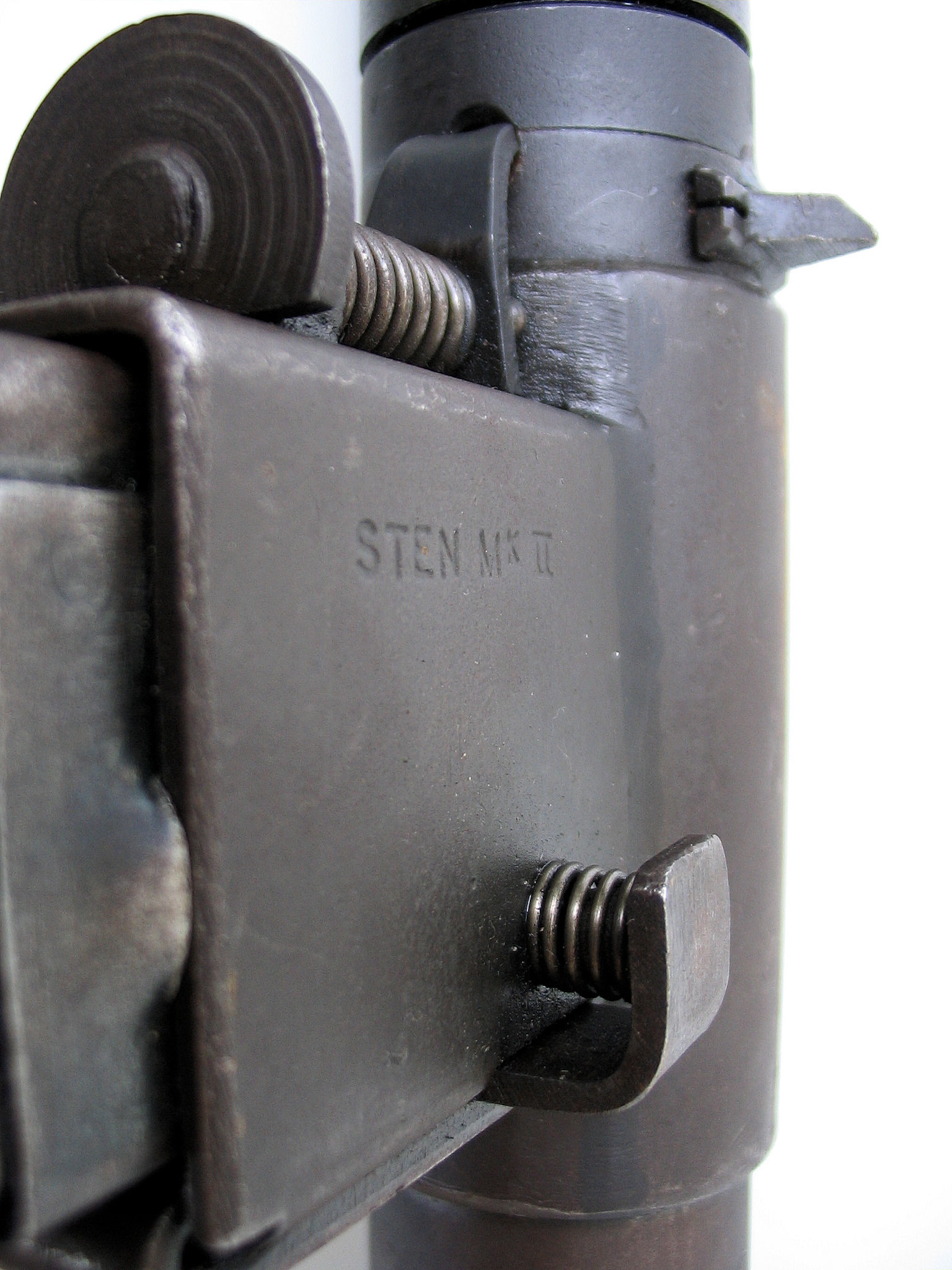
The Mk II is what every modern parts kit consists of (Apex, Sarco, IO — virtually 100% of US-market kits are Mk IIs), what every Path A NFA Class III transferable on the modern US market is likely to be (the surviving registered transferables are mostly Mk IIs because the Mk II was the volume gun), and what Path C lab fabrication should target by default. If you say “STEN” without a qualifier, you mean the Mk II.
There is a sub-variant worth knowing: the Mk II(S) (the “S” for Silenced) — a Mk II receiver with an integral suppressor sleeve replacing the standard barrel. The Mk II(S) was produced in small numbers (~5,000) specifically for SOE clandestine operations. It is mechanically distinct enough that some references treat it as a separate Mark; this deep dive treats it as a Mk II sub-variant. The Mk VI (Vol 3 § 3.6) is the equivalent suppressed sleeve on a Mk V receiver; the Mk II(S) is the equivalent on a Mk II.
3.3 The Mk III (1942-1944) — the Lines Brothers simplification
The STEN Mk III is the cost-reduction-of-the-cost-reduction. Lines Brothers Ltd. (the Tunbridge Wells toymaker who in peacetime made Tri-ang model trains and pedal cars) was contracted to produce STENs starting in mid-1942. Lines Brothers did not have the welded-tube-receiver tooling that the established small-arms factories (Enfield, BSA, Fazakerley) had built up; what they had was sheet-metal-stamping tooling, the kind they used to produce toy car bodies. So Lines Brothers’s chief engineer W.W. Marshall redesigned the STEN receiver to be a single-piece stamped sheet rather than a rolled-and-welded tube.
The Mk III receiver is a single sheet of stamped steel folded into a rectangular cross-section and welded along its bottom seam (rather than along the side, as on a rolled-tube Mk II). The magazine well is integral to the receiver stamping (not welded on as a separate sub-assembly). The result is a STEN that is mechanically identical to the Mk II — same bolt, same chamber, same magazine, same FCG — but with a receiver that is cheaper still: approximately £2 5s per unit at peak Lines Brothers production, vs the Mk II’s £2 9d at peak Fazakerley production.
Approximately 170,000 Mk IIIs were produced (Lines Brothers + a small Long Branch run + a tiny Enfield run). The Mk III is mechanically as good as the Mk II for the user; the stamped-sheet receiver is slightly more prone to flexing under sustained-fire heat soak than a rolled tube, but for the small-arms-of-WWII use case this was not a meaningful operational concern. From a modern-builder perspective, the Mk III is the cheapest variant to source as a parts kit (Apex periodically catalogs Mk III kits at $50-100 below Mk II prices) but the receiver is harder to fabricate in a hobbyist lab than a Mk II tube (single-piece stamped sheet requires sheet-metal stamping tooling Jeff does not have — a Mk II rolled-and-welded tube is more tractable for a CNC-and-bend-brake-and-welder lab).
3.4 The Mk IV (1944) — the paratrooper experimental
The STEN Mk IV is an experimental paratrooper variant developed in early 1944 to address the operational complaint that a Mk II was too long to comfortably carry on a parachute jump. The Mk IV had a shorter barrel (~4″), a folding stock that pivoted to the side, and a forward pistol-grip-style forearm to make it more like a pistol-with-a-shoulder-thing than a true SMG. Approximately 2,000 Mk IVs were built as a small initial run; the variant was never adopted in volume because the Mk V’s wood-stock-and-foregrip configuration was preferred by airborne forces in operational testing.
The Mk IV is the rarest production STEN and a Mk IV Path A acquisition would be a substantial collector premium (~3-5× a comparable Mk II). It is not a practical target for modern build paths — neither parts kits nor reproduction drawings circulate in the modern community in any volume. Reference-only for this deep dive.
3.5 The Mk V (1944-1953) — the respectable STEN
The STEN Mk V is what the STEN became when Britain had time to think about user experience rather than just manufacturability. Adopted in late 1944 and produced through the post-war era to 1953, the Mk V is the same Mk II mechanism with significantly improved furniture:
- Wooden buttstock (full-length, not a skeleton T-frame) — provides a much better cheek weld for aimed fire.
- Wooden foregrip under the barrel — allows the support hand to grasp the gun without touching the magazine well (eliminating the Mk II’s grasp-the-magazine feed-lip pathology).
- Lee-Enfield No 4 Mk I rear sight — replacing the Mk II’s fixed 100-yard battle sight; the No 4 rear sight has flip-up apertures for various range bands.
- Bayonet lug at the muzzle — accepts the Lee-Enfield No 4 bayonet, useful for airborne troops who might encounter close-quarters fighting after a drop.
- Pistol grip integral to the trigger group housing (rather than the Mk II’s bare-trigger-with-no-grip).
- Refined safety — the Mk V safety addresses some (not all) of the Mk II’s drop-fire concerns.
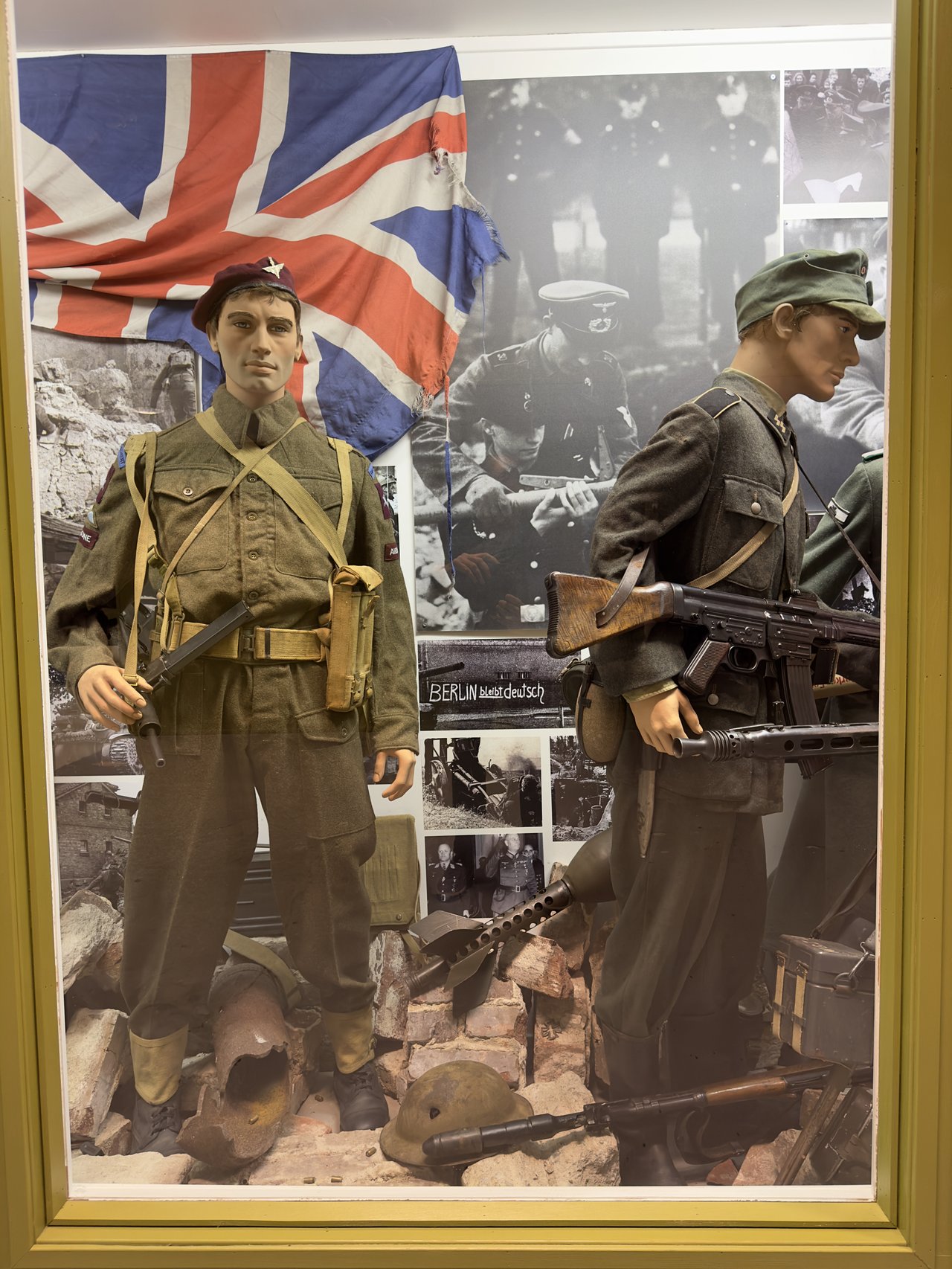
Production volume was approximately 400,000-500,000 Mk Vs across Fazakerley, BSA, and Long Branch. The Mk V was the British Army’s standard SMG for paratroop and special-forces use in 1944-1945 (the SAS, Parachute Regiment, and Royal Marines Commandos were all primarily Mk V-equipped by D-Day plus 60). Post-war it remained in British service until the Sterling Mk 4 / L2A3 replaced it in 1953.
The Mk V is the natural secondary build target if Jeff later wants a Stem build with a more-refined finish. The wood foregrip and wood buttstock can be made on the same CNC/lathe setup; the No 4 rear sight is a stock part Apex stocks; the bayonet lug is a piece of welded steel rod. The Mk V receiver tube is mechanically identical to the Mk II’s, so the Vol 4 engineering data applies to both.
3.6 The Mk VI (1944-end of war) — the suppressed Mk V
The STEN Mk VI is the Mk V receiver fitted with an integral suppressor sleeve replacing the standard 7.75″ barrel. The Mk VI was produced in small numbers (~5,000-10,000) specifically for clandestine and special-forces use. The suppressor is a Maxim-style expansion-chamber design — the bullet passes through a series of internal baffles separated by mesh-and-tube acoustic damping. The Mk VI used subsonic 9×19 ammunition (typically 147 gr at ~1050 fps) to avoid the supersonic crack that no suppressor can eliminate.
The Mk VI is the lineage ancestor of the Sterling L34A1 (the silenced Sterling, produced 1966-1988 for British special forces; see ../E-11/ Vol 3 § 3.3 for the Sterling family). The L34A1 is the Mk VI design philosophy refined with two decades of post-war suppressor engineering; mechanically they are cousins, not twins.
For modern US builders the Mk VI is only accessible via Path A (NFA Class III pre-86 registered transferable) — both because the original suppressor is itself an NFA item (a registered silencer) requiring a separate Form 4 + tax stamp, and because manufacturing a new silencer is a heavily regulated process (an NFA Class II SOT manufacturer’s license). A modern Mk VI replica without a working suppressor sleeve is possible (Path B with an extended barrel for SBR avoidance or Path C with a cosmetic-only suppressor housing) but lacks the operational point of a Mk VI. Reference-only for the practical build paths.
3.7 Commercial copies and clandestine variants
Several non-British STEN-pattern guns existed in WWII and the immediate post-war period. These are reference-only for the modern build paths but useful context for Vol 3 readers:
- Błyskawica (“Lightning”) — Polish Underground State clandestine copy, Warsaw 1942-44 (~700 produced). Top-mounted magazine (rotated 90° from the Mk II’s left-side feed for visual differentiation), Polish-sourced steel, otherwise mechanically a Mk II.
- Halcón — Argentine commercial copy, produced post-war 1950s by Halcón industrial. Similar to a Mk II with refinished surfaces.
- Australian STEN Mk II — Lithgow Small Arms Factory variant, ~17,500 units. Minor cocking-handle and magazine-well geometry differences from the UK Mk II.
- Long Branch STEN Mk II — Canadian Arsenals Limited variant, ~133,000 units. Used a cast aluminum trigger group housing from the start (most UK production used stamped-and-welded sheet steel housings).
- Vietnamese-modified STENs — Vietnam War era, French Indochina and later Viet Cong workshops modified STENs (and Błyskawica clones; some of the Polish Resistance STEN copies ended up in Soviet-bloc inventory and were re-exported through the Cold War). These are interesting to collectors but never reached the US civilian market in volume.
3.8 Identification handles — which Mk is this?
A quick field-identification key for a STEN of unknown variant:
- Wooden foregrip + wooden buttstock + Lee-Enfield rear sight + pistol grip + bayonet lug? → Mk V (most likely) or Mk VI (if the barrel is replaced by a thick suppressor sleeve)
- Bare receiver tube, skeleton-T or wire-loop stock, no wooden parts? → Mk II (most likely; the iconic war-fighter)
- Bare receiver, single-piece stamped sheet (not a tube), magazine well integral to the receiver? → Mk III
- Wooden foregrip under the barrel + cone flash hider + wooden cheekpiece on the stock? → Mk I
- Short barrel (~4″), side-folding stock, paratrooper configuration? → Mk IV (rare)
- Thick suppressor sleeve replacing the barrel? → Mk II(S) (on a Mk II receiver) or Mk VI (on a Mk V receiver)
Markings to look for:
- “STEN MK II” or “STEN MK V” etc. is stamped on the magazine well housing on most variants.
- Factory codes: “M/68” = ROF Fazakerley, “S/123” = BSA Birmingham, “R/97” = ROF Theale, “LB” = Lines Brothers (Mk III only), “L/B” = Long Branch (cast-aluminum housing variant), “LBL” = also Long Branch (later production code).
- Crown / broad arrow proof marks: Indicate UK military acceptance. A STEN without these may have been a sub-contracted parts assembly that never reached final UK proof, or a post-war commercial deactivation.
- Year stamp: Some variants stamp the production year on the magazine well; most do not.
3.9 What this means for build paths
| Build path | Mk recommendation | Why |
|---|---|---|
| A — NFA Class III pre-86 | Mk II for affordability, Mk V for cosmetic refinement, Mk I or Mk IV for collector premium | Most surviving registered transferables are Mk IIs |
| B — Parts kit + US-made semi-auto receiver | Mk II by default | Virtually all available kits (Apex, Sarco, IO) are Mk II; Mk V kits surface periodically but cost 30-50% more; Mk III kits cost 10-20% less but require a different US-receiver |
| C — From scratch in 9×19 | Mk II as the canonical target, Mk V as a stretch goal once Mk II is working | Mk II receiver is the most-tractable lab fabrication; Vol 7 is written assuming Mk II |
3.10 References (Vol 3)
- Skennerton, Ian. The Sten Machine Carbine. (The canonical variant catalog; this volume’s primary source.)
- Hogg, Ian V., and John Weeks. Military Small Arms of the 20th Century. (General reference; per-Mk dim sheets.)
- Bishop, Chris. The Encyclopedia of Weapons of World War II. (Per-Mk production volumes.)
- The Imperial War Museum Duxford. STEN variant identification displays. (Hands-on reference for the per-Mk identification handles in § 3.8.)
- Modern Firearms (max-popenker / world.guns.ru). STEN Mk II / Mk V / Mk VI variant comparison. (Useful modern overview.)
- The Polish Institute of National Remembrance. Błyskawica submachine gun. (Underground State clandestine copy; § 3.7.)
- Apex Gun Parts. STEN parts kit catalog. (Modern parts-kit availability; cited in Vol 6.)