G&G CM16 Raider 2.0 · Volume 1
Overview & Why It's a Favorite
1.1 The Gun Everyone Recommends First
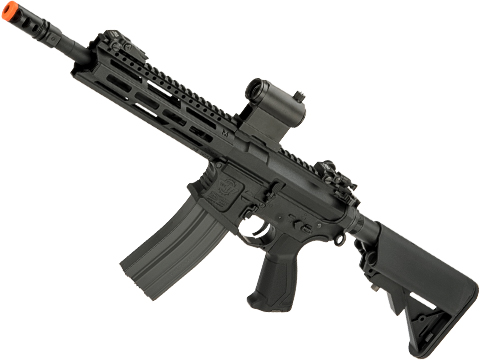
Ask any veteran airsofter what a brand-new player should buy, and the answer comes back so consistently it has become a cliché: a G&G Combat Machine. The CM16 Raider 2.0 is the rifle at the center of that consensus — an AEG (Automatic Electric Gun) M4 carbine that has spent more than a decade as the default starter platform for the sport. It is not the cheapest gun on the shelf, and it is not the most powerful, but it sits at the exact intersection of price, reliability, and platform that makes it the safest first purchase a new player can make.
An AEG is a battery-driven airsoft gun: an electric motor spins a gear train that compresses and releases a spring-loaded piston, and that piston shoves a column of air down the barrel to launch a 6 mm plastic BB. There is no gas, no CO₂ cartridge, and no liquid propellant in the picture — just a rechargeable battery, a gearbox, and a hop-up unit. That architecture is what lets an AEG fire hundreds of rounds between charges, run full-auto without a cooldown, and behave predictably across temperatures. The Raider is the textbook example of the type.
1.2 What It Replicates
The CM16 Raider is a replica of the Colt M4 / AR-15 carbine — the most recognizable rifle silhouette in the world, and by an enormous margin the most common platform in airsoft. It carries the M4’s flat-top upper, its pistol grip and adjustable carbine-style stock, and a modern M-LOK handguard in place of the original round handguards. Because it is an M4, it accepts standard M4/M16-pattern airsoft magazines from essentially every manufacturer — G&G, Tokyo Marui, Matrix, and the rest — and it slots into the deepest aftermarket ecosystem in the hobby. Almost every furniture part, rail accessory, and internal upgrade made for airsoft is made for the M4 first. Learning the Raider means learning the platform the entire sport is built around.
1.3 Why It Became the Golden Standard
The Raider’s reputation rests on a handful of qualities that matter disproportionately to a first-time buyer.
It works out of the box. G&G has a long-standing reputation for quality control, and the Raider ships ready to play: install a battery, load BBs, and it runs. Reviews and buyer guides repeatedly describe it as “a solid standard across every dimension” — not the best at any single thing, but with no glaring weakness either. For someone who has never owned an airsoft gun, that absence of a fatal flaw is worth more than a spec-sheet bragging point.
It is built on the right gearbox. Inside is a full-metal Version 2 gearbox, the standard mechanism for every M4-pattern AEG. That matters because it makes the Raider’s internals the most-documented, most-upgradeable, most-repairable in the sport. When the gun eventually needs service or the owner wants more performance, the parts and the tutorials already exist by the thousand. Volume 2 takes that gearbox apart in detail.
The price is right. The base 2.0 lands around $210–220 and the electronic 2.0E around $230 (typical, and airsoft pricing is volatile). That is squarely in the entry tier while still buying a metal gearbox and a recognized brand — cheaper guns exist, but they tend to use weaker internals that fail or disappoint. The Raider is the cheapest gun most people will recommend without a caveat.
It is a learning platform. A new player on a Raider learns hop-up adjustment, battery care, magazine types, and basic field maintenance on hardware that behaves the way the rest of the sport behaves. Nothing learned on it is wasted, because the M4/V2 combination is what they will keep encountering.
Table 1 — Why It Became the Golden Standard
| Buyer | Why the Raider fits |
|---|---|
| First-time airsofter | Out-of-box reliability, recognized brand, no fatal flaw |
| Budget-minded player | Entry-tier price with a real metal V2 gearbox |
| Future upgrader | Standard M4/V2 platform — the deepest parts and tutorial ecosystem in airsoft |
| Rental-fleet / loaner buyer | Durable, cheap to repair, runs on common batteries and mags |
1.4 The 2.0 and the 2.0E
There are two versions of the gun that share almost everything. The plain 2.0 is the base rifle. The 2.0E (“E” for electronic) adds a built-in ETU/MOSFET — an electronic trigger unit that gives a snappier trigger response, programmable burst, and clean LiPo-ready switching for only a small premium. That single distinction drives the buying decision and is treated in depth in Volumes 2 and 5; for now it is enough to know that the 2.0E is the upgraded-electronics version of the same gun.
1.5 What the Rest of This Series Covers
This deep dive treats the Raider as an engineering object. Volume 2 lays out the full specification sheet and walks the Version 2 gearbox, the long-type motor, the rotary hop-up, and the 2.0E’s ETU/MOSFET and wiring — the textbook explainer for how a V2 AEG with a MOSFET actually works. Volume 3 covers batteries, stock FPS, and rate of fire, including a joule-creep note that points to the gas family. Volume 4 is the upgrade and maintenance manual built around the V2 gearbox and the vast M4 aftermarket. Volume 5 is the buy guide: 2.0 versus 2.0E, the CM16 trim variants, price, and what to check before you pay. Where a figure is variant-dependent or derived rather than vendor-stated, it is labeled typical/approx in the text.
Comments (0)