G&G CM16 Raider 2.0 · Volume 3
Battery, FPS & Rate of Fire
3.1 What Drives the Gun
An AEG’s performance is set by three things working together: the battery that feeds the motor, the spring that sets muzzle velocity, and the gearbox-and-motor combination that determines how fast the cycle repeats. The Raider’s spring is fixed at the factory, so the lever an owner actually controls day to day is the battery — and the right battery choice is also the single most common first upgrade. This volume covers what to feed it, what it shoots, and how fast.
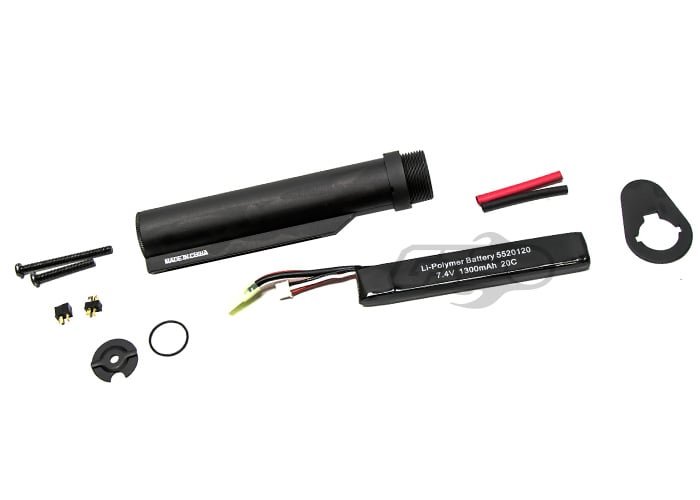
3.2 Battery: 7.4V LiPo Is the Right Answer
G&G’s listings recommend a 7.4V LiPo (small stick type) or a 9.6V NiMH (butterfly/nunchuck) for the Raider, and either fits the battery housing inside the buffer tube / PDW stock. Between the two, the 7.4V LiPo is the modern default, and on the 2.0E it is the natural pairing — the ETU/MOSFET is LiPo-ready, with low-voltage handling and clean switching that suit a lithium pack. A small stick LiPo slides into the buffer tube, holds voltage flat through the discharge, and weighs almost nothing.
The distinction between the two versions matters here. The 2.0E’s MOSFET is what makes a LiPo genuinely safe to run hard: the electronics switch the motor instead of bare trigger contacts, so the higher current a LiPo can deliver does not arc and pit the contacts. On the plain 2.0, a LiPo will work, but it runs through the mechanical contacts directly, which accelerates their wear — many owners of the plain gun either stick to NiMH or add an aftermarket MOSFET (Volume 4) before committing to LiPo. An 11.1V (3S) LiPo pushes the rate of fire higher still and is sometimes bundled in combo packages, but it stresses the stock gearbox and is better paired with the gearbox reinforcement Volume 4 describes.
A note that applies to either chemistry: the gun typically ships without a battery or charger on bare “gun only” SKUs. Budget for a battery and, for LiPo, a proper balance/smart charger — running and storing LiPo correctly is not optional. Some retailers sell combo packages that bundle a battery and charger; Volume 5 flags those.
Table 1 — Battery: 7.4V LiPo Is the Right Answer
| Battery | Fit | Behavior | Best for |
|---|---|---|---|
| 7.4V LiPo (2S stick) | Buffer tube | Flat voltage, light, snappy on the 2.0E | The default — especially the 2.0E |
| 9.6V NiMH | Buffer tube | Forgiving, no special charger discipline | Plain 2.0 owners avoiding LiPo wear |
| 11.1V LiPo (3S) | Buffer tube | Higher ROF, more gearbox stress | Upgraded guns (see Vol 4) |
3.3 Stock FPS
Out of the box the Raider chronographs around 350–370 fps on 0.20 g BBs (typical; individual listings range from roughly 340 to 380 depending on SKU and batch). That converts to a muzzle energy of about 1.14–1.27 joules — derived from the velocity, not published by G&G, so treat it as approx. That energy figure is the number field-legal limits are actually written in, which is why it matters more than raw FPS once a chronograph and a BB weight enter the picture.
This velocity is intentionally moderate. At roughly 350–370 fps the Raider clears the common CQB ceilings and field limits at most sites without needing a downgrade, while still reaching out far enough for general skirmish use. It is not a long-range DMR build and was never meant to be; it is a balanced all-rounder, which is exactly what makes it a safe first gun.
3.4 Rate of Fire
Rate of fire (ROF, measured in rounds per second) is a product of battery voltage, motor speed, and the gearbox’s gear ratio. On the 2.0E with a healthy battery — an 11.1V LiPo in particular — G&G cites 18+ rounds per second on full-auto. On a stock 7.4V LiPo the figure is lower (the published 18+ rps is the higher-voltage number; the 7.4V rate is an inference, not a vendor spec, and should be treated as approx) — comfortably usable, but not the headline number. The ETU/MOSFET helps the felt response regardless of raw ROF: active braking trims the motor’s overrun so semi-auto feels crisp and the gun stops on the shot rather than coasting into a second round.
Table 2 — Rate of Fire
| Configuration | Full-auto ROF |
|---|---|
| 2.0E + 11.1V LiPo | ~18+ rps (vendor-stated) |
| 2.0E + 7.4V LiPo | lower than 18 rps (approx, inferred) |
| Plain 2.0 + 9.6V NiMH | moderate; battery-dependent |
3.5 Joule Creep — Read the Gas Dive
There is one performance concept worth flagging even though it touches AEGs only lightly: joule creep. Joule creep is the phenomenon where a lighter BB leaves the muzzle with more energy than the same gun would impart to a heavier BB — it occurs when the system can keep accelerating the BB after a heavier one would already have left the barrel, so the extra dwell time dumps more energy into the lighter projectile. It is most dramatic in high-pressure gas guns, where it can push a gun over a field’s joule limit on light BBs even when it chronos legal on 0.20 g. An AEG’s fixed air volume makes the effect far smaller, but the principle is the same, and the place it genuinely bites is on the gas side of the sport. The full treatment of muzzle energy, BB weight, and joule creep lives in the Airsoft Gas deep dive — the practical takeaway for a Raider owner is simply to chronograph in joules on the BB weight you actually field, not just to trust the FPS-on-0.20 g number on the box.
Comments (0)