G&G CM16 Raider 2.0 · Volume 5
Buy Guide & Variants
5.1 The Decision That Matters: 2.0 vs 2.0E
Almost the entire buy decision for this gun comes down to two letters. The plain 2.0 is the base rifle: a full-metal Version 2 gearbox, mechanical trigger contacts, and a small Tamiya connector, with no electronics. The 2.0E (“E” for Electronic) is the same gun plus a built-in G&G ETU/MOSFET — the electronic trigger unit that protects the trigger contacts, gives a snappier response with active braking, adds a programmable 3-round burst, and is genuinely LiPo-ready. It is typically wired with a lower-resistance Deans (T-plug) connector and usually ships with a mini-Tamiya adapter.
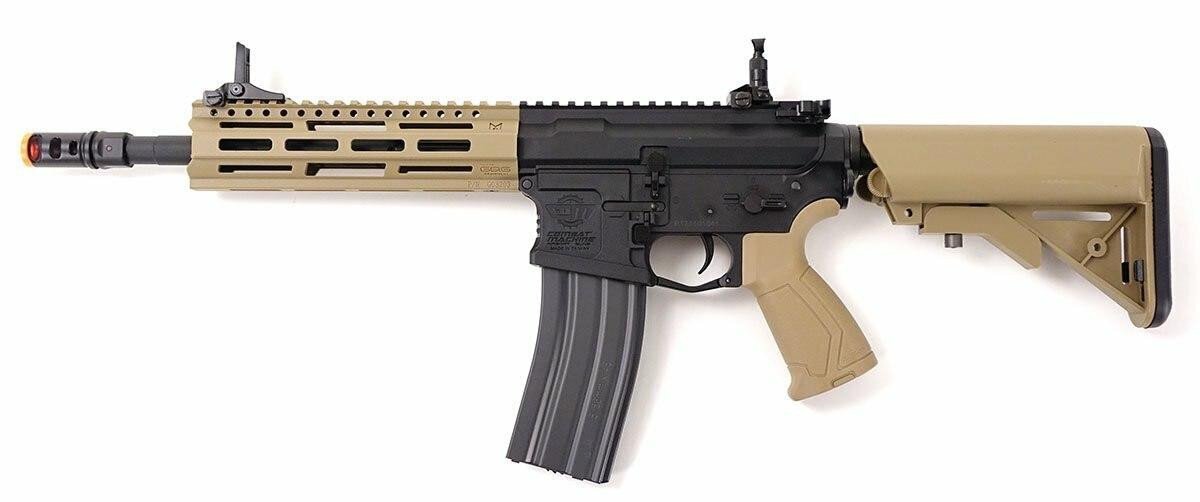
For the small premium (roughly $210–220 for the 2.0 versus ~$230 for the 2.0E, typical and volatile), the 2.0E is the easy recommendation for most buyers: the MOSFET is exactly what makes running a LiPo hard a non-issue, and it is the feature owners of the plain gun most often end up adding aftermarket anyway. The plain 2.0 still makes sense for the tightest budgets, for buyers who prefer NiMH, or for those who specifically want to install their own MOSFET later. The decision is genuinely that clean.
Table 1 — The Decision That Matters: 2.0 vs 2.0E
| 2.0 | 2.0E | |
|---|---|---|
| Electronics | None (mechanical contacts) | ETU + programmable MOSFET |
| Connector | Small Tamiya | Deans (usually; verify SKU) |
| Burst mode | No | Programmable 3-rd burst |
| LiPo posture | Works, but wears contacts | LiPo-ready |
| Typical price | ~$210–220 | ~$230 |
| Best for | Tightest budget, NiMH users, DIY MOSFET | Most buyers |
5.2 The Connector Caveat — Check Before You Pay
One detail trips up buyers and deserves a hard flag: the connector varies by SKU. The 2.0E is usually Deans-wired, but some 2.0E SKUs — particularly certain Evike listings — are explicitly wired for a small Tamiya plug instead. Likewise the plain 2.0 is Tamiya. This matters because it dictates which batteries plug in directly and whether an adapter is needed. Before buying, read the specific listing for the connector type and confirm whether the ETU/MOSFET is actually present (the “E” in the model name is the tell, but the listing’s wiring line is the proof). It is the single most common source of buyer surprise on this platform.
5.3 CM16 Trims and the Wider Family
The “Raider” is one trim within G&G’s broader Combat Machine CM16 line, and the names describe the configuration:
- CM16 Raider — the standard short carbine, the subject of this dive.
- CM16 Raider-L — the “Long” variant: a longer (~14.5 in) barrel and handguard with a PDW two-position stock. Same internals, more reach.
- Other CM16 trims — the line also includes guns like the CM16 SRL, CM16 LMG, and other configurations that share the same V2/M4 internals in different external dress.
All of them are M4-pattern, accept standard M4/M16 AEG magazines, and share the same upgrade ecosystem — so the choice between trims is about barrel length, handguard, and looks, not about a different mechanism. Colors are typically Black and Desert Tan.
Table 2 — CM16 Trims and the Wider Family
| Trim | Configuration | Notes |
|---|---|---|
| CM16 Raider 2.0 / 2.0E | Short carbine, M-LOK | The standard starter; this dive |
| CM16 Raider-L 2.0E | ~14.5 in barrel, PDW stock | More reach, same internals |
| Other CM16 (SRL, LMG, …) | Various | Shared V2/M4 platform, different dress |
5.4 What’s in the Box — and What Isn’t
A bare “gun only” SKU typically includes the rifle, one hi-cap magazine (300-rd current production; some older/regional SKUs cite 450-rd), and the manual — and usually no battery and no charger. That is normal for the tier, but it means the real out-the-door cost includes a battery and, for LiPo, a balance/smart charger. Some retailers sell combo packages that bundle a battery and charger (and occasionally an 11.1V LiPo), which can be the better value for a true first-time buyer who owns nothing yet. Volume 3 covers the battery choice itself.
5.5 Price Tier and Where to Buy
The Raider sits in the entry tier, and pricing is volatile, but as-listed figures cluster around $210–220 for the 2.0, ~$230 for the 2.0E, and ~$267 for a Raider-L 2.0E combo (typical, USD). That buys a recognized brand with a full-metal V2 gearbox — cheaper guns exist but typically cut the gearbox quality that makes the Raider safe to recommend.
It is widely stocked. In the US: Evike, Airsoft GI, Airsoft Station, Amped Airsoft, ANSgear, and Airsoft Atlanta, among others. In the UK: Defcon Airsoft and Airsoft Direct. Stock and price move around between retailers, so it is worth comparing — but the more important comparison is the listing details: confirm the version (2.0 vs 2.0E), the connector (Deans vs Tamiya), the magazine capacity, and whether a battery/charger is included.
5.6 The Buyer’s Checklist
Before paying, confirm:
- Version — 2.0E (ETU/MOSFET) unless budget or a deliberate DIY-MOSFET plan says otherwise.
- Connector — Deans or Tamiya? It dictates batteries and adapters; do not assume from the model name alone.
- Battery/charger — included or not? Budget for both, and for LiPo budget a balance charger.
- Trim — Raider (short) or Raider-L (long)? Same gun mechanically; pick the barrel/handguard you want.
- Magazine — 300-rd hi-cap on current production; M4-standard either way.
- Retailer terms — price is volatile and stock moves; compare, and read the spec line, not just the title.
Get those six right and the Raider does exactly what its reputation promises: it is the rifle a new player can buy with confidence, learn the sport on, and upgrade indefinitely on the deepest platform in airsoft.
Comments (0)