G&G CM16 Raider 2.0 · Volume 2
Specs & Internals
2.1 The Specification Sheet
The CM16 Raider 2.0 is a full-size M4 carbine replica that, on paper, reads like the baseline against which other entry AEGs are measured. The figures below are drawn from G&G’s retail listings; where they vary by SKU, region, or production batch, the spread is noted and the working number is labeled typical/approx.
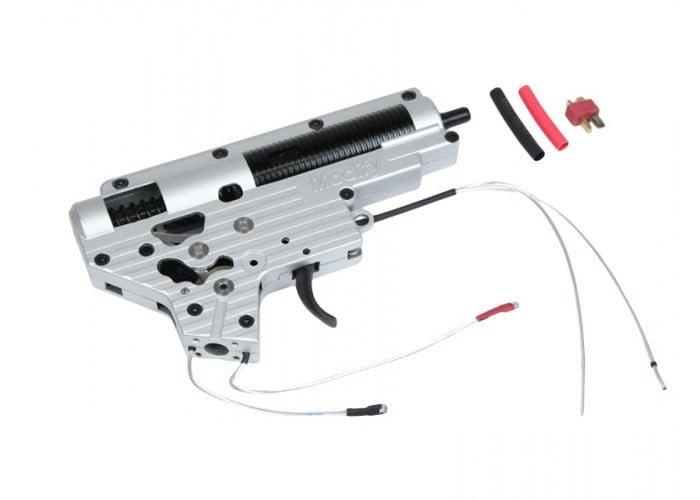
Table 1 — The Specification Sheet
| Specification | Value |
|---|---|
| Action | AEG (battery / electric), 6 mm BB |
| Replica of | Colt M4 / AR-15 carbine |
| Stock FPS (0.20 g) | ~350–370 fps (typical; listings range ~340–380) |
| Muzzle energy | ~1.14–1.27 J (derived from FPS, not vendor-stated — approx) |
| Gearbox | Version 2, full metal |
| Motor | Long-type, ~18,000 RPM class |
| Hop-up | Rotary adjustable |
| Inner barrel | ~275–300 mm, 6.04 mm tightbore brass (some 2.0E cited 6.01/6.03) |
| Magazine | 300-rd hi-cap (current; older/regional SKUs cite 450 rd) |
| Magazine type | Standard M4/M16 AEG |
| Length | ~710 mm collapsed / ~790 mm extended (adjustable stock) |
| Weight | ~2,300–2,600 g (~4.5–5.1 lb), variant-dependent |
| Receiver / furniture | Reinforced nylon-fiber polymer; M-LOK polymer handguard |
| Internals | Full metal |
| Muzzle thread | 14 mm CCW under the flash hider |
| Fire modes | Safe / Semi / Full-auto (2.0E adds programmable 3-rd burst) |
A few of these deserve comment. The Raider’s stock velocity of roughly 350–370 fps sits at the lower-mid end of the entry-AEG band — below the 380–400 fps some competitors advertise, which is deliberate: it keeps the gun field-legal at most US and UK sites without a downgrade. The nylon-fiber polymer receiver is the most-debated spec; it is a reinforced glass-or-nylon-filled polymer, genuinely durable and impact-resistant, but it is not metal, and that trade is discussed in Volume 4. The 6.04 mm tightbore barrel is a modest tightbore — tighter than a generic 6.08, looser than a precision 6.01/6.03 — a sensible middle ground for a stock gun.
2.2 The Version 2 Gearbox
Everything mechanical in the Raider hangs off its Version 2 (V2) gearbox — the full-metal, split-shell mechanism that is the M4/AR-pattern standard for AEGs. Understanding the V2 is understanding nearly every M4 airsoft gun ever made, because they all use it.
The principle is a spring-piston air pump driven by an electric motor. Pull the trigger and current flows to the motor, which spins a pinion gear that drives three gears in sequence — the bevel, the spur, and the sector gear. The sector gear’s teeth catch a rack on the underside of the piston and pull it rearward, compressing the main spring behind it. At the end of the sector’s toothed arc the last tooth releases the piston, the spring slams it forward inside the cylinder, and the piston head drives a slug of air through the cylinder head and air nozzle into the hop-up chamber and barrel. That single cycle launches one BB. On full-auto the motor simply keeps the gears turning and the cycle repeats as fast as the gearbox and battery allow.
The V2 shell is a clamshell of two metal halves holding the gear axles in bushings (the Raider uses brass bushings on the base box; the 2.0E full-metal box carries 8 mm bearings). It also houses the anti-reversal latch that stops the gears from unwinding, the tappet plate that retracts the air nozzle to time BB feeding, the trigger contacts or trigger switch, and the cut-off lever that ends a semi-auto shot after one cycle. The V2 is famous for one structural weakness — the area around the cylinder window and the front of the shell, which sees the most stress — and that is exactly where upgraders reinforce it, covered in Volume 4.
2.3 Motor and Hop-Up
The Raider drives its V2 with a long-type motor — the full-length motor that seats in a carbine-style pistol grip, the standard for an M4 with a full stock — rated in the ~18,000 RPM class. The motor’s magnets and the gear ratio together set the rate of fire; swapping to a high-torque or high-speed motor is a common tuning move (Volume 4).
Feeding the barrel is a rotary adjustable hop-up. Hop-up applies backspin to the BB by pressing a rubber bucking against the top of the BB as it passes; that backspin generates lift (the Magnus effect) and flattens the BB’s trajectory for far greater range than a bare barrel would give. The rotary design uses a click-detented dial rather than the older lever, which holds its setting better under recoil and handling. Dialing it in for the BB weight in use is the single most important thing a new owner does for accuracy.
2.4 The 2.0E: ETU and MOSFET — the Key Distinction
The plain 2.0 has no electronics: the trigger is a pair of mechanical copper contacts that switch the full motor current directly, and it ships with a small Tamiya connector. That is simple and serviceable, but the bare contacts arc and erode over time, and they are not ideal for the higher current a LiPo battery can deliver.
The 2.0E (“Electronic”) adds a built-in G&G ETU (Electronic Trigger Unit) with a programmable MOSFET. A MOSFET is a solid-state power switch: instead of the trigger contacts carrying the motor current, they now carry only a tiny signal current that tells the MOSFET to switch the heavy current. This does three things at once. It protects the trigger contacts from arcing, dramatically extending their life. It gives a crisper, faster trigger response, because the electronics fire the motor cleanly and apply active braking so the gun stops on the round rather than coasting. And it adds programmable features — notably a 3-round burst mode the mechanical gun cannot offer. The ETU is also LiPo-ready, the point Volume 3 builds on.
The 2.0E is typically wired with a Deans (T-plug) connector — a lower-resistance plug that suits the higher current — and usually ships with a mini-Tamiya adapter. One caveat earns a flag: some 2.0E SKUs are explicitly wired for Tamiya instead of Deans, so the connector must be verified per listing (Volume 5). The short version: 2.0 = mechanical contacts + Tamiya; 2.0E = ETU/MOSFET + (usually) Deans. That is the whole difference, and it is what most of the buy decision turns on.
Comments (0)