The Blanchard Lathe · Volume 4
The Stocking Line — Fourteen Machines
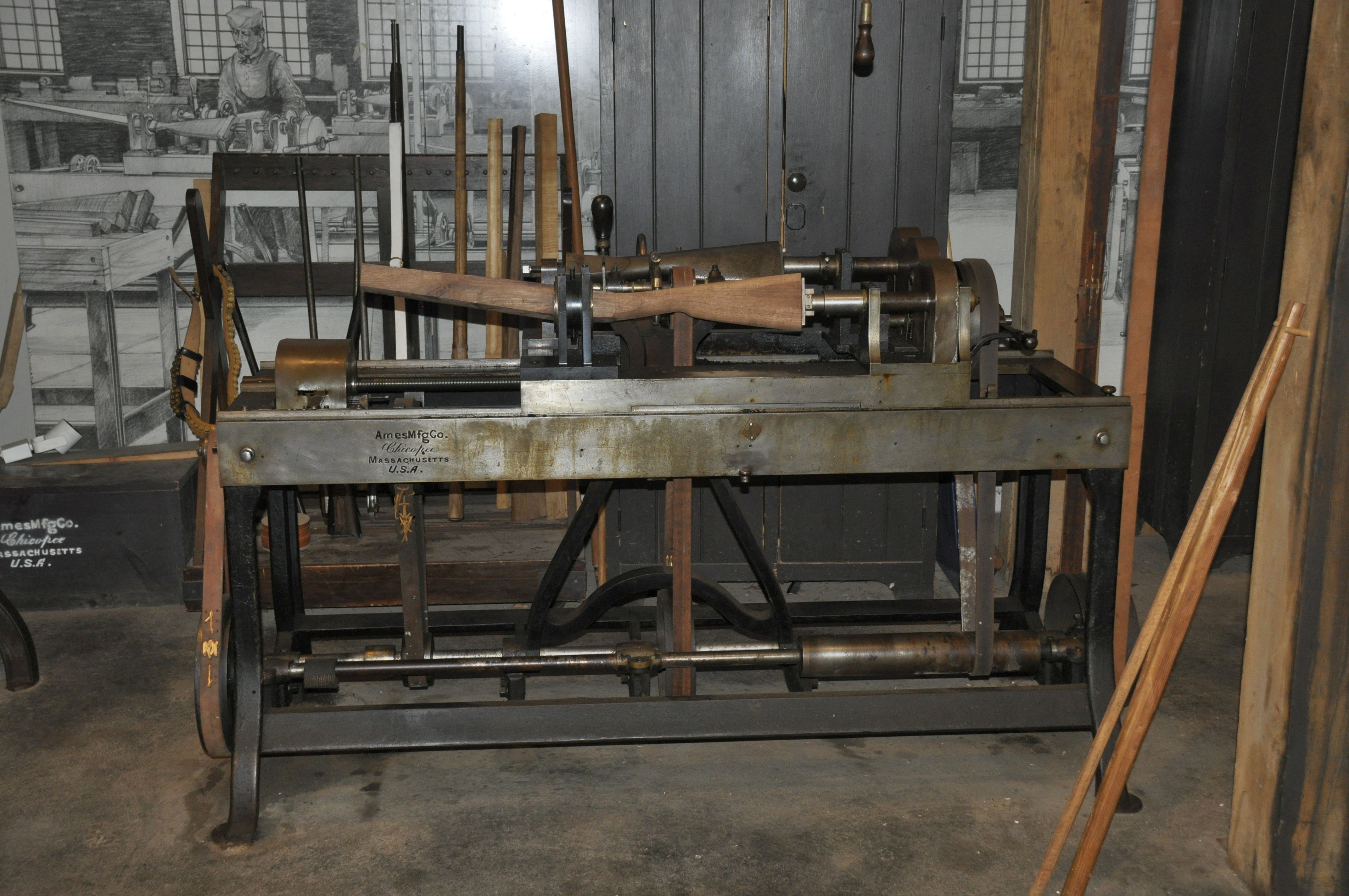
A point that gets lost in the popular telling: the Blanchard lathe made only the outside of the stock. It shaped the exterior profile — comb, wrist, butt, fore-end — and that was all. It cut no mortise for the lock, no channel for the barrel, no groove for the ramrod, no seat for the buttplate, no screw holes. Every one of those inletting operations was done by a separate, special-purpose machine in a sequence the lathe merely began. Blanchard’s real production achievement was not one machine but a line of fourteen, and this volume walks it.
4.1 The Number Is Fourteen, and Two Sources Agree
The count of the full Springfield stocking sequence is 14 machines, and it is corroborated by two independent sources:
- NPS (Springfield Armory NHS), citing Bessey’s Springfield Guidebook (1851-52): “The stocking room machinery at Springfield Armory consisted of 14 machines operated by 20 men, with gun stocks passing through the Blanchard turning machine first and then through the remaining machines in rapid succession… each machine would receive every depression for the reception of the lock and mounting, the grooving for the breech-pin, barrel and ramrod, holes for the reception of screws, turning, etc., until the stock was complete.”1
- National Inventors Hall of Fame: “To his lathe he added thirteen additional special purpose machines that together formed an early production line” — i.e., the lathe plus 13 = 14 total.2
Two independent counts landing on the same number is about as solid as anything in this dive gets.
Do not confuse this with the “fifty machines” figure. A separate source states that during the patent’s first term “no less than fifty machines were put in operation for various purposes, turning shoe lasts, wheel spokes, tackle blocks and hat forms.” That fifty refers to the total number of Blanchard-type lathes in commercial operation across all industries and licensees — not the count of machine types in the Armory stocking sequence. The two numbers answer different questions; keep them separate.3
4.2 What the Line Actually Did
Think of it as a fixture-and-operation flow, the way you would break a part into ops on your own machines. The stock enters as a rough-sawn walnut blank and leaves as a finished, fully-inletted stock ready for metal fitting. In sequence:
- Blanchard lathe — exterior profile. The stock’s whole outside contour is copied from the master, leaving a rippled near-net surface.
- Hand finishing. Scrapers and sandpaper knock down the ridges the lathe leaves — a bench operation, not a machine (see Volume 3).4
- The inletting machines — a battery of special-purpose cutters, each dedicated to one recess, run in rapid succession. Named examples confirmed by NPS:
- Barrel bedding machine — cut the semi-cylindrical, tapered channel the barrel lies in. Mechanized by the 1830s.4
- Lock bedding machine — cut the multi-depth mortise that seats the lockplate and its internals. Documented from the 1850s.4
- Buttplate inletting machine — cut the seat for the buttplate. An 1859 design that reportedly ran essentially unchanged through 1900.4
- Plus machines for the ramrod groove, breech-pin/tang grooving, trigger-guard mortise, and the various screw holes — the “every depression for the reception of the lock and mounting” Bessey describes.
Before this line existed, all of that fitting was done entirely by hand and was, per NPS, “a tedious job requiring great skill and experience.”4 The line’s achievement was to take the shaping and roughing of both the exterior and the recesses off the skilled bench-hand and put it on repeatable machines — while, crucially, leaving the final precision fitting of metal to wood still substantially a hand operation. That caveat is the entire subject of Volume 6.
4.3 Why a Line, Not One Machine
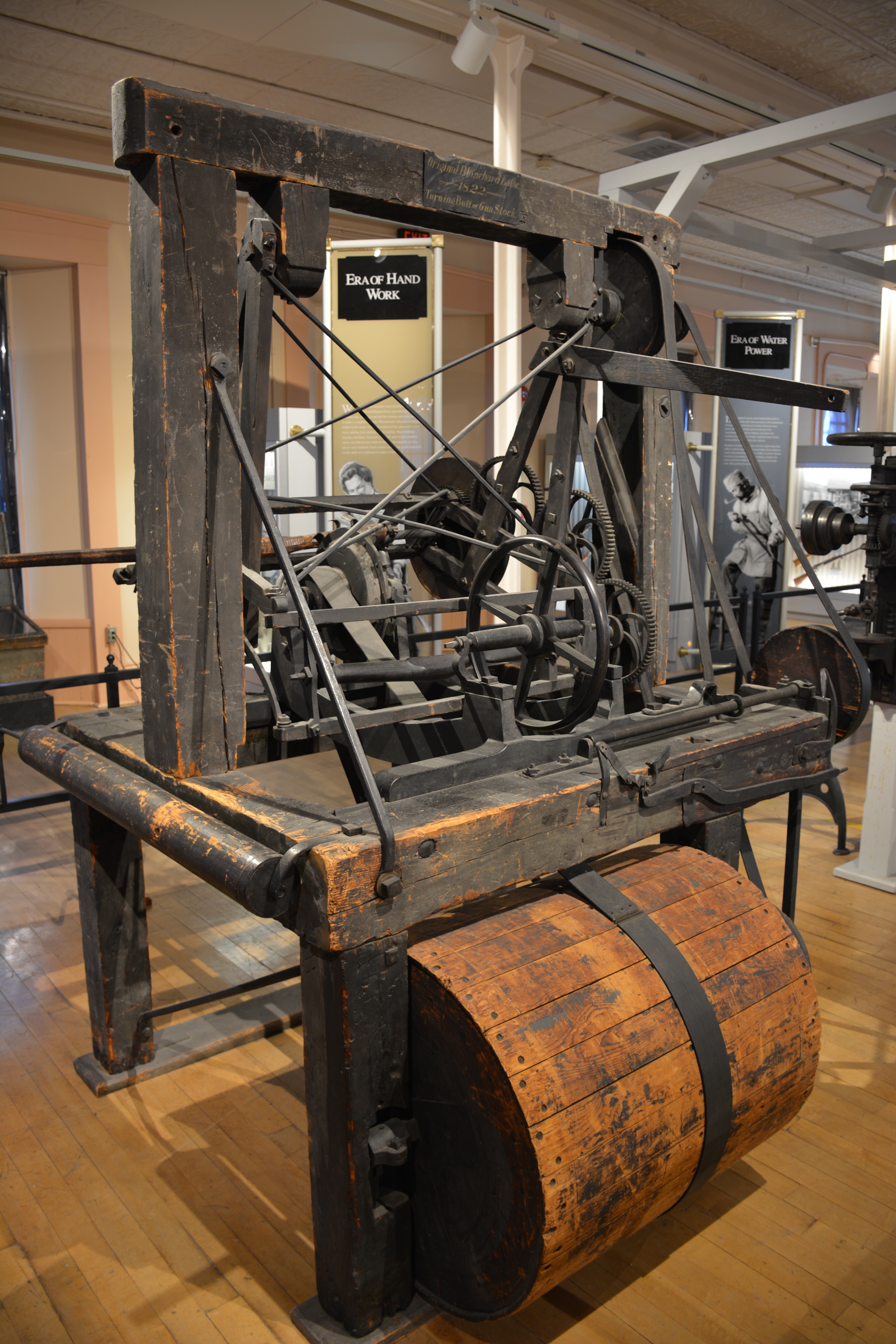
The reason the inletting could not be folded into the lathe is geometric. The lathe’s kinematics — rotate the work, trace a swinging follower over a spinning master — generate an exterior surface of revolution-plus-contour. A lock mortise is an internal, flat-bottomed, multi-depth pocket at a specific station and clock position; a barrel channel is a long semi-cylindrical trough. Those are milling and mortising operations, not turning operations. Different geometry demands a different machine, so Blanchard (and the Armory personnel who extended his approach) built a dedicated machine per recess, each essentially a purpose-built jig-and-cutter that indexed the stock and drove a cutter to a fixed depth and outline.
This is exactly how you would break the job down today: the profiling op and the pocketing ops are different setups with different tools, even on one CNC machine. The 1850s Armory simply used fourteen single-purpose machines where you would use one machining center with fourteen operations in the program. The logic is identical; only the consolidation differs.
4.4 The Surviving Line You Can See
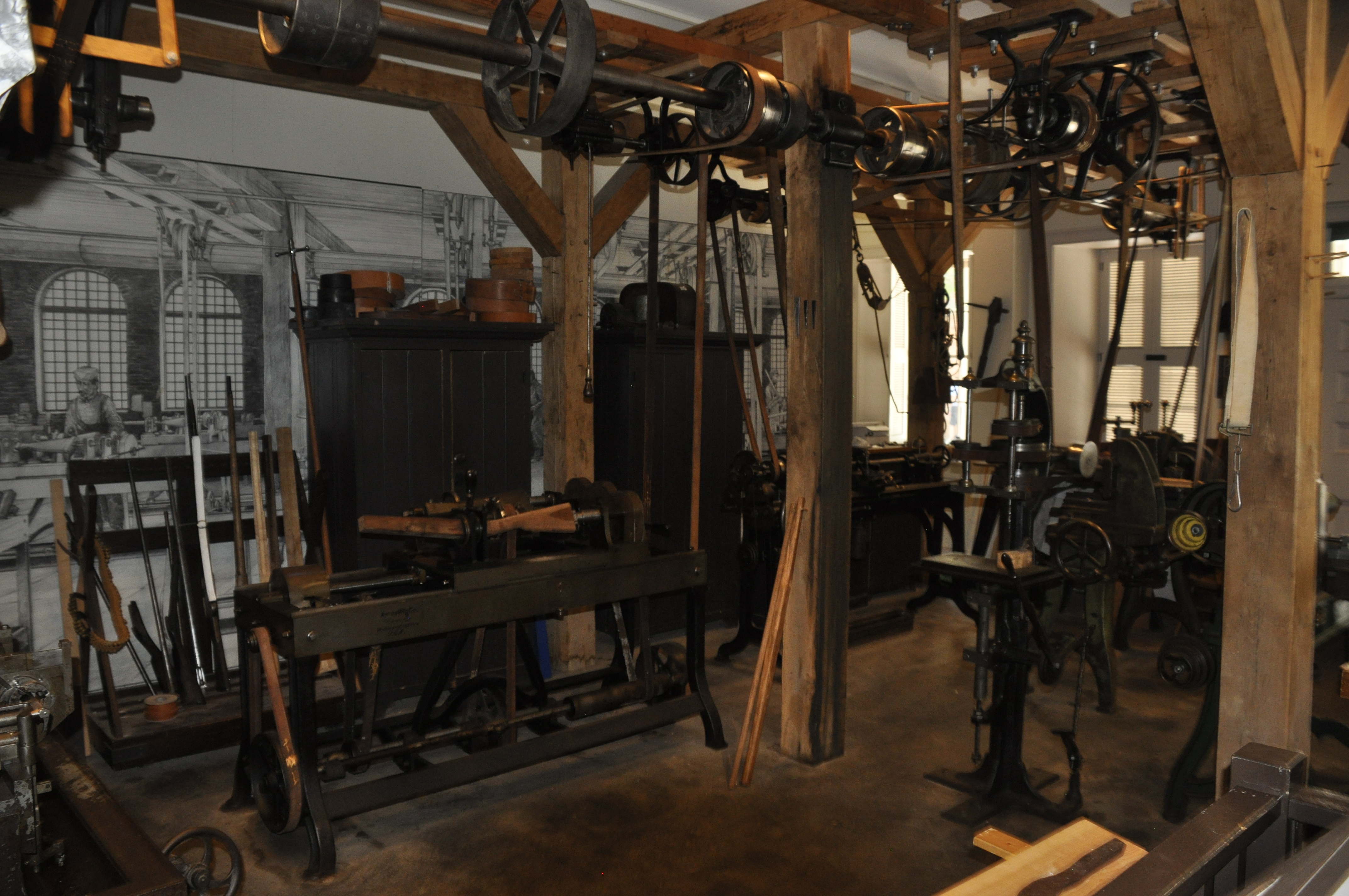
The reconstructed gunsmith shop at Harpers Ferry (National Park site) displays a later-generation, 1850s-era, water-powered Blanchard-type duplicating lathe as part of its representation of the stocking process — the machine in this volume’s figures. Note the “type”: this is a same-lineage machine at the reconstructed shop, not the original Springfield lathe (which survives separately and appears in Volumes 1, 6, and 9). It is the best publicly-photographed example of the machine in a shop context, belted to overhead line shafting, which is why it leads this volume.5
4.5 Bibliography
Footnotes
-
NPS, Springfield Armory NHS, citing Bessey’s Springfield Guidebook (1851-52). https://www.nps.gov/spar/learn/historyculture/machines.htm ↩
-
National Inventors Hall of Fame, “Thomas Blanchard.” https://www.invent.org/inductees/thomas-blanchard ↩
-
George Iles, Leading American Inventors (1912) — source of the “fifty machines… across industries” figure. Secondary. ↩
-
NPS, Springfield Armory NHS, “Woodworking at Springfield Armory” (barrel/lock/buttplate bedding machines). https://www.nps.gov/spar/learn/historyculture/sa-woodworking.htm ↩ ↩2 ↩3 ↩4 ↩5
-
Wikimedia Commons, File:Harpers_Ferry_gun_smith_shop_-Blanchard_lathe-_01.jpg and -02.jpg (Jarek Tuszynski, CC BY 4.0). ↩
Comments (0)