The Blanchard Lathe · Volume 7
Why They Are No Longer Used
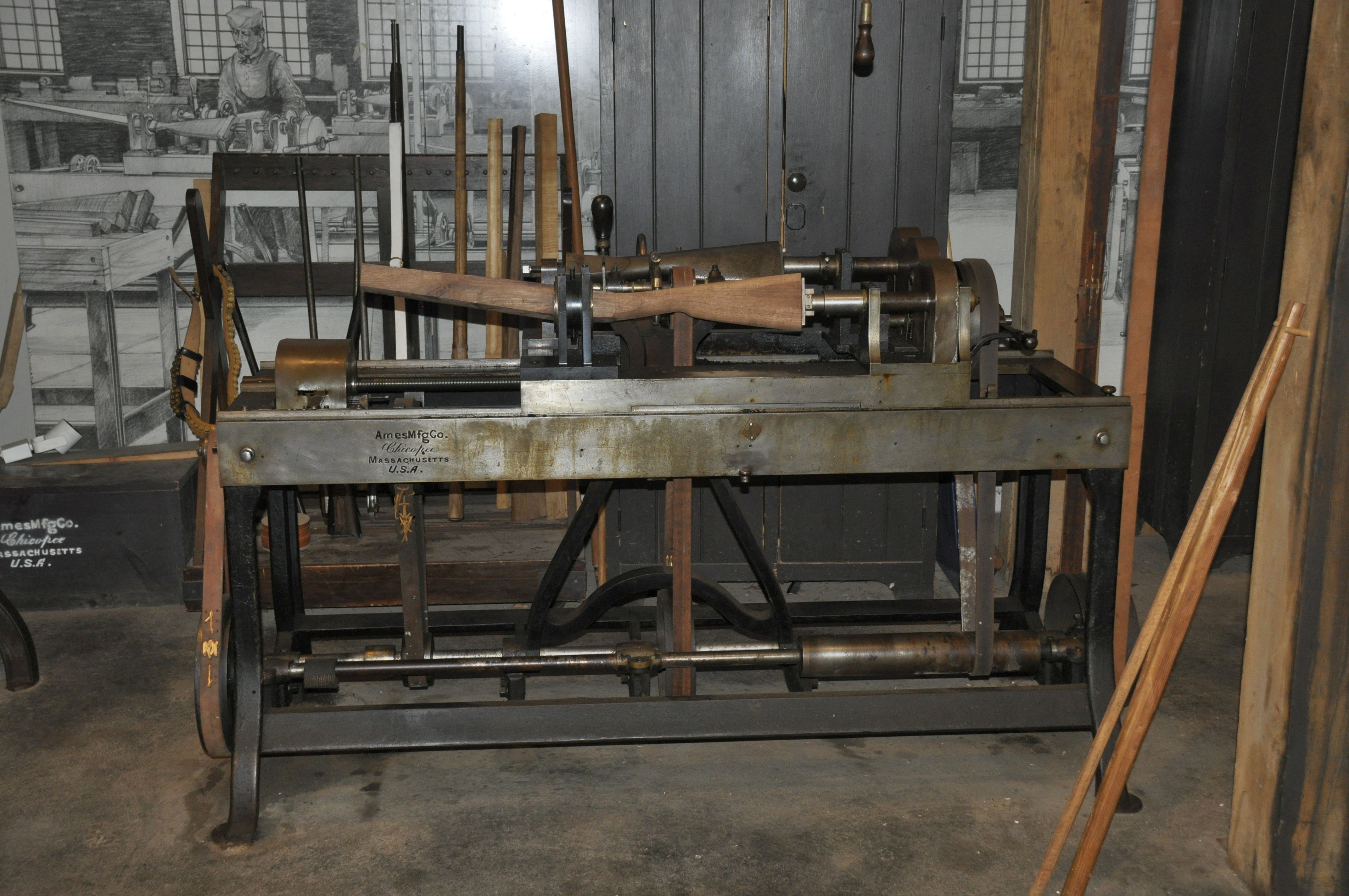
This is one of your explicit questions, so it gets a full volume. The short answer is that the Blanchard principle — a mechanical tracer synchronized to a cutter — had a very long and successful afterlife and was not so much abandoned as refined into extinction, first into hydraulic and mechanical duplicating carvers, then into CNC, while the underlying market (high-volume solid-wood stocks) simultaneously collapsed as stocks went synthetic. No single cause; four converging ones. This volume takes them in turn and ends with where the survivors are.
7.1 Cause 1: The Principle Got Better — Duplicating Carvers, Then CNC
The Blanchard idea did not die; it was superseded by machines that did the same job better. Mid-twentieth-century commercial gunmakers and aftermarket stock houses ran hydraulic and mechanical multi-spindle duplicating carvers — conceptually direct descendants of Blanchard’s tracer, refined into multi-station machines. A period practical-machinist description of a later-generation shop duplicator: “a massive machine duplicator where a master (a large version of the stock) was spun, and styluses rode the contours of the master to mechanically duplicate the shape on a smaller stock-sized spinning piece of wood.”1 That is Blanchard’s swing-frame tracer, grown up — multiple cutting spindles, better rigidity, sometimes a scaling ratio the original lacked, but the same trace-and-copy DNA.
Then came CNC, and the transition has named actors:
- Reinhart Fajen, Inc. is credited as first to apply CNC to gunstocks. It was neither cheap nor easy: “The learning curve and costs for CNC were far beyond what was imagined — programming was very difficult and time consuming, requiring four Shoda 4-spindle, 4-axis machines and one single spindle, five-axis machine.” Fajen’s Lincoln, Missouri manufacturing was suspended by fall 1998, after which its stock production was contracted to other CNC shops.2
- Boyds Hardwood Gunstocks (founded 1981; now the largest aftermarket maker) bought Fajen’s inletting equipment and runs CNC inletting to house-standard actions at scale, with a 100-plus-employee operation.3
- McMillan Fiberglass Stocks runs CNC precision inletting — computer-guided cutting of custom inlet programs “for thousands of action, bottom metal, and barrel profile combinations” — with a technician overseeing the cut, blending CNC with hand-laid composite construction.4
The broad modern summary is that “most duplicators today are using 5-axis CNC mills.”5 (That last is a soft, search-synthesized claim; treat it as directional, not gospel.) The through-line: CNC gives you a digital master instead of a physical one, better as-cut tolerance and finish, and near-instant design changes — every axis on which Blanchard’s machine was weak.
7.2 Cause 2: The Material Moved — Wood to Synthetic
A duplicating lathe for wood is only useful if stocks are made of wood, and increasingly they are not. The material shift is a parallel and reinforcing cause:
- Remington Nylon 66 (late 1950s) — an early commercially successful synthetic-stocked rifle (DuPont Zytel-101 nylon), aimed squarely at cost reduction.6
- Fiberglass stocks — borrowing boat-building lamination (epoxy and glass cloth over a mold) — gained ground in the 1950s-60s; Chet Brown is credited with introducing fiberglass stocks to competition shooting in the 1960s.6
- Weatherby Fibermark (early 1980s) — cited as the first synthetic-stocked factory rifle, after which “all of the major manufacturers” followed.6
- Today, injection-molded polymer stocks dominate factory-rifle production on cost, and synthetic stocks have “all but replaced wood stocks” in the mass market.6
Injection molding a polymer stock does not involve a duplicating lathe at any point — it involves a mold and a press. So as volume shifted to polymer, the addressable market for any wood-duplicating machine, Blanchard-style or hydraulic-tracer-style alike, shrank toward the premium and traditional niches.
7.3 Cause 3: The Economics Never Favored It Against CNC
Set the two side by side on the terms a shop actually cares about, and the Blanchard architecture loses on nearly every axis:
Table 1 — Set the two side by side on the terms a shop actually cares about, and the Blanchard architecture loses on nearly every axis
| Factor | Blanchard / physical-master duplicator | CNC |
|---|---|---|
| Master | One physical model per pattern; slow, skilled to make | A CAD file; copy/edit freely |
| Design change | Re-cut a whole new master | Edit the file |
| As-cut surface | Rippled, faceted; heavy hand finishing | Near-finish; light sanding |
| Tolerance | Follower/linkage slop; wear-dependent | Repeatable to machine tolerance |
| Operator | Skilled setup and monitoring | Skilled setup, then it runs |
| Product variety | One shape until you re-tool | Any shape in the library |
| Safety | Open, unguarded high-speed cutter | Enclosed, guarded, interlocked |
Two of those rows deserve emphasis. Setup and inflexibility: the physical master is the killer. Every new stock design meant fabricating a whole new master — the expensive, skilled, one-time step that made the machine economical only against a fixed, high-volume design (armory musket production). Change the design and you rebuild the tooling; with CNC you change a file. Safety: the cutter wheel carried “a score of sharp cutters” spinning at line-shaft speed, open and unguarded, directly where an operator loaded, unloaded, and watched the cut. By any modern machine-guarding standard that is a serious point-of-operation hazard — entanglement, laceration, amputation, flying chips. (No period accident records surfaced in the research — that is a gap, not a claim of safety.) A machine you cannot guard is a machine you cannot run in a modern shop regardless of its other merits.
7.4 Cause 4: The Volume Base Collapsed
Underneath all of it: the era of large-volume wooden gunstock production ended. Government armory contracts for millions of walnut-stocked muskets are a nineteenth- and early-twentieth-century phenomenon; the modern equivalent is polymer, injection-molded, at a scale and cost point no duplicating lathe can touch. When the giant captive customer for identical wooden stocks disappeared, so did the economic case for a machine optimized to make exactly that. What remains — premium walnut sporters, custom and traditional-pattern rifles, historical reproductions, the aftermarket — is served perfectly well by CNC (for volume) and hand work (for the top tier), with no niche left for the physical-master duplicator.
7.5 Where the Survivors Are
There is no evidence of any Blanchard-type lathe in working commercial use today. The role is fully superseded. The survivors are static museum pieces:
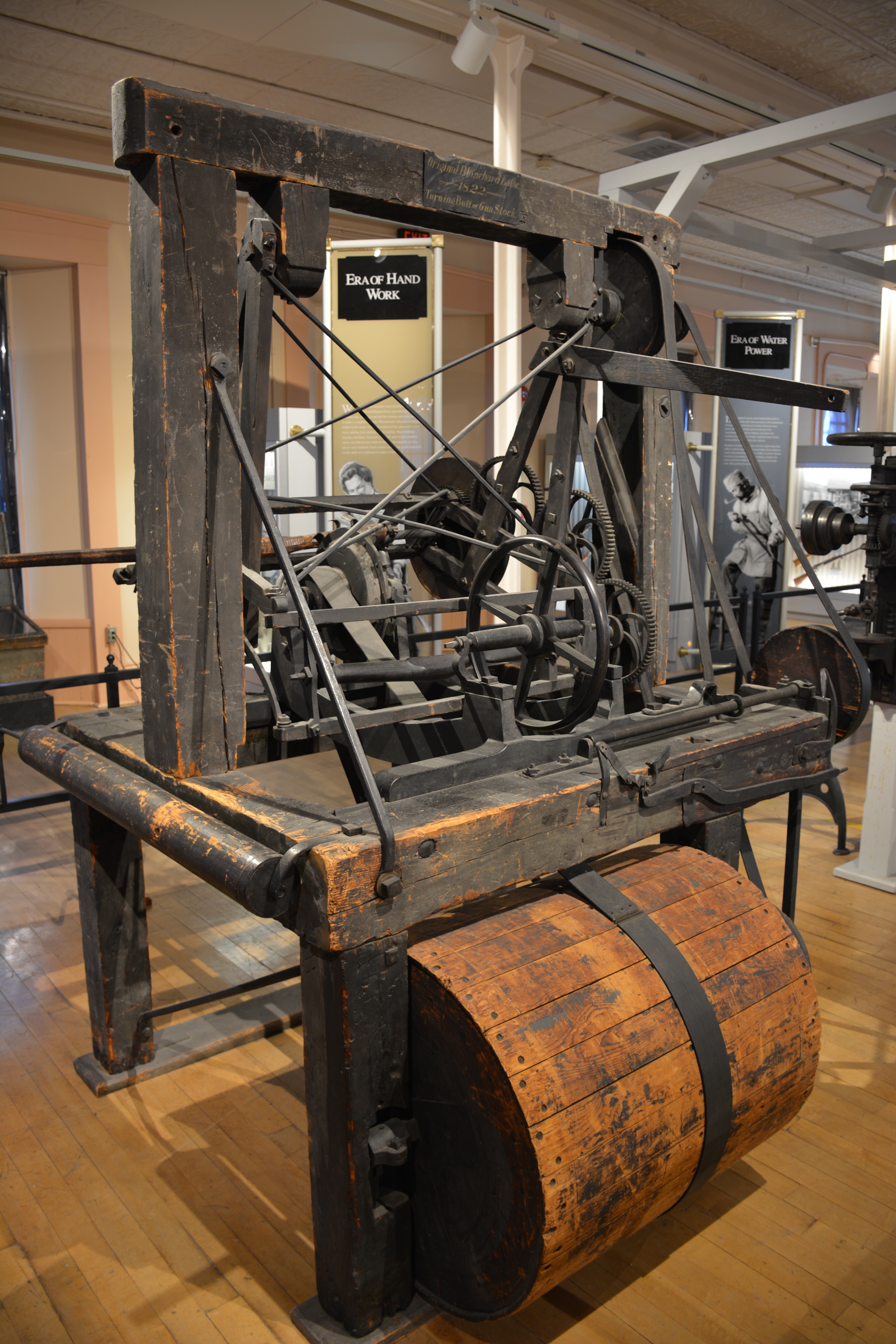
- Springfield Armory National Historic Site holds “the only surviving example of an original Blanchard Lathe,” dated 1822, catalog no. SPAR 5550, roughly 2.5 m tall, wood-and-metal — on permanent display (this series’ Vol 1/6/9 hero image).78
- American Precision Museum, Windsor VT (in the 1846 Robbins & Lawrence Armory) displays a Blanchard gunstock lathe as part of its American-System collection. No accession number or clean photo URL was resolved in the research — worth a direct inquiry if you ever visit.9
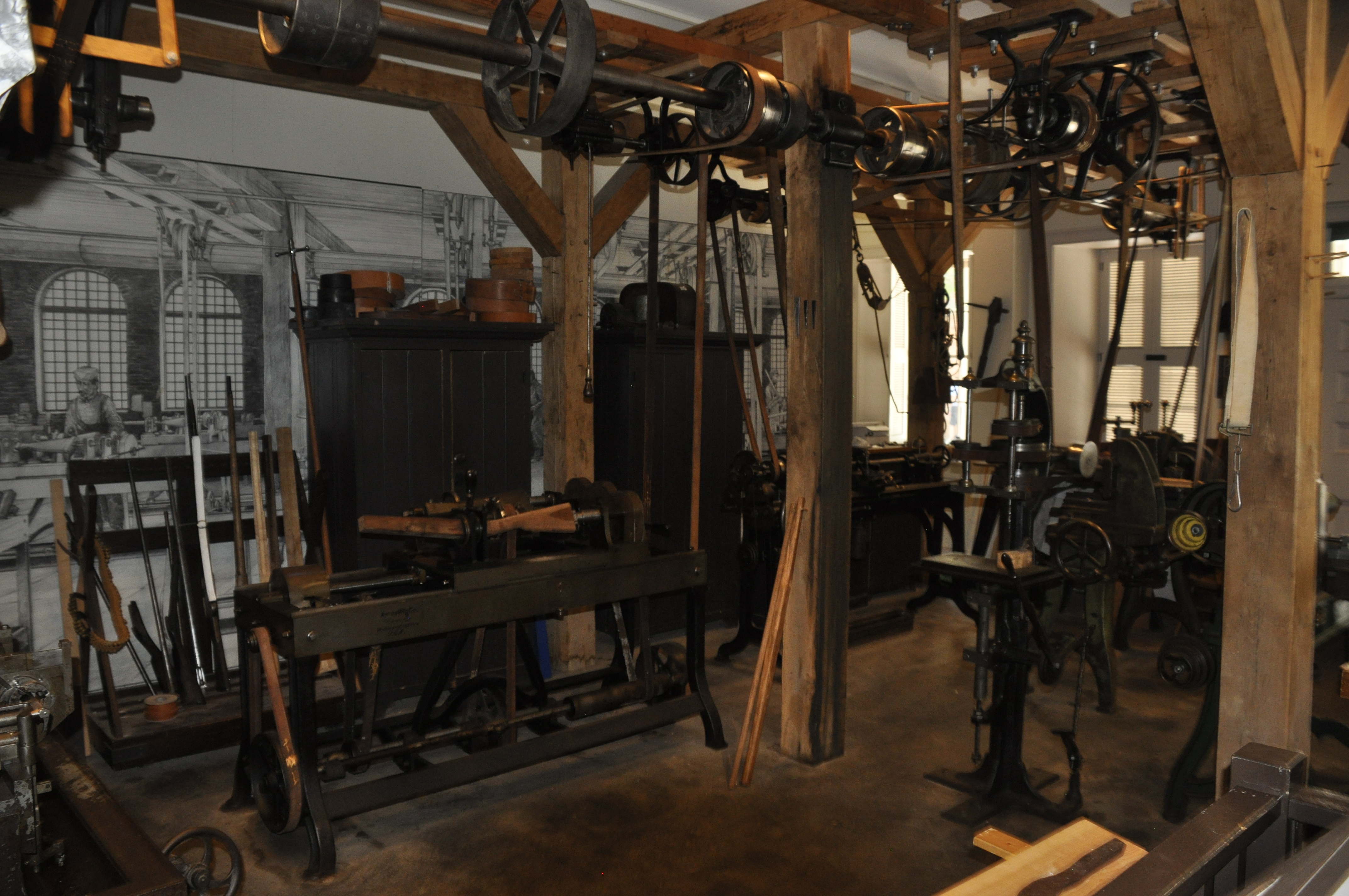
- Harpers Ferry (National Park) displays a later-generation, 1850s water-powered Blanchard-type duplicating lathe in the reconstructed gunsmith shop — the machine in this volume’s figure. A same-lineage representative, not the original Springfield machine.10
- The Henry Ford holds a cast-iron wood-copying lathe dated to the 1860s — Blanchard-type/descended technology, i.e., a later production example of the type, not necessarily an original Blanchard-built unit.11
The machine, in short, worked so well that its own principle out-evolved it, while the market it served walked away from wood entirely. That is the honest answer to “why don’t we use these anymore.”
7.6 Bibliography
Footnotes
-
Practical Machinist forum discussion of mid-20th-century gunstock duplicators (search-synthesized description). ↩
-
MidwayUSA, “The Fajen Years,” and related sources on Fajen’s CNC adoption and 1998 closure. https://www.midwayusa.com/larrys-short-stories/the-fajen-years/189 ↩
-
Boyds Hardwood Gunstocks, company history. https://www.boydsgunstocks.com/content/resource-center/about-boyds ↩
-
McMillan Fiberglass Stocks, CNC inletting process (search-synthesized from marketing/history content). ↩
-
General search synthesis on 5-axis CNC mills in modern stock duplication — soft-sourced. ↩
-
Search synthesis of RifleMagazine.com, American Hunter, and USA Wire on the Remington Nylon 66 / fiberglass / Weatherby Fibermark synthetic-stock timeline. ↩ ↩2 ↩3 ↩4
-
NPS, Springfield Armory NHS, “Thomas Blanchard and His Lathe.” https://www.nps.gov/spar/learn/historyculture/thomas-blanchard-and-his-lathe.htm ↩
-
Google Arts & Culture, “Blanchard Lathe” (dated 1822, catalog SPAR 5550, height 2.5 m). https://artsandculture.google.com/asset/blanchard-lathe/GQEi8p22l3Rj-A ↩
-
American Precision Museum, Windsor VT — collection reference. https://americanprecision.org/ ↩
-
Wikimedia Commons, File:Harpers_Ferry_gun_smith_shop_-Blanchard_lathe-_01.jpg (Jarek Tuszynski, CC BY 4.0). ↩
-
The Henry Ford, “Thomas Blanchard’s Wood Copying Lathe” (1860s cast-iron example). https://www.thehenryford.org/explore/blog/thomas-blanchard-s-wood-copying-lathe/ ↩
Comments (0)