The Blanchard Lathe · Volume 9
The Modern Equivalent & Cheatsheet
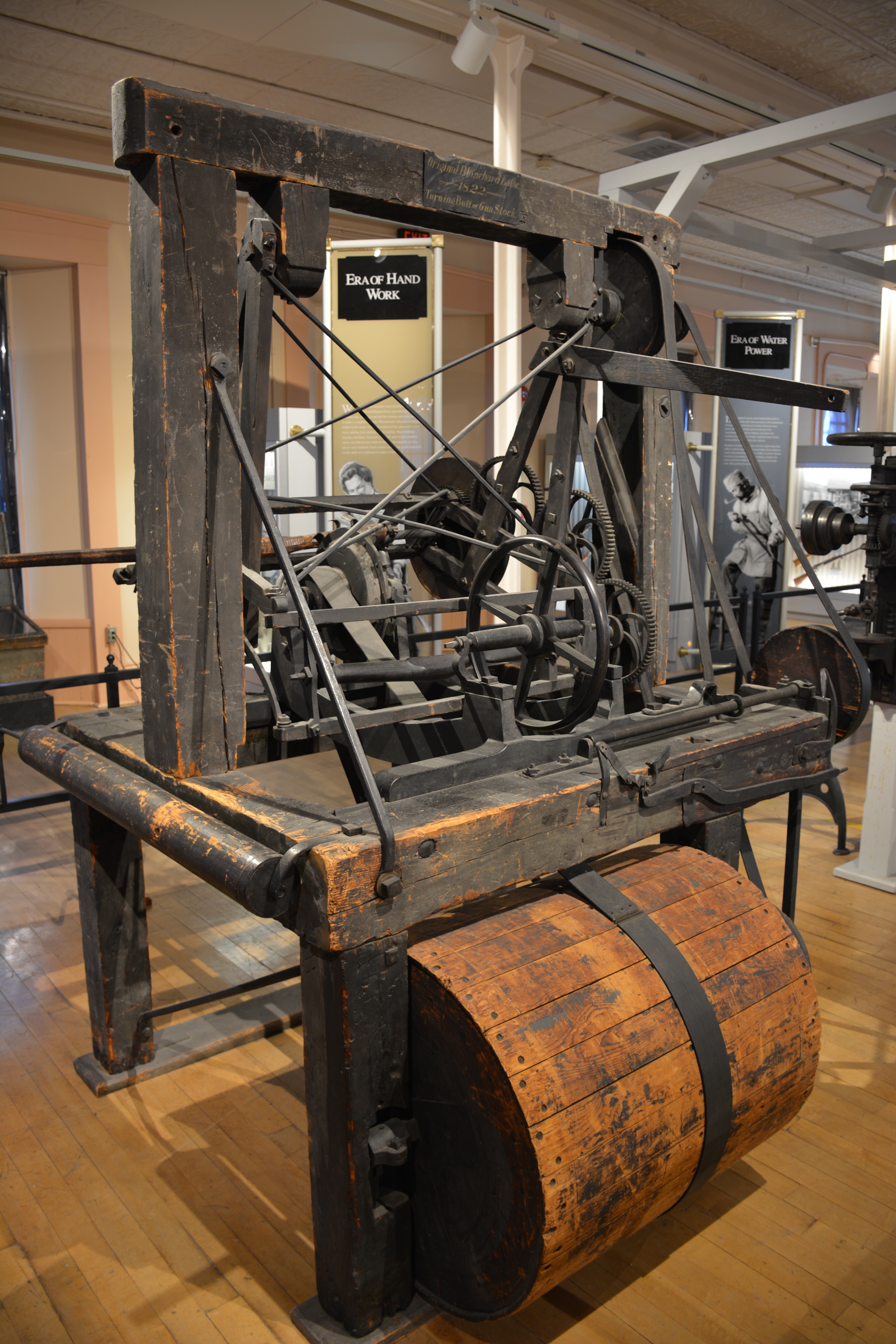
You already own the machine that made this one obsolete. This closing volume is the practical payoff: how you would actually reproduce a gunstock in your shop today, where a cheap middle path fits, whether building a Blanchard-principle copier is worth your bench time, and a laminate-ready cheatsheet that compresses the whole series onto one page.
9.1 The CNC Route — What Modern Stock-Makers Actually Do
The direct modern descendant of the Blanchard operation is a 4-axis (rotary A-axis) CNC setup, and it mirrors the original’s kinematics almost one-to-one: the workpiece rotates while a cutter traverses its length, except the “master” is now a digital model instead of an iron pattern. The workflow:
- Get the model. Either 3D-scan a donor/reference stock (photogrammetry or a hobby-grade structured-light/laser scanner) or model one from scratch in CAD (Fusion 360 or equivalent). The digital model is Blanchard’s iron master — with the enormous advantage that you can copy, edit, and version it freely, which is the single biggest thing the original could not do.
- Fixture on the 4th axis. Mount the blank between a rotary indexer (A-axis) and a tailstock so the CAM system can rotate it under the cutter — exactly the rotating-work geometry of the original.
- Rough with a ballnose or bull-nose end mill, stepping down in Z and indexing in A. Irregular organic 3D forms like a stock rough well with a ballnose and a rotary/parallel strategy; this is your roughing pass, and it is the analog of Blanchard’s single roughing traverse.
- Finish with a smaller ballnose to bring the scallop height down, then hand-sand to close the last bit. This is the same “machine to near-net, hand-finish the surface” division of labor the Blanchard line ran — just with vastly better as-cut tolerance and a far smaller finishing burden.
This is not theoretical: it is what real manufacturers do. Both McMillan and Boyds run CNC inletting/profiling programs keyed to specific action/barrel/stock combinations with a technician overseeing the cut.12 The router-with-4th-axis is the most direct, practical path for a one-off “Blanchard-style” duplication in a shop like yours; a mill would also work, but a router’s work envelope and speed usually suit wood better.
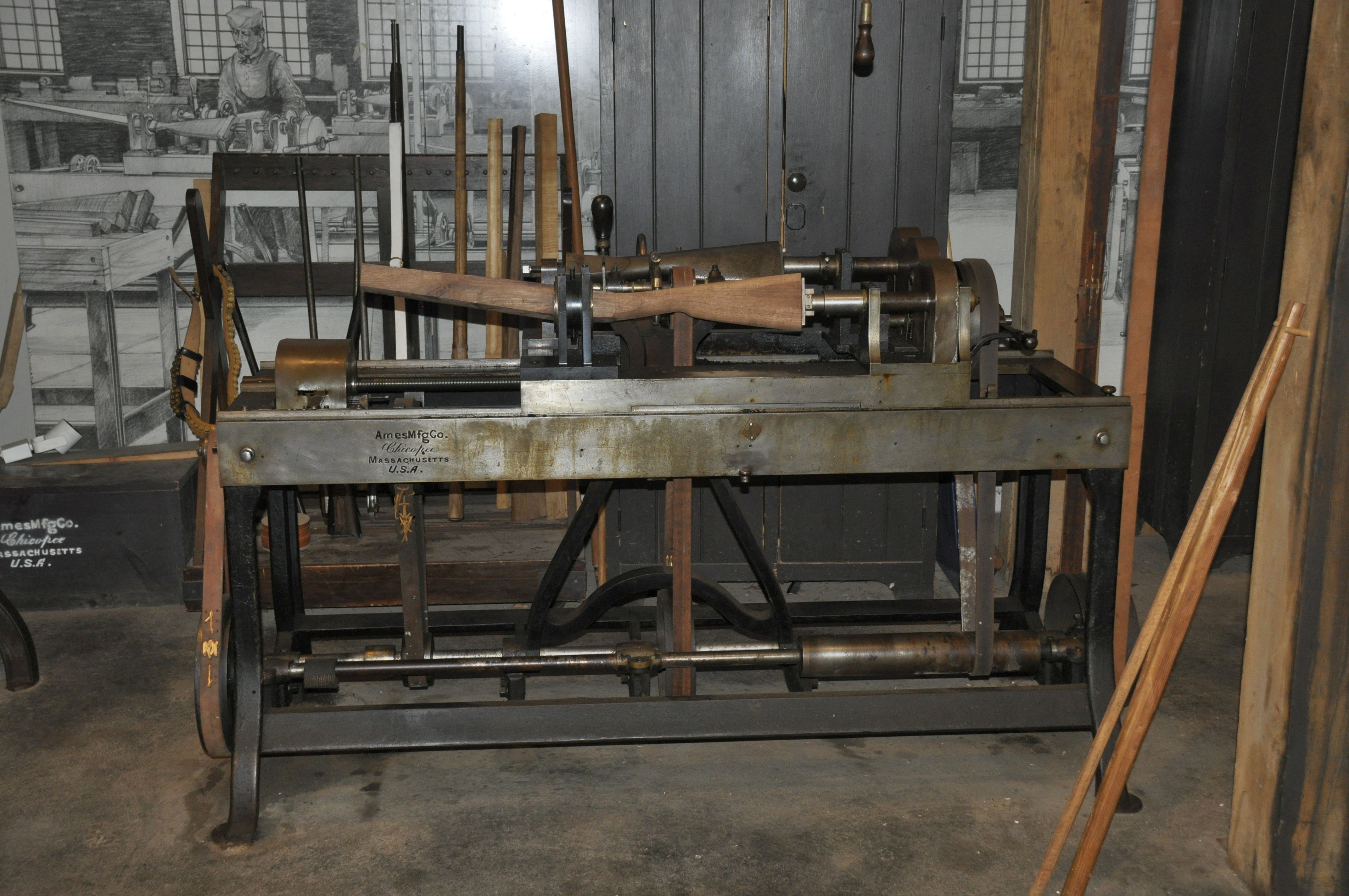
9.2 The Cheap Middle Path — Router Pantograph Duplicators
Between the CNC route and building your own machine sits a genuinely useful commercial tool: the router-based pantograph gunstock duplicator, e.g. the Gemini Universal / Gunstock Carver. It is a router-mounted rotary-fixture duplicator sized for gunstocks: a stylus/pattern-follower traces a master stock and guides a hand-fed router bit (roughly a 1¾-hp router, 3/4” carbide bit) over the blank, working in birch, maple, walnut, or laminate.3 Mechanically it is a true pantograph linkage rather than Blanchard’s swing frame, but in spirit it is the same trace-and-copy concept, and it is the direct commercial descendant of the idea. If you want to copy an existing stock without touching CAD, this is the low-friction option — cheaper than tooling up a CNC job for a single copy, and hands-on in a way some builders prefer.
9.3 Should You Build an Actual Blanchard-Principle Copier?
Straight answer: yes as a historical demonstrator, no as a production method.
The mechanism is genuinely approachable for your shop — two same-diameter wheels on a common pivoted arm, a means to synchronize model and blank rotation (shared shaft with belts or a timing arrangement), and a traversing carriage. The wheels, arm, bearings, and carriage are all mill-and-router work; nothing about it needs a capability you lack. As a working scale/historical recreation it would be a rewarding, instructive build and a great demonstration of why the thing works — which is squarely in the spirit of a deep dive about how machines functioned.
But be honest about the purpose. Against the CNC router and pantograph duplicator you already have (or can buy cheaply), a home-built Blanchard copier would be strictly worse for actually producing a stock: worse tolerance, worse finish, one physical master per design, an unguarded high-speed cutter to engineer around, and no ability to change the design without re-cutting the master. Build it because it is a beautiful mechanism you want to understand with your hands — not because it will make you a better stock than the machines that replaced it. Frame the project as “a working historical demonstrator,” and it is a great idea; frame it as “my new stock-making method,” and it is not.
9.4 Cheatsheet — The Whole Series on One Page
Timeline
Table 1 — Timeline
| Date | Event |
|---|---|
| 1788 | Thomas Blanchard born, Sutton, MA |
| ~1806-1817 | Tack machine (patent X0003010, 1817); dates conflict, unresolved |
| ~1817-1818 | Gun-barrel lathe for Asa Waters, Millbury MA |
| ~1818 | Gunstock lathe conceived/prototyped (reported, not certain) |
| 1819-09-06 | Patent X3,131, “Turning Irregular Forms,” granted (Millbury, MA) |
| 1820-01-20 | Patent withdrawn and reissued by act of Congress |
| ~1822 | Surviving/refined example built (the machine at Springfield NHS) |
| 1834 | Congressional patent extension (well-attested) |
| 1840 or 1848 | Further extension(s) — reported inconsistently; not resolved |
| 1851-52 | Bessey’s guidebook: 14 machines, 20 men in the stocking room |
| 1864 | Blanchard dies, Springfield MA |
| 1998 | Reinhart Fajen (first CNC gunstocks) suspends manufacturing — the type is gone |
Spec / fact table
Table 2 — Spec / fact table
| Item | Value | Confidence |
|---|---|---|
| Patent | US X3,131, “Turning Irregular Forms” | Verified |
| Granted | 1819-09-06, to Thomas Blanchard of Millbury, MA | Verified |
| Patent status | Restored pre-1836 X-patent (Patent Office fire, Dec 15 1836) | Verified |
| Copy ratio | 1:1 | Inferred from mechanism, not directly sourced |
| Machine type | Copying “lathe” — technically a shaper (rotating cutter) | Verified (NPS) |
| Stocking line | 14 machines (lathe + 13), 20 men | Verified, two sources |
| Royalty | 9¢ per gunstock, to Blanchard, at Springfield & Harpers Ferry | Verified (Iles) |
| What the lathe cut | Exterior profile only; inletting done by separate machines | Verified |
| Surface left | Rippled/faceted; hand-finished with scrapers & sandpaper | Verified (NPS) |
| Drive | Water power → line shaft → belts | Verified |
| Feeds/speeds/DOC | Unknown — no source found; not invented here | Gap |
| Surviving original | Springfield Armory NHS, 1822, SPAR 5550, ~2.5 m | Verified |
| Build year 1818/1819/1822 | Conflicting; 1819 = patent, 1822 = survivor | Flagged |
Do NOT confuse with: the Blanchard grinder — a vertical-spindle rotary surface grinder by Winslow Blanchard (Blanchard Machine Co.), first built 1909, still in production use. Different machine, different man, coincidental surname.
Source URLs
- Patent record (DATAMP): https://www.datamp.org/patents/displayPatent.php?pn=X3131&id=5435
- NPS, “Thomas Blanchard and His Lathe”: https://www.nps.gov/spar/learn/historyculture/thomas-blanchard-and-his-lathe.htm
- NPS, “Woodworking at Springfield Armory”: https://www.nps.gov/spar/learn/historyculture/sa-woodworking.htm
- National Inventors Hall of Fame: https://www.invent.org/inductees/thomas-blanchard
- Iles, Leading American Inventors (1912): https://todayinsci.com/B/Blanchard_Thomas/BlanchardThomas-LeadingAmInv.htm
- Gemini Gunstock Carver (router duplicator): https://www.wood-carver.com/gunstock.html
- Best modern scholarly source (un-fetched): Carolyn C. Cooper, Shaping Invention — via https://muse.jhu.edu/article/888479/summary
9.5 Bibliography
Footnotes
-
McMillan Fiberglass Stocks, CNC inletting process (search-synthesized). ↩
-
Boyds Hardwood Gunstocks, company history. https://www.boydsgunstocks.com/content/resource-center/about-boyds ↩
-
wood-carver.com, “Gunstock Carving and Duplication” (Gemini Universal/Gunstock Carver). https://www.wood-carver.com/gunstock.html ↩
Comments (0)