Types of Scopes · Volume 2
A History of the Telescopic Sight
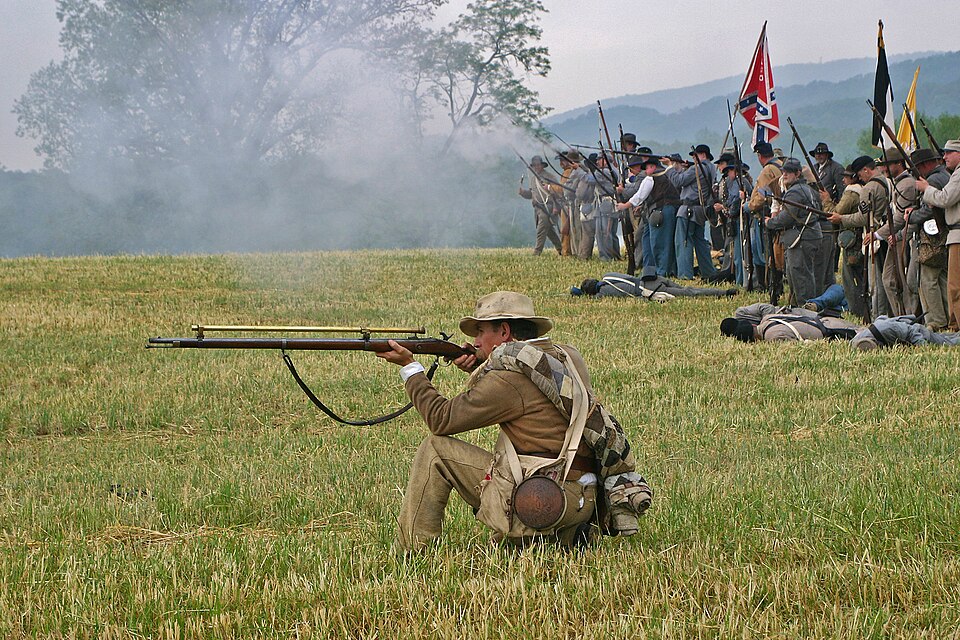
The telescopic sight is older than smokeless powder, older than the metallic cartridge, older than the American Civil War. Nearly every “modern” feature — an adjustable ocular, internal adjustment, nitrogen sealing, a mil-ranging reticle — was a fix for a specific failure of the design that came before it. Read the history that way, as a chain of solved problems, and the taxonomy in the rest of this series stops looking like a catalogue and starts looking like a lineage.
2.1 The American Origins: Chapman-James and Malcolm
The first documented telescopic rifle sight was built around 1835–1840. Civil engineer and rifleman John R. Chapman supplied the design concepts and the Utica, New York gunsmith Morgan James built the hardware; Chapman documented the result in his 1844 book The Improved American Rifle, and the optic is remembered as the Chapman-James sight.1 James’s telescopic sights were considered the best available until roughly 1855 and equipped Civil War sharpshooters, including Berdan’s men. (The earliest history here rests largely on secondary sources — the specialist primary record is thin — so treat the pre-1855 specifics as well-attested tradition rather than laboratory fact.)
The man who turned the idea into an industry was William Malcolm of Syracuse, who opened the first true riflescope manufacturing company in 1855. His innovations read like a list of the problems the American external-tube sights suffered: a 3/4-inch seamless steel tube for strength, achromatic lenses to fight chromatic aberration, lenses held in brass cells screwed against recoil, and — the commercial breakthrough — an adjustable ocular so a scope could be focused to any shooter’s eye and sold off the shelf rather than fitted to one man.2 Malcolm offered 3x to 20x, and his scopes served snipers on both sides of the Civil War alongside those of the Vermont jeweler L. M. Amidon.
These long external tubes had real limits. Mounted over or alongside the barrel, made of steel that was weak by later standards, with tight-tolerance focus mechanisms easily knocked out and lenses vulnerable to recoil shock, they cracked, lost zero, and demanded constant fussing. (The “weak steel” narrative is widely repeated but not backed by a primary engineering failure account — accept it as period-plausible, not documented.)
2.2 Europe Answers: Fiedler and Kahles
The fragility problem got its answer in Austria. August Fiedler, forestry commissioner for Prince Reuss at Stronsdorf, built an early practical refracting-telescope sight in 1880 — widely cited as the first optic rugged enough for genuine field use.3 The Austrian optical tradition it seeded produced Kahles of Vienna, founded 1898 by Karl Robert Kahles, whose first riflescope — the five-magnification TELORAR of 1900 — the company calls the first rifle scope, and itself “the oldest rifle scope manufacturer in the world.” (A popular story that Kahles began “following Fiedler’s 1880s design” conflates two separate Austrian milestones about twenty years apart; the primary 1898/1900 company dates are the ones to trust.) By 1900 telescopic sights had genuinely caught on for European hunting.
2.3 The World Wars
WWI forced the first mass military optics. The American answer was the Warner & Swasey Musket Sight, Model of 1908, designed by Ambrose Swasey: a prismatic (not simple refracting) 6x sight giving a wide field of view, mounted on the left of the M1903 Springfield’s receiver so the iron sights and stripper-clip loading survived. About 2,075 M1908s were procured. The Model of 1913 dropped magnification to 5.2x for brightness; some 5,730 were made, though most arrived after the Armistice and were never issued. It first saw combat in the 1916 Punitive Expedition into Mexico and was withdrawn in the mid-1920s.4 Germany fielded no single standard — 4x sights from Goerz and Zeiss, plus requisitioned civilian hunting scopes, on the Gewehr 98.
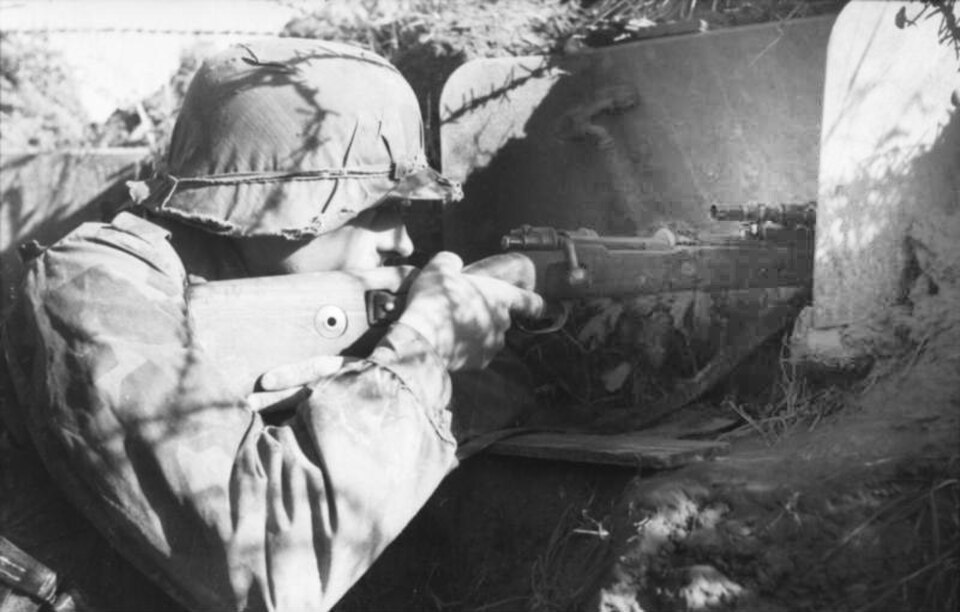
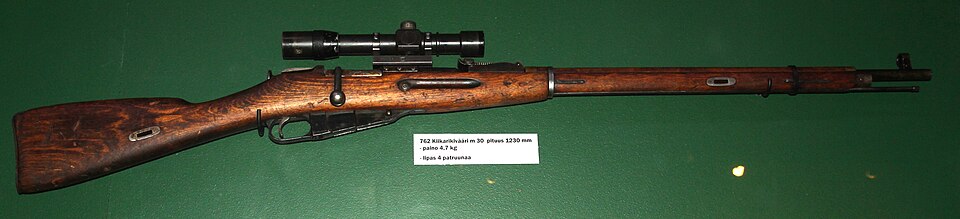
WWII produced the classics. The USMC adopted the Unertl 8x target scope (it actually measured ~7.8x) on modified M1903s from late 1942 — only about 2,500–2,600 were built, and famously they had no return spring, so snipers pulled the scope manually back into battery after each shot.5 The US Army, unable to get enough Lyman Alaskans (adopted as the M73), fielded the Weaver 330 as the M73B1 on the M1903A4 at 2.75x. Germany’s ZF41 was a 1.5x long-eye-relief sight introduced in 1941 — over 100,000 were made, but it was really a designated-marksman aid that snipers disliked, and the 4x ZF4 arrived in 1943 to replace it. The Soviets standardized on the PU, a compact 3.5×21 developed for the SVT-40 and adapted to the Mosin-Nagant from 1942 — simple, fog- and shock-resistant, graduated 0–1,300 m, and produced at roughly 53,000 scoped rifles a year by 1942.6
2.4 Post-War: Sealing, Variables, and Bigger Tubes
The post-war revolution was mundane and decisive: they got the fog out. Leupold, an Oregon surveying-instrument firm, entered riflescopes in 1947 after founder Marcus Leupold’s own scope fogged on a deer, and in 1949 became the first American maker to sell a nitrogen-filled, fog-proof scope — a technique borrowed from the Merchant Marine’s nitrogen-purging of shipboard optics. Nitrogen was chosen not just as “a dry gas” but because it is chemically inert (no internal oxidation of metal or coatings), it displaces the moisture-laden air that would otherwise condense to internal fog when the scope cooled below its dew point, and it is cheap and abundant; modern scopes increasingly use argon, whose larger molecule leaks past seals more slowly.7 Leupold added the Duplex reticle in 1962. (Note the common conflation: Redfield in WWI designed rotary dovetail mounts, not scopes — it became a scope maker only in 1958 by buying Kollmorgen’s operations.)
Variable-power scopes existed from the 1930s (Zeiss) but sold poorly, plagued by zero-shift, non-centered reticles, and fogging. Genuine internal adjustment traces to the German-born watchmaker Rudolph Noske, who built one by 1929, but it was Bill Weaver’s mass-produced Model 330 (1930, about $19 with mounts) that made scopes affordable. Variables did not become genuinely trustworthy until the mid-1960s, once sealing and reticle-centering were solved.
Tube diameter tells the same problem-solving story. One inch (25.4 mm) was the American standard; the move to 30 mm and then 34/35 mm is driven mainly by internal adjustment travel — the erector assembly must physically pivot inside the main tube, and a larger tube gives it more room before it runs out of travel. A 1-inch design might offer ~49 MOA total adjustment where a comparable 30 mm gives ~77 and a 34 mm can exceed 100 MOA (illustrative retailer figures, not maker-verified — the relationship is real but not strictly linear). Bigger tubes buy travel and rigidity, not light.

2.5 The Modern Era: LPVO, FFP, and the Mil/Mil Revolution
Three modern threads close the history. The LPVO arose from a real tactical gap: after the 1993 Battle of Mogadishu, SOF found themselves choosing between a red dot for close work and a fixed 4x ACOG for distant identification, neither ideal for both. Schmidt & Bender’s 1.1-4x20 Short Dot codified the answer — a true-1x illuminated reticle that dialed up — and the format every later LPVO followed. (Read the Mogadishu-causation as the industry’s standard narrative rather than a documented procurement record.) FFP became the precision default through the 2000s–2010s because its subtensions stay valid at any magnification. And the mil/mil convention won precision shooting: the mil-dot reticle was a USMC development fielded on Unertl-built M40 scopes in the early 1980s to range man-size targets before laser rangefinders were common, and the founding of the Precision Rifle Series in 2012 — 164 competitors then, 20,000+ by 2025 — cemented milliradian math as the sport’s lingua franca.8
2.6 Bibliography
- Wikipedia, “Telescopic sight.” https://en.wikipedia.org/wiki/Telescopic_sight
- Hi-Lux Optics, “Wm. Malcolm Played a Major Role in the Earliest Riflescope Development.” https://hi-luxoptics.com/blogs/history/wm-malcolm-played-a-major-role-in-the-earliest-riflescope-development
- WarPC, “Springfield M1903 with the Warner & Swasey Telescopic Sight Model 1908 and 1913.” https://www.warpc.org/articles/springfield-m1903-with-the-warner-swasey-telescopic-sight-model-1908-and-1913/
- American Rifleman, “The M1903A1 Unertl USMC Sniper Rifle.” https://www.americanrifleman.org/content/the-m1903a1-unertl-usmc-sniper-rifle/
- Wikipedia, “PU scope.” https://en.wikipedia.org/wiki/PU_scope
- Leupold, “A Living History.” https://www.leupold.com/a-living-history
- Shooting Illustrated, “LPVO History and Applications.” https://www.shootingillustrated.com/content/lpvo-history-and-applications/
- Wikipedia, “Precision Rifle Series.” https://en.wikipedia.org/wiki/Precision_Rifle_Series
Footnotes
-
Chapman supplied the design; James manufactured; the sight was documented in Chapman’s 1844 The Improved American Rifle. Wikipedia, “Telescopic sight.” ↩
-
Malcolm’s 1855 firm introduced the 3/4-inch seamless steel tube, achromatic lenses in screwed brass cells, and an adjustable ocular allowing off-the-shelf sale. Hi-Lux Optics, “Wm. Malcolm.” ↩
-
Fiedler, forestry commissioner at Stronsdorf, built a field-usable refracting sight in 1880. Wikipedia, “Telescopic sight.” ↩
-
The M1908 was 6x prismatic; the M1913 was 5.2x; the M1913 first saw combat in the 1916 Punitive Expedition. WarPC, “Springfield M1903 with the Warner & Swasey Sight.” ↩
-
The Unertl 8x (measured ~7.8x) had no return spring; ~2,500–2,600 were built. American Rifleman, “The M1903A1 Unertl USMC Sniper Rifle.” ↩
-
The PU 3.5×21 was developed for the SVT-40 and adapted to the Mosin-Nagant from 1942, graduated 0–1,300 m. Wikipedia, “PU scope.” ↩
-
Nitrogen is inert, displaces moisture-laden air, and is cheap; argon’s larger molecule leaks more slowly through seals. Leupold, “A Living History”; Optics Warehouse and Tract Optics on purging. ↩
-
The mil-dot reticle was fielded on USMC M40 Unertls in the early 1980s; the PRS was founded in 2012 and grew to 20,000+ competitors by 2025. Hi-Lux Optics, “The Long Life of the M40”; Wikipedia, “Precision Rifle Series.” ↩
Comments (0)