Types of Scopes · Volume 5
Reflex, Prism & Holographic
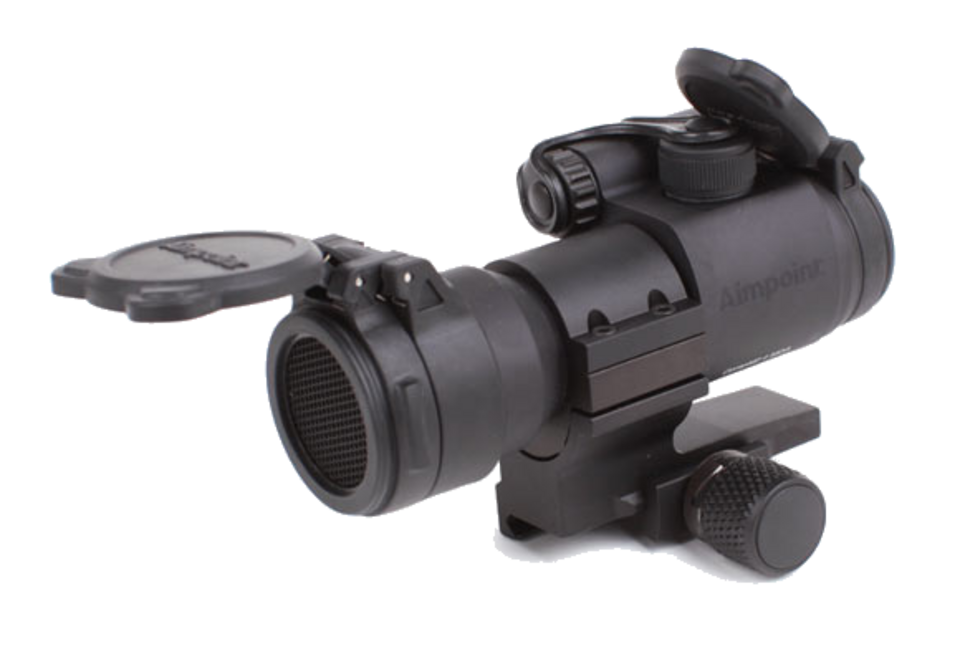
These are the non-magnified (or barely magnified) sights, and they are grouped together for a good reason and split apart for a better one. The good reason: all three put an aiming mark on the target without asking the eye to focus at the sight’s distance. The better reason to split them: a reflex sight reflects a dot, a holographic sight reconstructs a diffraction pattern, and a prism sight shows a real etched image — three fundamentally different pieces of physics that produce three different behaviors with astigmatism, dead batteries, and cold weather.
5.1 Reflex / Red-Dot Sights: The Collimated Dot
The core principle is elegant. An LED sits at the focal point of a curved (spherical or parabolic) reflector lens. Light from the LED reflects off that curve back toward the eye and emerges collimated — the rays leave parallel, so the eye perceives a point source at optical infinity. Because it is at infinity, the dot floats on the target regardless of where the eye sits behind the sight; there is no alignment of front-and-rear elements to get right. The curved lens carries a dichroic coating tuned to reflect only the LED’s wavelength (~650–670 nm red, ~510–530 nm green) while transmitting the rest of the scene, which is why you see the world clearly and a bright dot painted on it.1
“Parallax-free” deserves a precise qualifier. Collimation is truly parallax-free only for a target at infinity; at finite distance a small residual parallax remains, bounded by roughly the diameter of the collimating optic — real, but small at practical ranges, not a strict zero.2 For a pistol-sized window that residual is a fraction of the dot; for practical shooting it is negligible.
Open vs enclosed emitter. An open (exposed) reflex has a bare LED in an open cup ahead of a single exposed lens. A raindrop, mud smear, or dust across that lens can distort or kill the dot, and clearing it means digging debris out of the cup. An enclosed emitter seals the LED and reflective lens inside a housing with flat front and rear windows: debris only lands on an external window you wipe in one pass, and the dot keeps working through a dirty window the whole time. The cost is extra bulk, weight, and a taller mounting height on a pistol.3
Astigmatism and the starburst. An astigmatic cornea or lens is not a uniform sphere, so it cannot focus a point source to a single retinal point — it forms two focal lines. The collimated LED that resolves to a clean dot in a normal eye gets smeared across those misaligned lines, producing a starburst, comet-tail, or blown-out blob. It is worse at brighter dot settings and in low light (large pupil). Dimming the dot or shooting in bright daylight (small pupil) reduces it — and, as below, a prism sight sidesteps the problem entirely.4
MRDS footprints. Pistol micro red-dot mounting is a compatibility minefield because the industry never converged on one footprint. The verified-real standards worth knowing:
Table 1 — MRDS footprints. Pistol micro red-dot mounting is a compatibility minefield because the industry never converged on one footprint. The verified-real standards worth knowing
| Footprint | Representative optics | Note |
|---|---|---|
| Trijicon RMR | RM06 (3.25 MOA), RM07, RM09 | De-facto full-size/duty standard |
| Docter / Noblex | Burris FastFire, Vortex Viper/Venom | Four corner sockets + two screws |
| Shield RMSc | Holosun 407K/507K, Vortex Defender-CCW | Narrow-frame subcompact standard |
| Aimpoint ACRO | ACRO P-1, P-2; Steiner MPS (adapter) | Proprietary enclosed “Acro interface” |
| Holosun K | Holosun 507K (fits SIG P365 natively) | Narrower RMSc variant; not drop-in with RMSc cuts |
Exact millimeter spacings are only secondary-source reported (several makers’ own pages block direct access), so trust the footprint names as compatibility keys and treat any quoted mm dimension as “commonly reported.”
5.2 Prism Sights: The Etched Reticle
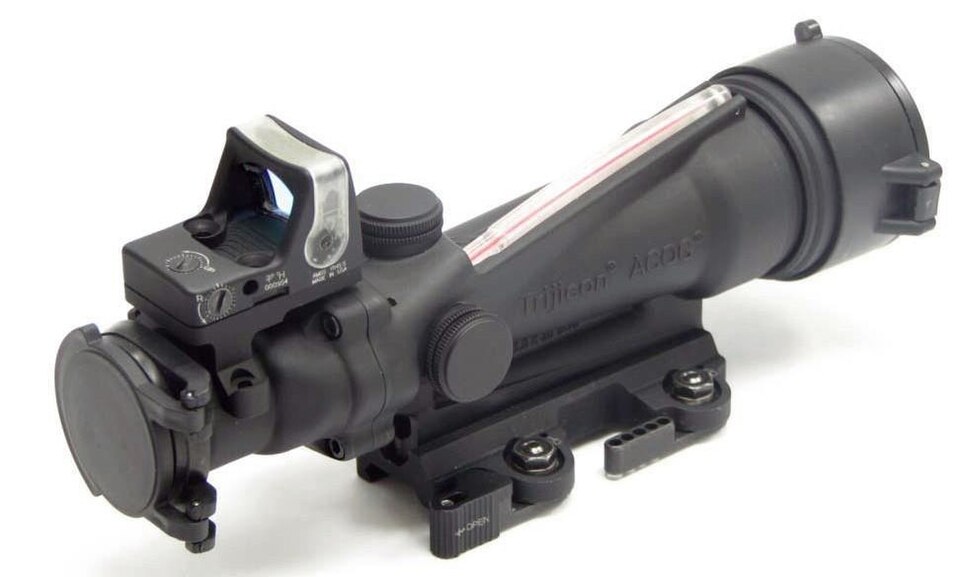
A prism sight uses a prism to erect the image and an etched glass reticle at a real, fixed focal plane. That single fact drives all its behavior. The eye focuses on the reticle like any real object, so — crucially — the etched reticle stays visible with a dead or absent battery; illumination is a bonus, not a requirement for the reticle to exist. And because the reticle is a real image on glass rather than a collimated point source, the astigmatic eye’s inability to focus point sources to a point does not smear it — no starburst. This is why prisms are the standard recommendation for shooters with astigmatism.5 The costs are fixed low magnification (~1x–5x) and short eye relief (~2–4 in), because a prism uses real magnifying and erecting optics rather than projecting a mark to infinity. The Squad Day Optic below pairs a prism-class magnified optic with a piggyback red dot — a common way to get an etched ranging reticle plus a fast close-in dot.
5.3 Holographic Sights: Reconstructing a Wavefront
A holographic sight is not a reflex sight with a fancier reticle — it is a different machine. A laser diode (coherent light, not an LED) illuminates a holographic film that recorded, at manufacture, a transmission-hologram interference pattern of the reticle. Illuminating that recorded pattern diffracts and reconstructs the original reticle wavefront, so the shooter sees a reconstructed holographic image of the reticle appearing out at the target plane — not a dot bounced off a curved mirror.6 Three practical consequences follow. First, the reticle can be far more complex and detailed (EOTech’s signature 1-MOA dot inside a 68-MOA ring). Second, because it is a reconstructed wavefront rather than a simple collimated reflection, it holds together differently off-axis and needs no dichroic mirror coating, so the window transmits more light. Third, the laser diode’s wavelength drifts with temperature, so the design must include achromatic compensation to keep the reticle stable.
That thermal sensitivity is not academic. EOTech (real-world holographic exemplar; the HoloSight debuted at the 1996 SHOT Show) became a cautionary tale: its sights exhibited thermal drift — point of aim shifting from point of impact under temperature extremes — plus moisture-incursion problems. In 2015 the US Attorney for the Southern District of New York filed and simultaneously settled a False Claims Act suit against L-3 Communications/EOTech for knowingly selling defective sights for roughly a decade, settling for $25.6 million on November 24, 2015.7 The exact drift magnitude varies by source — from about 4 in in Army safety language up to 12–20 in at 300 yd elsewhere — so treat it as “up to several inches to over a foot depending on temperature extreme and source,” not a single hard figure. The other holographic cost is power: driving a laser diode is far hungrier than an LED, so EOTech AA/CR123 models run roughly 600–1,100 hours against modern LED reflex sights’ tens of thousands (an Aimpoint ACRO P-2 or Holosun 507K claims ~50,000 hr).

5.4 Magnifiers Behind Red Dots
A magnifier is a separate fixed-power optic mounted behind a red dot or holographic sight on the same rail. The shooter looks through the magnifier at the dot’s reticle, and the magnifier applies true afocal magnification to the whole sight picture — target and dot together — turning a 1x reflex into a fixed 3x, 5x, or 6x without modifying the reflex at all. A flip-to-side mount rotates it out of the path in under a second for 1x close work. Verified real flip magnifiers include the SIG Sauer JULIET3 and Holosun HM3X/HM3XT/HM6X; 3x is the most common (roughly 50–200 yd) with 5x/6x for longer identification.8
5.5 Bibliography
- Wikipedia, “Red dot sight.” https://en.wikipedia.org/wiki/Red_dot_sight
- Revell Photography, “How Do Red Dot Sights Work?” https://revellphotography.com/how-do-red-dot-sights-work/
- Primary Arms, “Open vs Closed Emitter Red Dot for Pistols.” https://blog.primaryarms.com/guide/open-vs-closed-emitter-red-dot-for-pistols/
- Primary Arms, “Red Dot with Astigmatism Guide.” https://blog.primaryarms.com/guide/red-dot-with-astigmatism-guide/
- Wikipedia, “Prism sight.” https://en.wikipedia.org/wiki/Prism_sight
- Wikipedia, “Holographic weapon sight.” https://en.wikipedia.org/wiki/Holographic_weapon_sight
- Military.com, “US Optic Maker Settles Lawsuit Over Defective Rifle Sights.” https://www.military.com/daily-news/2015/12/02/us-optic-maker-settles-lawsuit-over-defective-rifle-sights.html
Footnotes
-
An LED at the focal point of a coated concave lens produces a collimated dot; a dichroic coating reflects only the LED wavelength. Wikipedia, “Red dot sight”; Revell Photography. ↩
-
Residual finite-distance parallax is bounded by roughly the collimating optic’s diameter. Wikipedia, “Red dot sight.” ↩
-
Enclosed emitters seal the LED and lens behind wipeable external windows; open emitters expose the LED cup to debris. Primary Arms, “Open vs Closed Emitter.” ↩
-
Astigmatism forms two focal lines that smear a collimated point source into a starburst, worse when the dot is bright or the pupil large. Primary Arms, “Red Dot with Astigmatism.” ↩
-
A prism’s etched reticle is a real image at fixed focus, so it survives a dead battery and does not starburst; costs are ~1–5x fixed magnification and ~2–4 in eye relief. Wikipedia, “Prism sight.” ↩
-
A laser diode reconstructs a recorded transmission hologram of the reticle by diffraction, unlike a reflex’s collimated reflection. Wikipedia, “Holographic weapon sight.” ↩
-
SDNY filed and settled a False Claims Act suit against L-3/EOTech for $25.6 million on Nov 24, 2015, over thermal-drift and moisture defects. Military.com. ↩
-
A rear-mounted magnifier applies afocal magnification to the whole reflex sight picture; flip-to-side mounts (SIG JULIET3, Holosun HM3X/HM6X) swing it aside for 1x. Retailer product listings. ↩
Comments (0)