Types of Scopes · Volume 4
Magnified Optics
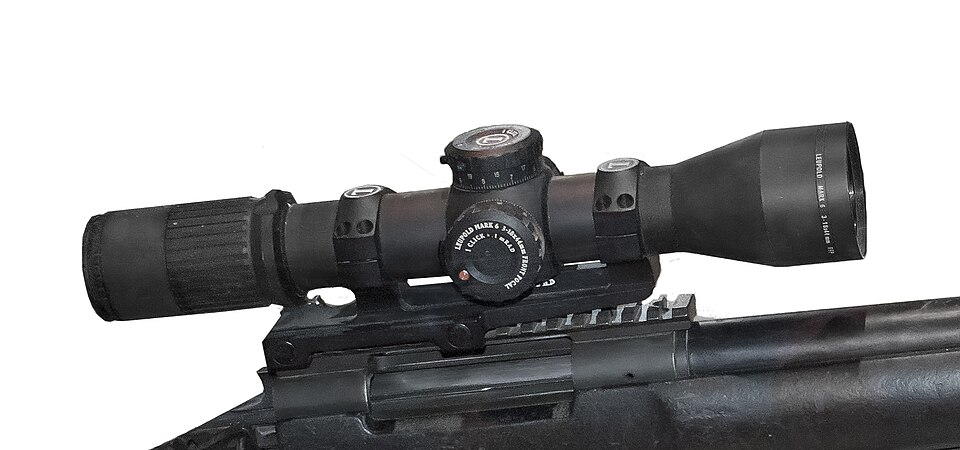
Magnified optics are the oldest and broadest family, and “how much magnification” is the least interesting thing about them. What actually separates a hunting scope from a precision scope from a scout scope is a cluster of design decisions — focal plane, turret style, reticle language, tube robustness, eye relief — that follow from the shooting problem each is built for. This volume walks the sub-families and the trade-offs that place them.
4.1 Fixed vs Variable Power
A fixed-power scope has one static erector-to-lens relationship: a simpler optical path, fewer moving parts, and historically more durability and less point-of-impact shift than early variables. That reliability is exactly why Jeff Cooper’s scout-rifle spec called for a fixed 3x, and why fixed 4x and 6x ACOG-class prisms earned their combat reputation.
A variable-power scope zooms by physically sliding the erector lens group fore and aft. The power ring rotates a cam tube whose angled slots translate that rotation into the erector’s linear travel, changing the effective focal length while the erector keeps re-inverting the image throughout its stroke.1 Ranges run from hunting ratios (3-9x, 4-12x) to long-range (5-25x, 6-30x). Modern variables have long since solved the zero-shift and fogging that doomed their 1930s ancestors, so the fixed-power advantage today is mostly weight, simplicity, and cost — not reliability.
4.2 Precision / Tactical Scopes
A precision scope is defined by a bundle of features, not by magnification:
- Exposed / tactical turrets meant to be dialed shot-to-shot, versus the capped, set-once turrets of a hunting scope.
- First focal plane so subtensions stay true at any power (Volume 3).
- Mil/MRAD (or MOA/MOA) reticles — “MRAD” is milliradian, not “military” — matched to the turret unit.
- Higher top-end magnification, roughly 15–25x and up, versus a hunting scope’s 9–12x.
- Robust construction — thicker tubes, often 34 mm, reinforced turrets rated for repeated dial cycles, and mil-spec shock and water testing.2
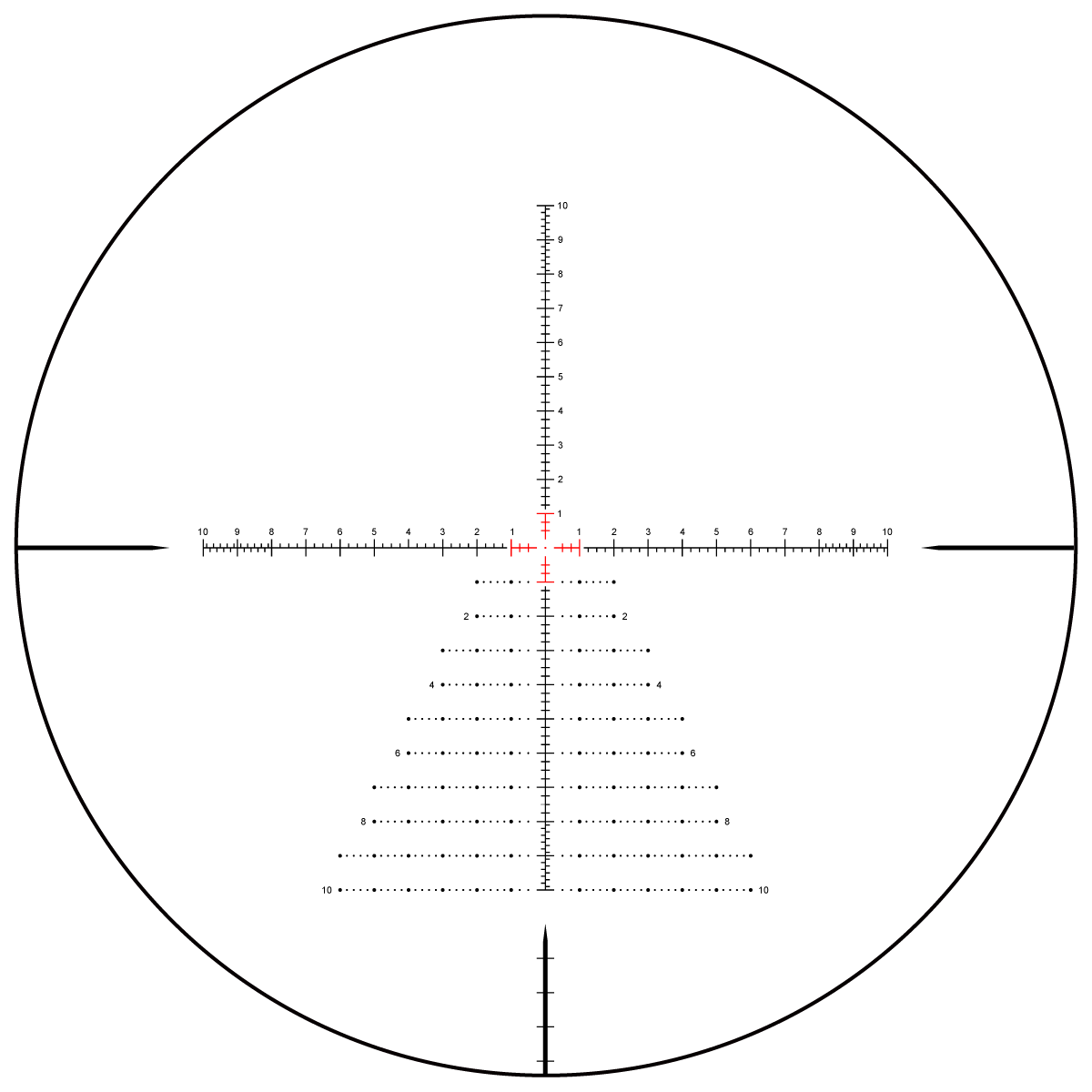
Some military and law-enforcement users still choose SFP in this class, trading true-at-any-power subtensions for a bold reticle that stays visible at low power. The “Christmas tree” holdover grid below is the reticle style that defines modern PRS-oriented precision optics — a dense matrix of wind and elevation references for holding rather than dialing.
4.3 LPVO (Low-Power Variable Optic)
The LPVO is the do-everything carbine optic: dominant ranges are 1-6x and 1-8x, with 1-10x now common. The whole proposition rests on a genuine true 1x, which lets the shooter run it both-eyes-open like a red dot for close work, then dial up for identification and precision at distance. Be warned that not every advertised “1x” is truly 1.0x — some show slight magnification and eye-box quirks at their bottom setting — but no reliable source names specific offenders, so treat it as a buyer’s caution rather than a model list. Historically the category answered the post-Mogadishu need for one optic that did both close and distant work; Schmidt & Bender’s Short Dot codified the format, and 3-Gun’s “Tactical Optics” divisions made 1-6x/1-8x the default competition class.3
The LPVO’s honest costs are weight, a fussier eye box than a red dot at speed, and — at its low end — a reticle that in FFP form can be nearly invisible until you dial up (which is why many LPVOs are SFP with a daylight-bright center dot, or FFP with an illuminated floating dot for the 1x role).
4.4 Scout Scopes
The scout concept is Jeff Cooper’s, from the Gunsite Scout Rifle Conferences of 1983–84: a compact general-purpose rifle carrying a forward-mounted, long-eye-relief low-power (2–3x) optic. The forward mount preserves peripheral vision, keeps the action open for stripper-clip reloads, and keeps the ocular clear of the brow under recoil. True forward-scout eye relief runs ~9–12 in (a Burris Scout is 9.2–12 in); loosely marketed “IER” scout optics offer only ~6–7 in and are not the same thing. The Steyr Scout, developed with Cooper, entered series production in 1998.4
4.5 Spotting Scopes
A spotting scope is the one member of this family that does not mount on a rifle — it is a stand-alone tripod instrument for confirming impacts, calling shots and wind, and glassing. Magnification typically runs 15–45x (high-end 40–60x) on 60–85 mm objectives, far larger than a riflescope’s 32–56 mm, purely for light-gathering and resolution at distance. Above roughly 40x a tripod is mandatory — no rifle platform is steady enough to exploit that power, which is precisely why the spotting scope is a separate class rather than a big riflescope.5
4.6 The Trade-Off Table
Table 1 — The Trade-Off Table
| Sub-family | Typical mag | Focal plane | Turrets | Best at | Chief cost |
|---|---|---|---|---|---|
| Fixed power | 3x, 4x, 6x | SFP | Capped | Durability, simplicity, weight | No zoom flexibility |
| Hunting variable | 2-7x, 3-9x, 4-12x | SFP | Capped | Field shots inside ~300 yd | Subtension true at one power |
| Precision/tactical | 5-25x, 7-35x | FFP (usually) | Exposed | Dialed long-range hits | Weight, cost, eye box at top |
| LPVO | 1-6x, 1-8x, 1-10x | SFP or FFP | Capped/exposed | One optic, CQB to ~mid-range | 1x quirks, weight vs red dot |
| Scout | 2-3x | SFP | Capped | Fast, forward-mount, iron backup | Limited magnification |
| Spotting | 15-60x | n/a | n/a | Observation, wind/impact calls | Not rifle-mountable; needs tripod |
The through-line: pick the focal plane and turret style for how you will use the subtensions, then let magnification and objective follow from the distance and the light. A hunter who dials nothing and shoots inside 300 yd is poorly served by an FFP mil scope whose reticle vanishes at 4x; a PRS shooter holding wind at 18x is crippled by an SFP duplex. The optic follows the job.
4.7 Bibliography
- Rainier Arms, “Rifle Scopes Basics: How They Work.” https://www.rainierarms.com/blog/rifle-scopes-basics-how-they-work.html
- Outdoorsmans, “Riflescopes: First Focal Plane vs Second Focal Plane.” https://outdoorsmans.com/blogs/rifle-scopes/riflescopes-first-focal-plane-vs-second-focal-plane
- AmmoMan, “The Rise of the LPVO.” https://www.ammoman.com/blog/the-rise-of-the-lpvo/
- Wikipedia, “Scout rifle.” https://en.wikipedia.org/wiki/Scout_rifle
- Wikipedia, “Steyr Scout.” https://en.wikipedia.org/wiki/Steyr_Scout
- Scheels, “Spotting Scopes Buying Guide.” https://www.scheels.com/e/post/spotting-scopes-buying-guide/
Footnotes
-
A variable zooms by sliding the erector group on a cam tube whose slots convert power-ring rotation into linear travel. Rainier Arms, “Rifle Scopes Basics.” ↩
-
Precision scopes are defined by exposed turrets, FFP, mil/MOA reticles, higher magnification, and robust construction — not magnification alone. Outdoorsmans, “FFP vs SFP.” ↩
-
LPVOs center on 1-6x/1-8x with a true 1x; the category traces to the post-Mogadishu ID need and the Schmidt & Bender Short Dot, then 3-Gun adoption. AmmoMan, “The Rise of the LPVO.” ↩
-
Cooper’s scout concept (1983–84) used a forward long-eye-relief 2–3x optic (~9–12 in relief); the Steyr Scout entered production in 1998. Wikipedia, “Scout rifle” and “Steyr Scout.” ↩
-
Spotting scopes run 15–60x on 60–85 mm objectives and require a tripod above ~40x — a separate class from rifle optics. Scheels, “Spotting Scopes Buying Guide.” ↩
Comments (0)