Types of Scopes · Volume 6
Night Vision & Thermal
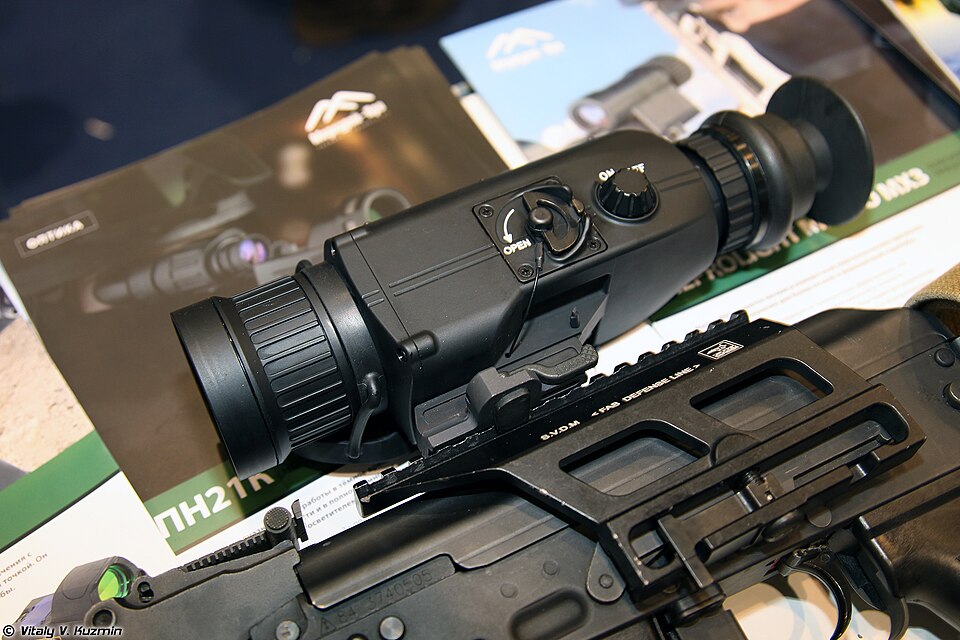
Night vision and thermal are the two families most shrouded in marketing fog, and they are genuinely different physics doing genuinely different jobs. Image-intensified night vision amplifies the tiny amount of light that is already there; thermal ignores visible light entirely and images the heat objects emit. Get that distinction wrong and every purchasing decision downstream is wrong. This volume takes them in turn, then addresses the export controls that wrap both.
6.1 Image-Intensified Night Vision: The Generations
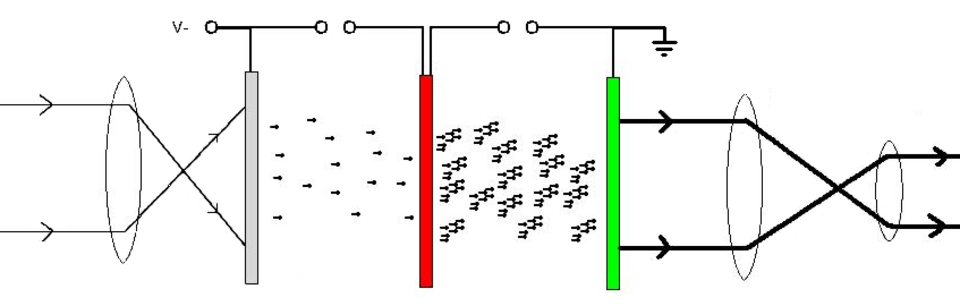
An image-intensifier (I²) tube is an analog light amplifier: a photocathode converts incoming photons to electrons, those electrons are multiplied, and they strike a phosphor screen that re-emits the amplified image as visible light. The US-government “generation” scheme tracks tube construction, not marketing:
- Gen 0 (WWII): S-1 (Ag-O-Cs) photocathode, required an active IR spotlight.
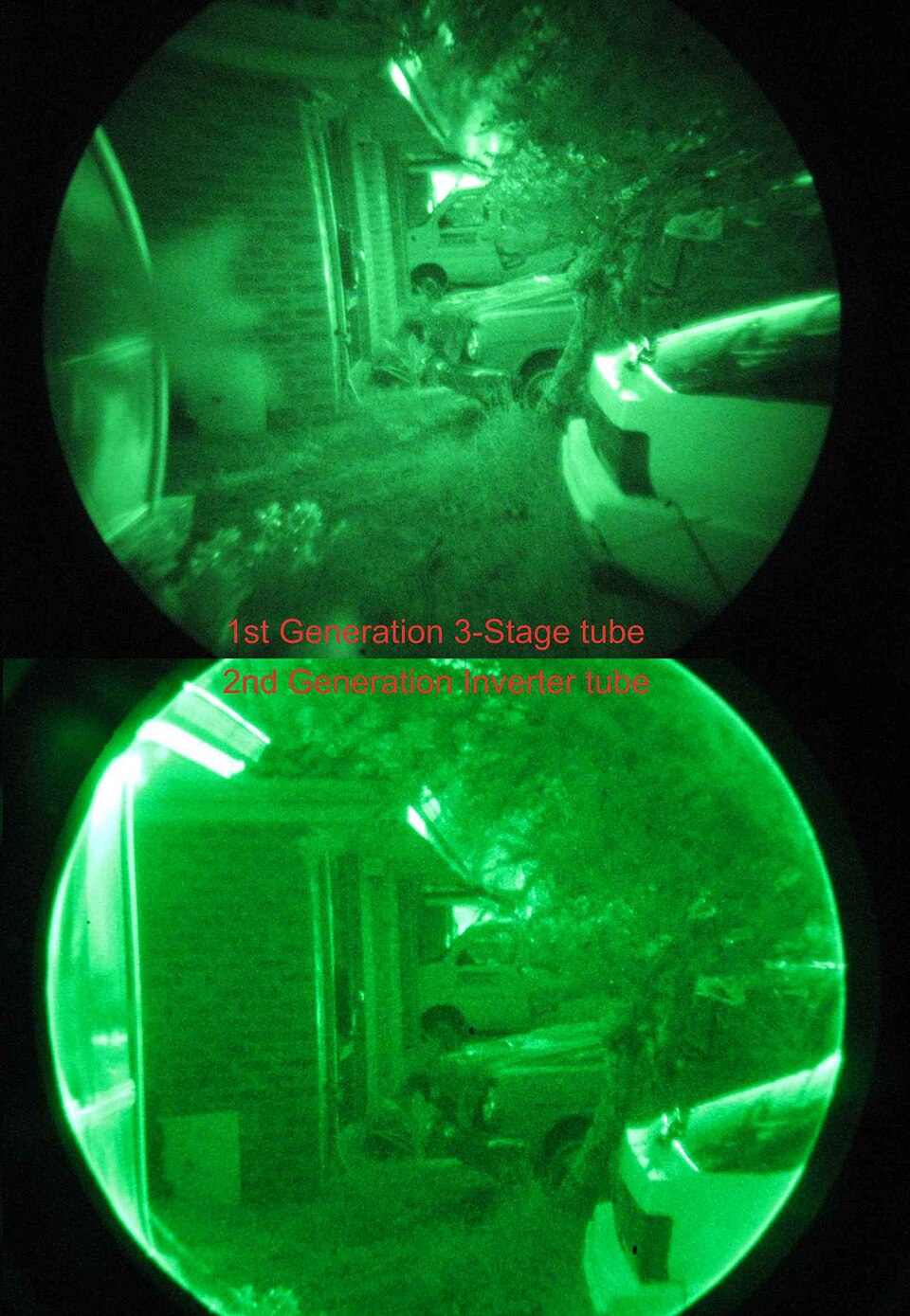
- Gen 1 (1960s): passive; S-20 multi-alkali photocathode; gain from three cascaded intensifier stages with no microchannel plate — long, heavy, with edge distortion and blooming.
- Gen 2 (late 1960s): the defining change is the microchannel plate (MCP) — a perforated glass disc that multiplies the photoelectron stream by secondary-electron cascade, replacing the three-stage cascade. The photocathode is unchanged; the gain mechanism changed, and the result is a dramatic size and weight reduction (goggles and handhelds) with a brighter, less-distorted image.
- Gen 3 (mid-1970s onward): two advances — a gallium-arsenide (GaAs) photocathode that extends near-IR sensitivity for a large gain in low-light performance, and an ion-barrier film on the MCP that stops back-migrating positive ions from destroying the GaAs, extending tube life from Gen 2’s ~2,000–4,000 hr to 10,000+ hr, at a small signal-to-noise cost from the film absorbing some photoelectrons.1
Two refinements matter in the field. Autogating rapidly switches the photocathode voltage thousands of times per second during bright events (muzzle flash, headlights) to protect the tube and keep it usable in mixed light. And “filmless” terminology is genuinely vendor-inconsistent: L3Harris brands film-removed tubes “unfilmed,” Armasight/FLIR market “FLAG” (Filmless Auto-Gated), and ITT/Exelis built an intermediate “thin-filmed” tube. Fully filmless tubes post higher average specs but shorter service life. Note there is no official DOD “Gen 4” — the Army briefly recognized it in the late 1990s, then rescinded that in 2001 when filmless tubes showed reduced lifespan; “Gen 4” survives only as marketing.2
Two numbers quantify a tube. Photocathode sensitivity (µA/lm against a 2856 K source; higher is better) ran ~60 µA/lm for a Gen 0 S-1 and can exceed 1,500–1,800 µA/lm for modern Gen 3 GaAs — a 25–30× improvement. Figure of Merit (FOM) is simply resolution (lp/mm) × signal-to-noise ratio; current US mil-spec OMNI VIII floors at 64 × 25 = 1600, ~1600+ is solid civilian, ~2200+ is premium. FOM’s flaw is that it is a scalar hiding real differences: a high-resolution/low-SNR tube and a low-resolution/high-SNR tube can score identically yet look completely different — grainy-sharp versus smooth-soft — and it captures nothing about EBI or gain.3
Phosphor color (green P43 vs white P45) is mostly folklore-ridden. Per the actual phosphor maker, there is no lab-measured decay or persistence difference between them; the “green has longer persistence” claim is wrong. The real difference is perceptual: the eye detects motion and silhouettes well against green (why the military first chose it) but separates fine contrast within one hue poorly, so similarly-toned green objects merge; white/grayscale gives more perceptual contrast for sharper apparent detail in cluttered scenes. Field trials found no measurable performance difference — it is preference and eye fatigue, and most new US contracts now specify white.4
Clip-on vs dedicated. A clip-on mounts in front of the day optic and uses the day scope’s magnification, reticle, and zero — one 24-hour platform, no re-zero, fast day-to-night transitions — but stacking glass makes the image dimmer and roughly halves the field of view. A dedicated NV weapon sight replaces the day optic, so it is more compact, brighter, and full-FOV, but needs its own zero and reticle.5
Digital NV is a different technology entirely: no photocathode, MCP, or phosphor. A CMOS/CCD sensor tuned for near-IR captures the scene onto an LCD/OLED, usually paired with an ~850 nm IR illuminator. An analog I² tube has higher raw sensitivity in true darkness (digital struggles without its illuminator), but digital works in daylight without being damaged by bright light, is cheaper, and records video natively. Its real cost is display latency — a perceptible “swimmy” lag on fast movement, against the essentially latency-free direct-optical I² chain. (The specific millisecond figures quoted online are unverified; state the effect qualitatively.)6
6.2 Thermal Imaging: Seeing Emitted Heat
Thermal detects long-wave infrared (~8–14 µm) radiation emitted by objects because of their own temperature — blackbody physics — not reflected light. A moonless, zero-ambient-light night is therefore a non-issue for thermal in a way it fundamentally is not for image-intensified NV: there is nothing to intensify, but everything warm is still glowing in the LWIR.7
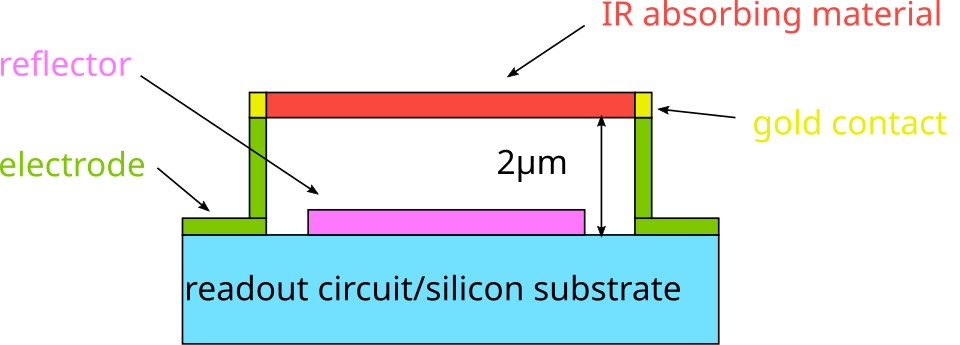
The detector splits into two camps. An uncooled microbolometer — the dominant civilian weapon-sight technology (Pulsar, ATN, AGM, Trijicon REAP-IR, SIG ECHO) — operates at ambient temperature, so it is instant-on, small, light, low-power, cheap, and reliable, at the cost of higher NETD (worse sensitivity). A cooled array (high-end and military, e.g. Teledyne FLIR HISS-HD) uses a cryo-cooled detector for far better sensitivity, range, and refresh, but pays with cooldown time, high power draw, bulk, mechanical complexity in a wearing cryo-cooler, and high cost.8
The specs that matter:
- NETD (Noise Equivalent Temperature Difference), in mK, lower is better: the smallest temperature difference the sensor can resolve above its own noise floor. It matters most in low-thermal-contrast conditions — fog, rain, warm ambient near body temperature. Rough bands: <25 mK excellent, <40 good, <50 acceptable, <60 satisfactory.9
- Pixel pitch, 12 µm vs 17 µm (both real and common): the trade is not primarily resolution — both build at the same pixel count. A larger 17 µm pixel collects more incident LWIR, so it delivers lower NETD for the same detector generation (Pulsar’s own figures: 17 µm at <25 mK vs 12 µm at <40 mK). A 12 µm sensor of equal resolution is physically smaller, allowing a more compact device (or higher resolution on the same die) and a smaller, lighter, cheaper objective.10
- Base magnification vs digital zoom: base optical magnification (objective focal length vs sensor size) resolves real detail; digital zoom is pure interpolation — bigger on-screen, no new resolution, blocky past a point.
- Refresh, 30 Hz vs 60 Hz: 60 Hz tracks fast movement and pans far more smoothly; 30 Hz is choppier but often the export-friendly cap (below).
- Germanium optics: ordinary optical glass is essentially opaque across 8–14 µm — which is exactly why thermal cannot see through window glass (the glass absorbs the LWIR before it reaches the sensor). Germanium transmits LWIR efficiently and has a very high refractive index (~4.0) for thin, compact, low-dispersion lenses, so every consumer thermal sight specs germanium (or chalcogenide) objectives.11
Verified-real thermal makers and models worth naming: Trijicon REAP-IR Mini, AGM Rattler TS, Pulsar Thermion 2, ATN ThOR 4, SIG ECHO (including the ECHO SV50-LRF with integrated LRF and Applied Ballistics), and the cooled Teledyne FLIR HISS-HD (unveiled at SHOT Show January 2024). Armasight’s Zeus 336 exists, but treat its exact specs (336×256, ~1,500-yd detection) as single-source and unconfirmed.
6.3 Export Controls (ITAR / EAR)
Both families are export-controlled in a way an ordinary red dot or riflescope is not. Image-intensifier tube technology (Gen 2/3/4) and thermal cores/sensors are controlled under ITAR (State/DDTC) and/or EAR (Commerce/BIS); weapon-sight thermal systems fall under USML Category XII, with classification driven by shock rating, an integrated reticle, clip-on mounting, ballistic-computer electronics, an integrated IR laser, automatic target recognition, or a military end-user. It is unlawful to export or transfer these — even to a foreign person inside the US — without a license, controls cover technical data (manuals) too, and ITAR status is not shed by age or resale. Per FLIR’s own guidance, thermal cameras at roughly 60 fps and/or 30 fps (NTSC) are the practical trigger points, which is why some products are refresh-rate-capped for export. (The exact current numeric thresholds get revised — verify against the current 15 CFR CCL / USML XII text before relying on a specific number.)12
6.4 Bibliography
- ModArmory, “Night Vision Terminology: Generations.” https://www.modarmory.com/night-vision-terminology/generations/
- L3Harris, “Unfilmed Gen III Image Intensification Tube Technology.” https://www.l3harris.com/all-capabilities/unrivaled-unfilmed-gen-iii-image-intensification-tube-technology
- IREO, “Understanding the Figure of Merit (FOM).” https://www.ireocam.com/info/understanding-the-figure-of-merit-fom-in-ima-102849664.html
- Exosens, “P43 Green Phosphor or P45 White Phosphor.” https://www.exosens.com/products/p43-green-phosphor-or-p45-white-phosphor
- LightPath, “Comprehensive Guide to LWIR Imaging Systems.” https://www.lightpath.com/insights/comprehensive-guide-to-lwir-imaging-systems
- Pulsar, “Pixel Pitch Explained: 12 µm vs 17 µm.” https://pulsarvision.com/journal/pixel-pitch-explained-12-%C2%B5m-vs-17-%C2%B5m/
- ATN, “Thermal Scope Specs Explained: NETD.” https://www.atncorp.com/blog/thermal-scope-specs-explained-netd-mk-resolution
- ATN, “Export Information.” https://www.atncorp.com/exportinformation
Footnotes
-
Generation is defined by tube construction: Gen 2 introduced the MCP, Gen 3 added a GaAs photocathode and an ion-barrier film. ModArmory, “Night Vision Generations.” ↩
-
“Filmless” branding varies by vendor; there is no official DOD Gen 4 (recognized late-1990s, rescinded 2001). L3Harris, “Unfilmed Gen III.” ↩
-
FOM = resolution × SNR (OMNI VIII floor 1600) but masks resolution/SNR trade-offs and omits EBI/gain. IREO, “Figure of Merit.” ↩
-
The phosphor maker reports no lab decay difference between P43 and P45; the difference is perceptual. Exosens, “P43 vs P45.” ↩
-
Clip-ons reuse the day optic’s zero but dim the image and halve FOV; dedicated NV sights are brighter and full-FOV but need their own zero. Armasight, clip-on vs scope. ↩
-
Digital NV uses a NIR CMOS/CCD sensor plus an ~850 nm illuminator; it works in daylight and records video but has perceptible display latency. x20.org; Digital Crosshairs. ↩
-
Thermal images emitted LWIR (~8–14 µm) from an object’s own temperature, so total darkness is irrelevant. LightPath, “LWIR Imaging Systems.” ↩
-
Uncooled microbolometers are instant-on and cheap with higher NETD; cooled arrays are far more sensitive but need cooldown, power, and cost. ICO Optics; Lynred. ↩
-
NETD (mK, lower is better) is the smallest resolvable temperature difference; it dominates in low-contrast conditions. ATN, “NETD Explained.” ↩
-
17 µm pixels collect more LWIR for lower NETD; 12 µm sensors are smaller/more compact at equal resolution. Pulsar, “Pixel Pitch.” ↩
-
Glass is opaque to 8–14 µm (why thermal can’t see through windows); germanium transmits LWIR with a ~4.0 index for compact lenses. Workswell; ATN, germanium lenses. ↩
-
NV tubes and thermal cores fall under ITAR/EAR (USML Category XII); ~60/30 fps NTSC are practical export triggers, but verify current thresholds. ATN, “Export Information.” ↩
Comments (0)