Types of Scopes · Volume 3
Optical Fundamentals
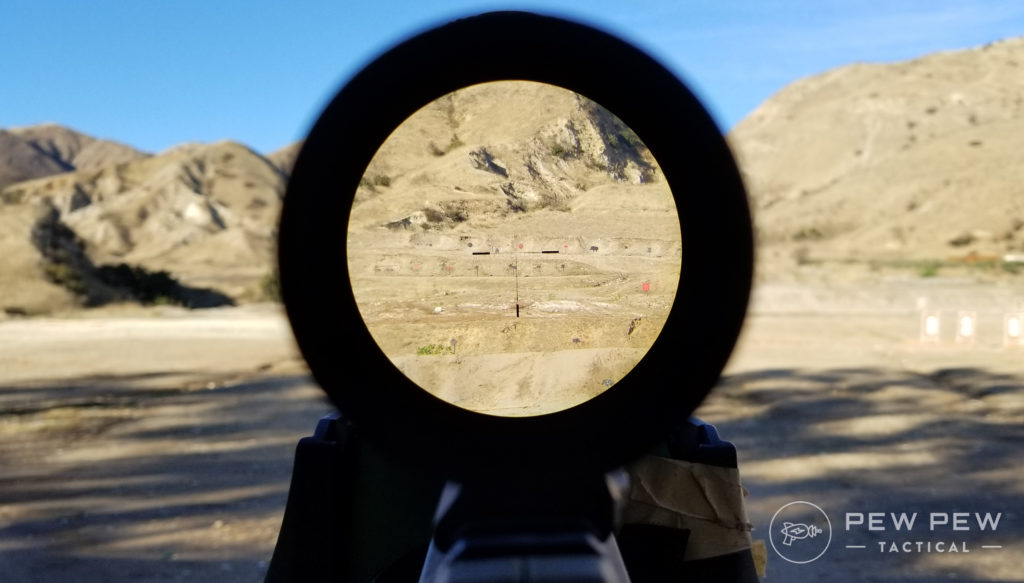
This is the volume a precision shooter has to own cold, because everything downstream — choosing FFP or SFP, trusting a hold at 14x, dialing a correction and having it land — rests on the physics here. None of it is hard, but the arithmetic has to be exact, and several widely repeated shortcuts are wrong at distance.
3.1 The Core Quantities
An afocal telescope has three lens groups: the objective gathers light and forms an initial (inverted) image, the erector re-inverts it and, in a variable, magnifies it, and the ocular presents it to the eye. From that architecture the working numbers fall out.
Exit pupil is the disc of light leaving the ocular, and its diameter is simply objective diameter ÷ magnification. A 56 mm objective at 14x gives a 4 mm exit pupil; a 50 mm at 10x gives 5 mm.1 Match or exceed the eye’s dilated pupil (~3 mm bright, up to ~7–8 mm fully dark-adapted, less with age) and the image is as bright as the glass allows; fall below it and you are effectively stopping down the system and vignetting the image. This is why a high-magnification scope on a small objective is dim in low light — the exit pupil has collapsed.
Eye relief is the distance from the rear ocular surface to the eye at which the full, unvignetted field is visible. Eye box is the three-dimensional volume of head positions that still yields that full picture — a function of both eye relief (length) and exit pupil (width). Generous eye relief with a tiny exit pupil still gives a cramped, fussy box, which is exactly what a 25x setting on a small objective feels like.2
Field of view is conventionally quoted in feet at 100 yd for riflescopes. It shrinks as magnification rises — a direct consequence of the afocal optics (magnification is objective focal length ÷ eyepiece focal length; more magnification means a longer effective focal length and a narrower captured angle). The angular-to-linear conversion is angular FOV in degrees ≈ linear FOV (ft at 1,000 yd) ÷ 52.5.
A word on twilight factor — √(magnification × objective mm) — which you will see on spec sheets: treat it as nearly worthless. It ignores glass, coatings, and transmission entirely, and it is mathematically symmetric to absurdity — an 8×40 and a hypothetical 40×8 return the same twilight factor, though the latter has a minuscule dim exit pupil and could never form a bright image.3 Exit pupil diameter plus actual measured transmission percentage tell you what twilight factor pretends to.
3.2 Parallax and Side Focus
Parallax is the reticle appearing to shift against the target when the eye moves off-axis. Its cause is precise: the objective’s primary image of the target does not fall exactly on the reticle plane, so the two are at slightly different depths, and any off-axis eye position sees them separate. The side-focus (or objective-focus, AO) control moves an internal lens group to shift the target’s focused-image location until it coincides with the reticle plane — it does not adjust reticle focus (that is the separate ocular/diopter setting).4 Higher-magnification scopes need the control more because the angular error from a given plane mismatch is magnified along with everything else; a low fixed-power hunting scope is often factory-set parallax-free at ~100–150 yd and needs no dial at all.
3.3 The Erector Tube and Internal Adjustment
Inside the main tube sits the erector assembly — an inner tube carrying the erector lenses and, in most designs, the reticle. It does not rotate. An internal erector spring pushes it against the tips of the windage and elevation turret screws. Turning a screw inward drives the erector tube further against the spring in that axis, tilting the whole assembly within the main tube; because the reticle rides on that assembly, tilting it moves the crosshair relative to the bore line. That is the entire windage/elevation mechanism.5 It also explains the real “maxed-out adjustment” failure: dial too far and the spring can no longer keep the tube seated against the screw tips, the erector floats loose, and point of impact wanders erratically. This is why a scope run near the end of its travel — the reason 20 MOA rails exist (Volume 8) — is a scope run near failure.
3.4 FFP vs SFP: Why Subtensions Hold
A variable scope has (at minimum) two focal planes, one near the objective and one near the ocular, with the erector/zoom system between them. Where the reticle sits relative to the erector is the whole story.
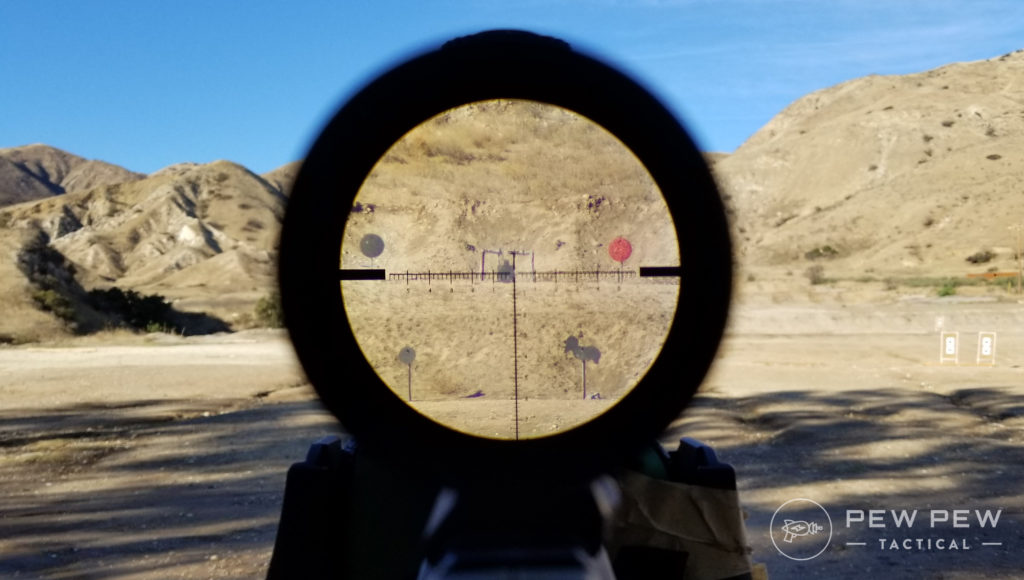
In a first focal plane scope the reticle sits in front of the erector, on the objective-side plane. The erector magnifies and demagnifies everything ahead of it as the power ring turns — and that includes the reticle. So the reticle and the target image scale by exactly the same factor at every power, and a mil-dot spacing or a one-MOA hash subtends the same true angle at 4x as at 24x. That constancy is not a design bonus bolted on; it is the direct consequence of the same erector magnification acting on both the reticle and the target image at the same optical location. It is why an FFP scope lets you range, hold over, and hold wind at any magnification without recalculating.
In a second focal plane scope the reticle sits behind the erector, downstream of the zoom. The erector’s magnification acts only on the target image formed ahead of it; the reticle stays a constant physical size while the target grows and shrinks around it. The reticle’s angular value is therefore true at only one magnification — usually the top power, though some scopes calibrate to another marked setting. At any other power you must correct the subtension by the ratio (actual power ÷ calibrated power): a mil-dot on a 25x-calibrated SFP scope subtends its nominal value at 25x, but two mils’ worth at 12.5x. The tradeoff readers actually feel: an FFP reticle can shrink to invisibility at low power, while an SFP reticle stays bold and usable at 1x — which is why hunting and low-power scopes are overwhelmingly SFP and high-mag precision scopes are FFP.6
3.5 MOA vs MIL: The Derivations
Both are angular units; the arithmetic is where money is won or lost.
MOA (minute of angle). One degree is 60 arcminutes, so 1 MOA = 1/60°. The true linear subtension at distance d is d·tan(θ) — exact trig, and for such a tiny angle the arc-length approximation is fine. At 100 yd (3,600 in): tan(1/60°) ≈ 0.00029089, so 3,600 × 0.00029089 ≈ 1.047 in.7 At 100 m: 10,000 cm × tan(1/60°) ≈ 2.908 cm. The trap is “shooter’s MOA” (SMOA), which rounds 1 MOA to a clean 1.000 in at 100 yd. The error is under 0.05 in at 100 yd — lost in group noise — but it compounds linearly: at 1,000 yd, true MOA is 10.47 in versus a rounded 10.0 in, about a 4.7% difference, enough to walk a first-round shot off a plate. Makers are not universally consistent about which their turrets use, so verify (the tall-target test in Volume 8 measures it directly).
MIL (milliradian). One radian is arc length over radius, and 1 mil = 1/1000 rad = 0.001 rad. Because the radian is an arc-to-radius ratio, the linear subtension at distance d is just d × 0.001 (the tan θ ≈ θ error here is parts-per-million):
- At 100 yd (3,600 in): 3,600 × 0.001 = 3.6 in.
- At 100 m (100,000 mm): 100 m × 0.001 = 0.1 m = exactly 10 cm.8
The clean 10 cm at 100 m is not a coincidence — it is the radian’s definition meeting a base-10 metric system. A mil’s linear subtension in any metric unit is distance ÷ 1,000 (1,000 m → 1 m, 100 m → 10 cm), with no conversion arithmetic at all. The same never lands cleanly in imperial (100 yd → an ugly 3.6 in) because inches and yards are not decimally related. That — not “military heritage” — is the real, math-grounded reason mils are metric-friendly, and it is why precision shooting converged on mil/mil: base-10 mental math, larger clicks (0.1 mil ≈ 0.36 in versus 0.25 MOA ≈ 0.26 in), and a reticle whose hashes and turret speak the same language.
The cardinal rule that follows: match the reticle to the turret. A mil reticle with MOA turrets (or the reverse) forces a unit conversion on every correction under stress — the most avoidable error in the whole system.
3.6 Bibliography
- Accurate Ordnance, “Exit Pupil.” https://accurateordnance.com/exit-pupil/
- Swampfox Optics, “Understanding Rifle Scope Eye Relief and Eye Box.” https://www.swampfoxoptics.com/understanding-rifle-scope-eye-relief-and-eye-box
- Optics Trade, “Twilight Factor.” https://blog.optics-trade.eu/twilight-factor/
- Shooting Illustrated, “Understanding Optical Parallax.” https://www.shootingillustrated.com/content/understanding-optical-parallax/
- Optics Trade, “Erector Tube / Internal Adjustment.” https://www.optics-trade.eu/blog/5661835-2/
- ScopesField, “First Focal Plane vs Second Focal Plane.” https://scopesfield.com/first-focal-plane-vs-second-focal-plane/
- Wikipedia, “Minute and second of arc.” https://en.wikipedia.org/wiki/Minute_and_second_of_arc
- Wikipedia, “Milliradian.” https://en.wikipedia.org/wiki/Milliradian
- NSSF, “Minute of Angle (MOA).” https://www.nssf.org/shooting/minute-angle-moa/
Footnotes
-
Exit pupil diameter = objective ÷ magnification, the image of the aperture stop for an afocal system. Accurate Ordnance, “Exit Pupil.” ↩
-
The eye box is a cone-shaped volume set by eye relief and exit pupil together. Swampfox Optics, “Eye Relief and Eye Box.” ↩
-
Twilight factor ignores optical quality and is symmetric to absurdity (8×40 = 40×8). Optics Trade, “Twilight Factor.” ↩
-
Side-focus/AO moves an internal lens to coincide the target image with the reticle plane; it is separate from ocular focus. Shooting Illustrated, “Understanding Optical Parallax.” ↩
-
The erector tube does not rotate; a spring holds it against the turret-screw tips, which tilt the assembly to move the reticle. Running out of spring engagement is the true “maxed adjustment” failure. Optics Trade, erector-tube article. ↩
-
FFP reticle sits ahead of the erector and scales with the target (constant angular subtension); SFP sits behind it and holds constant physical size (true angle at one power only). ScopesField, “FFP vs SFP.” ↩
-
3,600 in × tan(1/60°) ≈ 1.047 in at 100 yd; SMOA rounds to 1.000 in and diverges ~4.7% by 1,000 yd. Wikipedia, “Minute and second of arc”; NSSF, “MOA.” ↩
-
1 mil = 0.001 rad → 3.6 in at 100 yd and exactly 10 cm at 100 m. Wikipedia, “Milliradian.” ↩
Comments (0)