Types of Scopes · Volume 7
Rangefinding, Ballistic Solvers & the Anemometer Connection
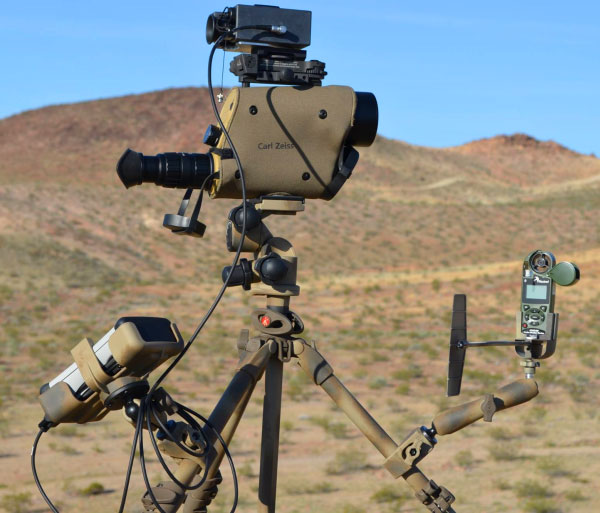
This volume is where the whole series stops being about glass and starts being about data. A modern first-round-hit system is a small sensor network: a laser measures distance, a weather meter measures the atmosphere, a solver turns both into a firing solution, and an optic displays it. Understanding it means understanding each sensor’s failure modes and exactly which environmental variables the solver eats. For the interior/exterior-ballistics groundwork behind the drop and drift numbers here, cross-reference the ballistics dive at /ammo-and-ballistics/ballistics-overview/ — this volume assumes it and focuses on the instrumentation.
7.1 Laser Rangefinders
A laser rangefinder measures distance by time of flight: it emits a laser pulse, times the round-trip return, and computes D = c·t/2. Modern units fire many pulses per event and statistically average the returns.1 Three properties govern real-world performance.
Beam divergence (in mrad) is how much the beam widens with range — roughly 1 mrad grows the spot about 1 m per km. A wider beam illuminates a wider spot, raising the chance of a return off something other than the target (a branch, a brush edge, a rock behind the animal) and producing false-short reads; a narrower beam is more precise but less forgiving of aim wobble on a small or distant target.2
First vs last return is the mode that decides which surface the unit reports. First reports the nearest reflecting surface — range the near deer, not the ridge behind it. Last reports the farthest return in the pulse train, letting you see past closer clutter to an animal glimpsed through brush where First would lock onto the branches. In fog, rain, or snow, “Last” is generally recommended because airborne particles trigger false-short “First” reads; many units add a “Best”/algorithmic mode.3
Reflectivity sets the true maximum range. Reflective, light targets return more energy and range at or beyond the rated maximum; dark, matte, absorptive targets (black hide, wet dark bark, dense foliage) return less and range shorter with noisier reads. Advertised maximum ranges are best-case, optimally-reflective numbers — the “2,000 yd” on the box is a reflective-target figure, not what you will get on a bull elk at dusk.
7.2 Auto-Ranging Scopes with an Onboard Solver
A handful of optics fold the rangefinder and the solver into one device that presents a computed aim point in the sight picture. Get the landscape right, because it is littered with conflated and discontinued products.
- Burris Eliminator (current flagship Eliminator 6, 4-20x52 mm): ranges with a button and illuminates an aim point within the reticle at the calculated holdover, plus a wind-hold value — it does not move physical turrets. It carries a built-in thermometer, barometer, and inclinometer for automatic density altitude, and a Bluetooth app for DOPE; it ranges 2,000+ yd on reflective targets, ~1,400 yd on deer.4
- SIG SAUER BDX (Ballistic Data Xchange): a KILO BDX rangefinder pairs over Bluetooth to a SIERRA BDX scope. The rangefinder’s onboard Applied Ballistics Ultralite solver computes drop from bullet/velocity/atmosphere data set in the free BDX app, then transmits the solution to the scope’s illuminated BDX-R1 reticle — an illuminated holdover dot plus a wind hold. BDX 2.0 added preset caliber groups that work without the app for common cartridges.5
- Swarovski dS (current dS Gen II): an integrated LRF plus a real-time solver (distance, angle, pressure, wind, temperature) drives an illuminated aiming point at one button press, with rifle/load data pushed from an app over Bluetooth.
- ATN: note carefully that X-Sight (digital day/night) and ThOR (thermal) are separate product lines — there is no single “X-Sight ThOR” model. Both carry an onboard ballistic calculator (range/angle/temp/humidity), Wi-Fi streaming, video recording, and recoil-activated video; the LRF variants (X-Sight 5 LRF, ThOR 5 XD LRF) add a built-in rangefinder.6
Several products that get cited in this category do not belong here, and stating so is part of getting the taxonomy right:
- Zeiss does not currently sell an auto-ranging riflescope. Its only one, the Victory Diarange, is discontinued; the current Zeiss rangefinding product is the Victory RF binocular (with ballistic calc and Bluetooth to the Zeiss Hunting App), not a riflescope.7
- Vortex likewise has no “Impact HD AB” auto-ranging scope — that name is a conflation. The Vortex Impact 1000 is a basic angle-compensating rangefinder with no Applied Ballistics, and the Fury HD 5000 AB — which does carry Applied Ballistics Elite — is a rangefinding binocular, not a riflescope.8
- Nightforce and Hawke sell no consumer riflescope with an LRF inside the optic that auto-illuminates a holdover. Their ballistic support is turret- and reticle-calculator based (Nightforce custom BDC turrets and the Mil-XT grid; Hawke X-ACT reticles with a separate standalone rangefinder). Nightforce’s R-VPS is a separate military rangefinder module on a purpose-built mount, not a rangefinder inside the optics and not civilian retail.
- TrackingPoint is real but must be described honestly. Founded by John McHale in 2011, it shipped the first “precision guided firearm” in 2013 — a networked tracking scope that ranged, computed a solution, and used a guided trigger hard-wired to the scope that released only at the computed firing solution (“tag the target; the trigger breaks at the right instant”). The company hit serious financial trouble and stopped taking orders in 2015, and Talon Precision Optics acquired its assets in November 2018 and still lists TrackingPoint-branded rifles for sale. There is no independent 2024–2026 confirmation that it is an actively shipping business — treat it as “assets acquired by Talon in 2018; brand still listed, independent recent reviews scarce.”9
7.3 Ballistic Solvers
Two solvers dominate. Applied Ballistics, founded in 2009 by ballistician Bryan Litz, licenses its solver into third-party hardware at tiered levels (Pro-tier in the Kestrel 5700X-WEZ and Leica Geovid Pro AB+); confirmed AB-licensed devices include the Kestrel 5700 Elite family, SIG KILO BDX, and Vortex Fury HD 5000 AB.10 Hornady 4DOF (Four Degrees Of Freedom) goes further than a standard 3-DOF point-mass calculator: where a 3-DOF model tracks range/elevation/windage and treats the bullet as inert, 4DOF adds the bullet’s rotation about its center of gravity and the resulting angle of attack, and drives off the projectile’s measured drag-coefficient curve rather than a single BC — computing spin drift, aerodynamic jump, and Coriolis effects.11
7.4 The Anemometer Connection: Kestrel
The Kestrel 5700 Elite is the anemometer at the center of the modern system — the “industry gold standard,” carrying Applied Ballistics onboard and Kestrel’s LiNK Bluetooth. Its sensor suite is the point: an impeller anemometer (wind speed, held into the wind), a thermistor (ambient temperature), a barometric/station-pressure sensor, and a calibrated digital humidity sensor. From those it computes density altitude — the standard-atmosphere altitude at which air density equals the current local density, collapsing temperature, pressure, and humidity into a single number.12 Over LiNK (BLE, ~100 ft) the meter connects both to the free Kestrel LiNK app (view/log data, build and transfer gun profiles) and to LiNK-compatible laser rangefinders for a combined ranging-plus-environmental solution; it interoperates with AB-enabled rangefinders and binoculars (a Vortex Fury explicitly pairs with Kestrel and Garmin devices). (Kestrel and Hornady are partners, not one owning the other — the Kestrel 5700 with Hornady 4DOF shipped in June 2019.)
7.4.1 How Each Environmental Variable Perturbs the Solution
This is the heart of the matter — what the solver actually consumes, and which way each input moves the answer:
- Wind speed and direction: the crosswind component pushes the bullet laterally over the time of flight and is the dominant wind-hold output, so direction relative to the bore matters, not just speed. The head/tailwind component changes velocity relative to the air mass, altering time of flight and thus gravity drop (a smaller, separately handled effect). Advanced solvers also compute aerodynamic jump — a vertical deflection when a crosswind acts on a yawed, spin-stabilized bullet.
- Temperature: warmer air is less dense, so less drag and a flatter trajectory (the primary effect, via air density). Secondarily, temperature changes powder burn rate and thus muzzle velocity in temp-sensitive propellants — a separate input the solver may take.
- Station/barometric pressure: air density scales roughly linearly with pressure at a given temperature, so higher pressure means denser air, more drag, and more drop; altitude/low pressure means thinner air and a flatter path. This is the single biggest environmental drag driver.
- Humidity (counterintuitive but real): humid air is less dense than dry air at the same temperature and pressure, because water vapor (~18 g/mol) is lighter than the N₂ (~28) and O₂ (~32) it displaces at constant total pressure. The effect is small next to temperature and pressure but genuine.
- Density altitude: the single collapsed figure folding temperature, pressure, and humidity into one number the solver — or a simplified field drop chart — indexes directly, instead of juggling three raw inputs.13
The practical takeaway for an experienced shooter: the optic is the display, not the brain. The brain is the solver, and the solver is only as good as the atmosphere you feed it — which is why the Kestrel, not the scope, is the component that most improves a genuine cold-bore first-round hit at distance.
7.5 Bibliography
- Wikipedia, “Laser rangefinder.” https://en.wikipedia.org/wiki/Laser_rangefinder
- Vortex Optics, “How Laser Rangefinder Modes Work.” https://vortexoptics.com/blog/how-laser-rangefinder-modes-work.html
- Burris Optics, “Eliminator 6 4-20x52mm.” https://www.burrisoptics.com/riflescopes/eliminator-6-4-20x52mm
- SIG SAUER, “BDX (Ballistic Data Xchange).” https://www.sigsauer.com/electro-optics/bdx.html
- Zeiss, “Victory RF.” https://www.zeiss.com/photonics-and-optics/us/hunting/products/binoculars/victory-rf.html
- Wikipedia, “TrackingPoint.” https://en.wikipedia.org/wiki/TrackingPoint
- Applied Ballistics. https://appliedballisticsllc.com/
- Hornady, “4DOF Ballistic Calculator Technical Document.” https://static.hornady.media/presscenter/docs/1410992918-4-DOF----Ballistic-Calculator-Technical-Document.pdf
- Kestrel Ballistics, “Ballistics Weather Meters.” https://kestrelballistics.com/ballistics-weather-meters
- Kestrel Instruments, “LiNK Connectivity.” https://kestrelinstruments.com/link-connectivity
Footnotes
-
Time of flight: D = c·t/2, with many pulses averaged per event. Wikipedia, “Laser rangefinder.” ↩
-
Beam divergence widens the spot (~1 mrad ≈ 1 m/km), trading precision against forgiveness of aim wobble and false-short returns. Safran-Vectronix; Eyoungtec. ↩
-
First return reports the nearest surface, last return the farthest; last is preferred in fog/rain/snow. Vortex Optics, “Rangefinder Modes.” ↩
-
The Eliminator 6 illuminates a holdover aim point and wind hold (no moving turrets), with onboard density-altitude sensors. Burris Optics; American Hunter review. ↩
-
SIG BDX pairs a KILO rangefinder (AB Ultralite solver) over Bluetooth to a SIERRA scope with an illuminated BDX-R1 reticle. SIG SAUER, “BDX.” ↩
-
ATN X-Sight (day/night) and ThOR (thermal) are separate lines, both with onboard ballistic calculators; LRF variants add a rangefinder. ATN, X-Sight 5 / ThOR 5 XD. ↩
-
Zeiss’s only auto-ranging riflescope (Victory Diarange) is discontinued; current Zeiss RF is the Victory RF binocular. Zeiss, “Victory RF.” ↩
-
“Impact HD AB” is a conflation: the Impact 1000 has no Applied Ballistics, and the AB-equipped Fury HD 5000 AB is a binocular. Vortex Optics product pages. ↩
-
TrackingPoint’s assets were acquired by Talon Precision Optics in Nov 2018; the brand is still listed but there is no independent 2024–2026 confirmation it is actively shipping. Wikipedia, “TrackingPoint.” ↩
-
Applied Ballistics (Bryan Litz, 2009) licenses its solver into Kestrel, SIG KILO BDX, Vortex Fury, and Leica devices. Applied Ballistics. ↩
-
Hornady 4DOF adds bullet rotation/angle of attack and uses a measured drag-coefficient curve, computing spin drift, aerodynamic jump, and Coriolis. Hornady, “4DOF Technical Document.” ↩
-
The Kestrel 5700 Elite measures wind, temperature, station pressure, and humidity and computes density altitude, with Applied Ballistics onboard and LiNK Bluetooth. Kestrel Ballistics; Kestrel Instruments. ↩
-
Crosswind drives lateral hold; temperature and pressure drive air density and drop; humid air is less dense; density altitude folds all three into one index. Hornady 4DOF document; Boldmethod, density altitude. ↩
Comments (0)