Ballistics Overview · Volume 1
Overview & the Domains of Ballistics
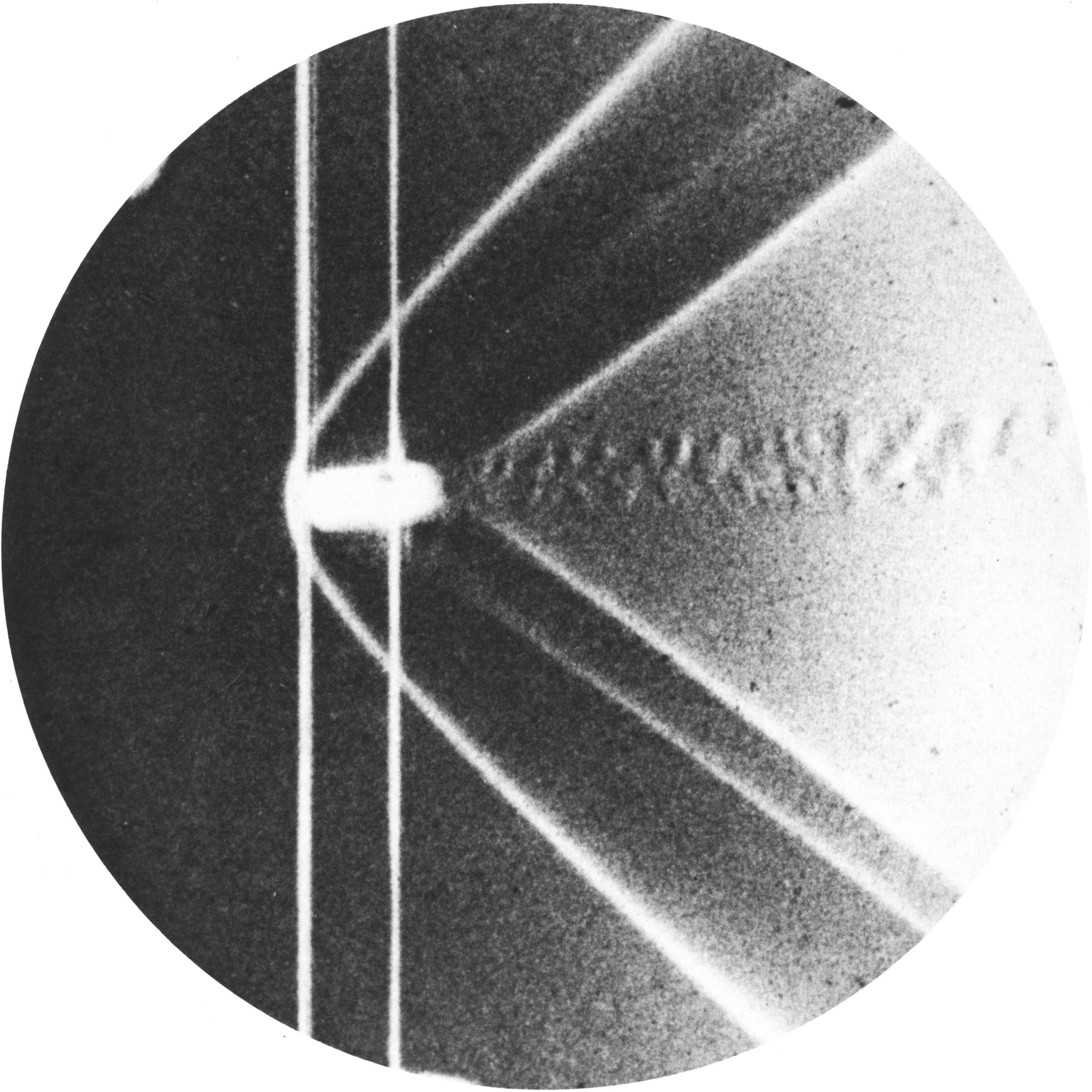
Ballistics is the study of what happens to a projectile from the instant the primer lights until the moment the bullet stops moving inside the target. That is a longer and stranger journey than most shooters picture. A rifle bullet spends roughly a millisecond and a half being violently accelerated inside a steel tube, emerges into a turbulent cloud of gas travelling faster than it is, spends a second or two in free flight fighting drag and gravity while being nudged by wind, its own spin, and the rotation of the planet underneath it, and then delivers whatever energy survives into flesh, steel, or gelatin. Each of those phases obeys different physics and rewards a different kind of attention. This series walks the whole path, and it exists mainly to get right the handful of effects that almost everyone — including a lot of published shooting writers — gets wrong.
1.1 The Four Domains
The field splits, by long convention, into four domains defined by where the bullet is, not by which force dominates.1
- Internal (interior) ballistics covers everything from ignition until the bullet’s base clears the muzzle. This is the domain of chamber pressure, powder burn rate, barrel time, and recoil. It ends at the muzzle crown.
- Transitional (intermediate) ballistics is the brief, messy interval from muzzle exit until the propellant gas has expanded enough to stop meaningfully pushing on the bullet — pressure roughly equalising with the atmosphere. It is measured in inches of travel and microseconds, but it is where crown quality and muzzle devices do their work, and where a bullet can pick up a destabilising yaw it spends the rest of its flight shedding.2
- External (exterior) ballistics is free flight to the target: drag, gravity, wind, spin drift, Coriolis, air density. This is the largest domain in this series and the one where the interesting mistakes live.
- Terminal ballistics is the interaction with the target medium: penetration, expansion, fragmentation, energy transfer.
The boundaries are clean because they are defined geometrically. Internal ballistics ends at the muzzle face; transitional ballistics ends when the gas lets go; external ballistics ends at impact; terminal ballistics is everything after. A single shot passes through all four in under three seconds.
1.2 The Spine of This Series
Volumes 2 and 3 handle the inside of the gun and the muzzle. Volume 4 builds the drag model — the ballistic coefficient, why it is not a constant, and how modern Doppler-measured drag curves are quietly replacing it. Volume 5 lays down trajectory and zero. Volume 6 is air density, the single most important environmental variable, and the home of the humidity trap. Volume 7 is wind, the effect that dominates every long-range miss. Volume 8 is angle firing and the rifleman’s rule. Volume 9 is the reason this dive was commissioned: the subtle deflections — spin drift, Coriolis, the Eötvös effect, and aerodynamic jump — worked numerically and ranked by size. Volume 10 is terminal ballistics, kept clinical. Volume 11 is how you actually solve a firing solution in the field, plus a laminate-ready cheatsheet.
Throughout, every quantitative claim is sourced, and where the underlying research could only reach medium confidence or could not verify something at all, the prose says so out loud rather than laundering a guess into a fact. That honesty is the point of the exercise.
1.3 The Traps — With the Answers Stated Up Front
Five effects in external ballistics are routinely explained backwards, conflated with each other, or asserted with a confidence the physics does not support. Because they recur through the series, here are the correct answers first, so nothing downstream can drift from them.
Humidity makes air less dense, not more. Water vapour has a molar mass of about 18 g/mol; dry air averages about 29 g/mol. At a fixed temperature and pressure, water molecules displace the heavier nitrogen and oxygen, so humid air is lighter than dry air. More humidity therefore means slightly less drag and a slightly flatter trajectory — the opposite of the “thick, heavy, humid air” intuition printed in countless hunting articles. The effect is tiny (on the order of a few tenths of a percent of density across a large humidity swing; the exact figure is medium confidence and is treated carefully in Volume 6), but its sign is not in doubt.3
Horizontal Coriolis deflects right in the Northern Hemisphere and left in the Southern — regardless of which direction you fire. It scales with the sine of your latitude and with time of flight, not with compass heading. Firing north, south, east, or west, a Northern-Hemisphere bullet drifts right. Volume 9 explains why azimuth cannot flip the sign.4
The Eötvös effect is vertical and is a separate phenomenon. Firing east, the bullet impacts slightly high; firing west, slightly low. It scales with the cosine of latitude and is independent of hemisphere. It shares an origin with horizontal Coriolis (Earth’s rotation) but is a different term with a different dependence, and the two must never be blurred together.4
Spin drift is not Coriolis. It is gyroscopic — a right-hand-twist bullet drifts right, a left-hand-twist bullet drifts left — and it would happen on a non-rotating planet. Bryan Litz states it flatly: spin drift “has nothing to do with the earth’s rotation.”5
Aerodynamic jump is the vertical kick a crosswind gives a spinning bullet. A gyroscopically stable bullet weather-vanes into the apparent wind, and that one-time deflection near the muzzle nets out to a small constant vertical angle for the rest of the flight. The mechanism and magnitude are well established. The sign convention — whether a left-to-right wind pushes the impact up or down for a given twist — could not be pinned to a primary source in the research behind this series, and this series therefore refuses to assert it. That refusal is deliberate and is repeated wherever aerodynamic jump appears.6
Keep these five answers in mind. Most of external ballistics is bookkeeping; these are the entries people post to the wrong column.
1.4 Who This Is For
This is written for an experienced shooter and gunsmith who wants the real equations, the real coefficients, and the real magnitudes — not a primer. It does not explain what sectional density is three times; it explains why a stated ballistic coefficient of 0.5 can quietly mean 1.040 at one range and 1.068 at another for the same bullet. Where a number is soft, it is flagged soft. Where the field genuinely disagrees — barrel harmonics, hydrostatic shock — both sides are presented and neither is adjudicated. The goal is a reference you can trust precisely because it tells you where its own floor is thin.
1.5 Bibliography
Footnotes
-
Wikipedia, “Internal ballistics,” “Transitional ballistics,” “External ballistics” — canonical four-domain boundary definitions. https://en.wikipedia.org/wiki/Internal_ballistics ; https://en.wikipedia.org/wiki/Transitional_ballistics ; https://en.wikipedia.org/wiki/External_ballistics (confidence: high). ↩
-
Wikipedia, “Transitional ballistics” — definition of the interval and the near-muzzle yaw window. https://en.wikipedia.org/wiki/Transitional_ballistics (confidence: high). ↩
-
Standard ideal-gas reasoning as reported across ballistics-education sources; e.g. https://ballistixco.com/blogs/news/how-environmental-factors-impact-ballistic-compensation-in-custom-turrets and https://gundigest.com/more/how-to/firearm-training/humidity-effects-bullet-trajectory . Sign is high confidence; the exact per-humidity magnitude is medium confidence (see Vol 6). ↩
-
Bryan Litz / Applied Ballistics, “Gyroscopic (spin) Drift and Coriolis Effect.” https://appliedballisticsllc.com/wp-content/uploads/2021/06/Gyroscopic-Drift-and-Coriolis-Effect.pdf (confidence: high). Corroborated by https://www.gunssavelife.com/2015/03/05/eotvos-coriolis-effects-on-long-range-shooting/ . ↩ ↩2
-
Litz, ibid. — “has nothing to do with the earth’s rotation” (confidence: high). ↩
-
Mechanism and magnitude: forum summary of Litz, Applied Ballistics for Long-Range Shooting (2nd ed.), pp. 75–83, https://forum.accurateshooter.com/threads/aerodynamic-jump.3939113/ ; Wikipedia, “External ballistics,” https://en.wikipedia.org/wiki/External_ballistics . The left-wind sign convention is not established in the sources consulted and is not asserted here (confidence: medium on mechanism; sign: unresolved). ↩
Comments (0)