Ballistics Overview · Volume 4
Drag & the Ballistic Coefficient

Drag is the force external ballistics spends all its effort accounting for. Gravity is simple and constant; wind is a nuisance you read; but drag is what turns a flat 300-yard trajectory into a rainbow at 1000, and it is the reason a ballistic coefficient is the single most-quoted — and most-misunderstood — number on a box of bullets. This volume builds the drag model from the physics up and then dismantles the idea that a BC is a constant.
4.1 The Drag Equation
The aerodynamic drag force on a bullet is the universal fluid-dynamics form:
F_d = 0.5 * rho * v^2 * C_d * Awhere rho is air density, v is the bullet’s velocity relative to the air, C_d is the drag coefficient, and A is the reference cross-sectional area.1 Two things in this equation carry all the interesting behaviour. Density (rho) is the environmental variable — the whole of Volume 6. And C_d, the drag coefficient, is not a constant for a bullet: it depends strongly on Mach number.
4.2 C_d Depends on Mach Number
Real Doppler-radar measurements of a Lapua GB528 Scenar bullet, reported via Wikipedia’s External Ballistics article, show the shape of the curve clearly: C_d is about 0.229 at Mach 0.4 (subsonic), climbs to a peak of roughly 0.348 near Mach 1.2 (low transonic), and reads about 0.306 at Mach 1.0.2 In words: drag coefficient is low and nearly flat in subsonic flight, rises sharply as the bullet approaches the speed of sound, peaks in the low transonic zone where the shock structure is fully formed and dumping energy, then falls again as the bullet goes solidly supersonic. (These specific numbers are high confidence as reported, though the source research recommends fetching the underlying Lapua dataset before quoting them to three digits.)
This is why a bullet’s drag is not one number. A supersonic bullet decelerating toward the target is sliding down and across this curve continuously.
4.3 The Transonic Trap
The region from roughly Mach 1.2 down to Mach 0.9 is where stability, not just drag, is at risk. As the bullet approaches Mach 1, standing shock waves form around it and the drag coefficient spikes. More dangerously, as it decelerates through the transonic band the centre of pressure migrates forward, toward the nose and ahead of the centre of mass. That migration reduces — and can reverse — the restoring torque a gyroscopically stabilised bullet depends on, allowing limit-cycle yaw (“transonic buffet”) to grow as the shockwaves dissipate unevenly around the bullet.3 Once the bullet is fully below about Mach 0.90–0.95 the shock structure clears and it re-settles into stable subsonic flight with a sharply lower C_d. The practical consequence: a bullet that arrives at the target still supersonic behaves predictably; one that transitions through Mach 1 on the way can lose precision exactly there, and it is why long-range shooters try to keep the bullet supersonic all the way to the target and why a marginal stability factor (Volume 9) is most dangerous in this band.
4.4 Ballistic Coefficient — a Ratio, Not a Property
The ballistic coefficient collapses a bullet’s drag behaviour into one number by comparing it to a standard reference projectile:
BC = SD / iwhere SD is sectional density and i is the form factor — the ratio of the actual bullet’s drag to the drag of the chosen standard shape at the same velocity.4 Sectional density is simply weight over frontal area:
SD = weight(lb) / diameter(in)^2For a 175 gr .308 bullet: SD = (175/7000) / 0.308^2 = 0.264.4
The word that matters is ratio. A BC is always “the drag of this bullet relative to the drag of a standard shape.” It is not an intrinsic property of the bullet the way mass or diameter is. And that has a consequence people quote past constantly.
4.5 G1 versus G7
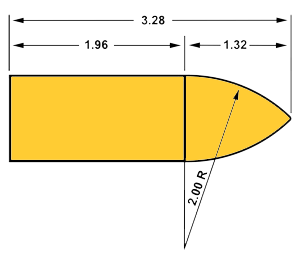
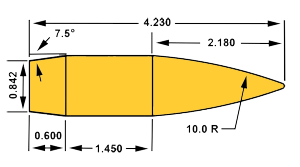
The G1 standard projectile is a flat-base shape with a blunt, 2-caliber-radius ogive, about 3.28 calibers long — a reference dating to 1881-era Krupp/Mayevski work that poorly matches modern streamlined bullets. The G7 standard is a long boat-tail with a 10-caliber secant ogive and a roughly 7.5° boat-tail — much closer to a modern boat-tailed match or hunting bullet.5
Because G7’s shape tracks a modern bullet so much more closely, a G7 BC stays far more constant across the velocity range — including through the transonic transition — than a G1 BC for the same bullet. A G1 BC visibly drifts as velocity changes, because the mismatch between the real bullet’s drag curve and the G1 standard’s curve itself changes with Mach number. The same Lapua GB528 Scenar is quoted with a G1 BC of 0.785 and a G7 BC of 0.377 — wildly different numbers for one physical bullet, because they are ratios to two different reference curves, and the G7 number is the one that stays nearly flat with velocity.6 For a modern boat-tail bullet, always prefer the G7 BC if the solver supports it.
4.6 Why BC Is Not Constant — Proof
Wikipedia’s own worked table shows a .50 BMG bullet’s G1 BC ranging from 1.040 to 1.068 lb/in² across the 500–1500 m range/speed regime for the same physical bullet.7 That is direct proof: the “constant” on the box is an average over some velocity band. Quote a single BC and you are quoting the middle of a curve.
4.7 Custom Drag Models Supersede the Single BC
The modern answer is to stop forcing the bullet’s drag onto a scaled G1 or G7 curve at all. Both Applied Ballistics (Custom Drag Models / “CDF”) and Hornady (the 4DOF bullet library) now measure the actual drag-versus-velocity curve of an individual bullet with Doppler radar and feed that whole curve into the solver.8 As Applied Ballistics puts it, “a drag curve doesn’t change” — it is an intrinsic measured property of that exact bullet — while a BC changes as velocity changes. A bullet-specific drag curve is therefore strictly more accurate, most of all through the transonic zone where the G1/G7 shape mismatch is largest.
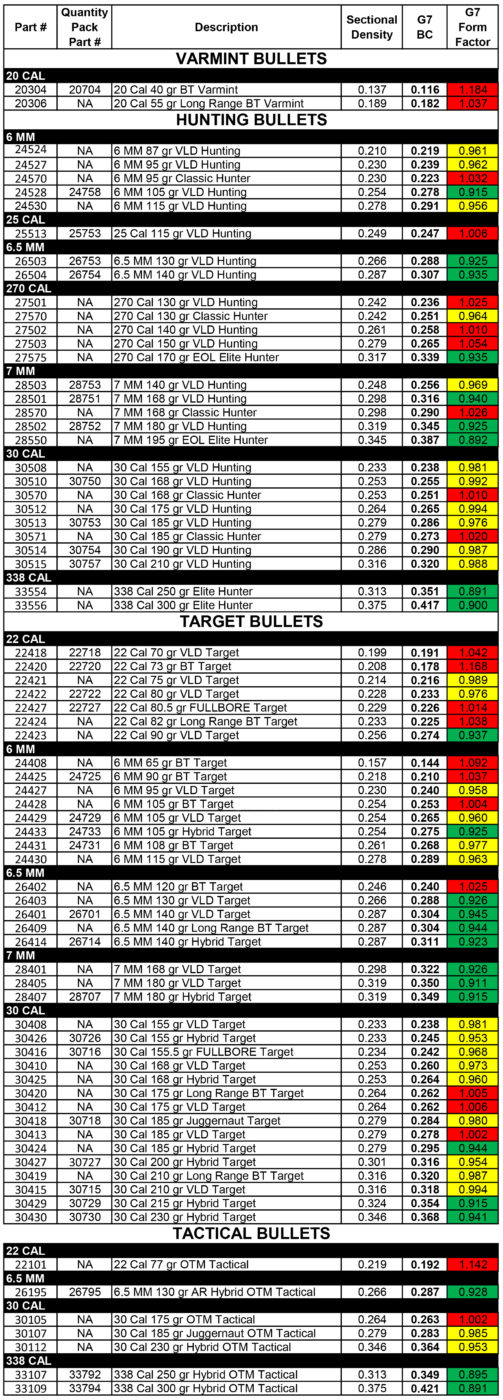
The takeaway for a firing solution: use a G7 BC over a G1 BC for a modern bullet, use a published custom drag curve over either if one exists for your exact bullet, and never treat any of these numbers as valid outside the velocity band it was derived in.
4.8 Bibliography
Footnotes
-
Standard drag equation (textbook fluid dynamics). https://en.wikipedia.org/wiki/External_ballistics (confidence: high). ↩
-
Doppler-measured C_d vs Mach (Lapua GB528 Scenar), via Wikipedia “External ballistics.” https://en.wikipedia.org/wiki/External_ballistics (confidence: high as reported; re-verify against the primary Lapua dataset before quoting to three digits). ↩
-
Transonic center-of-pressure migration and limit-cycle yaw. https://www.faac.com/blog/2018/01/28/bullet-stability-part-1-weight-vs-barrel-twist-rate-of-bullets-transonic-range-speed-more/ ; https://www.accurateshooter.com/ballistics/transonic-effects-on-bullet-stability-bc/ (confidence: medium-high). ↩
-
BC = SD/i and the SD formula. Applied Ballistics / Bryan Litz, “Form Factors: A Useful Tool.” https://appliedballisticsllc.com/wp-content/uploads/2021/06/ABDOC2.3-Form-Factors-A-Usefull-Tool-2021-Copyright.pdf (confidence: high). ↩ ↩2
-
G1 and G7 standard-projectile geometry. https://en.wikipedia.org/wiki/Ballistic_coefficient (confidence: high). ↩
-
G1 vs G7 constancy and the GB528 0.785/0.377 example. https://en.wikipedia.org/wiki/External_ballistics ; https://precisionrifleblog.com/2019/06/09/g1-vs-g7-vs-custom-drag-models/ (confidence: high). ↩
-
.50 BMG G1 BC ranging 1.040–1.068 for one bullet. https://en.wikipedia.org/wiki/Ballistic_coefficient (confidence: high). ↩
-
Custom Drag Models and 4DOF. https://appliedballisticsllc.com/custom-drag-factor-cdf/ ; https://precisionrifleblog.com/2019/06/30/personalized-drag-models-the-final-frontier-in-ballistics/ ; https://www.hornady.com/team-hornady/ballistic-information/ballistic-resources/4dof-overview (confidence: high). ↩
Comments (0)