Ballistics Overview · Volume 9
The Subtle Deflections
This is the volume the whole series was commissioned to get right. The four effects here — spin drift, horizontal Coriolis, the Eötvös effect, and aerodynamic jump — are each a few inches at 1000 yards, small enough to ignore below extreme range and large enough to matter past it. They are also the effects that shooting literature most reliably explains backwards or blends together. Every claim below is anchored to Bryan Litz’s Applied Ballistics technical work, the primary authoritative source, and where the research could not confirm something, this volume says so plainly.
9.1 Spin Drift — Gyroscopic, Not Coriolis
A spin-stabilised bullet drifts sideways in the direction of its spin: right-hand twist drifts right, left-hand twist drifts left, by the same magnitude.1 The mechanism is gyroscopic precession. As gravity pulls the bullet’s velocity vector downward through the arc, the bullet’s nose weather-vanes to track that vector — but a spinning body’s response to a torque appears 90° away in the direction of spin, so the nose ends up pointed slightly to one side (right, for right-hand twist) rather than purely nose-down. That persistent slight nose-right attitude generates a small sideways aerodynamic force, and the bullet drifts that way over the flight. This is the “yaw of repose.”
The critical point, in Litz’s own words: spin drift “has nothing to do with the earth’s rotation.” It is not Coriolis. It would happen exactly the same on a non-rotating planet. Anyone who lumps spin drift in with Coriolis has made a category error.1
Magnitude: typically 8–9 inches at 1000 yards for small-arms trajectories, with an upper bound Litz gives as “no more than 10 to 12 inches at 1000 yards” across a wide range of small-arms calibers in flat-fire (under 10°) trajectories.1 It depends on air density (denser air, more drift) and grows nonlinearly with time of flight. A commonly cited closed-form empirical fit, attributed to Litz via Wikipedia, is:
SD = 1.25 * (SG + 1.2) * TOF^1.83where SG is the gyroscopic stability factor and TOF is time of flight in seconds.2 Treat this equation as medium confidence: it is a widely repeated empirical fit attributed to Litz, but it was not found spelled out in the primary Litz PDF opened for this research, which discusses spin drift numerically and qualitatively without giving this exact expression. Use it as a “commonly cited fit,” not a verbatim quote.
9.2 Horizontal Coriolis — Latitude Only, Not Azimuth
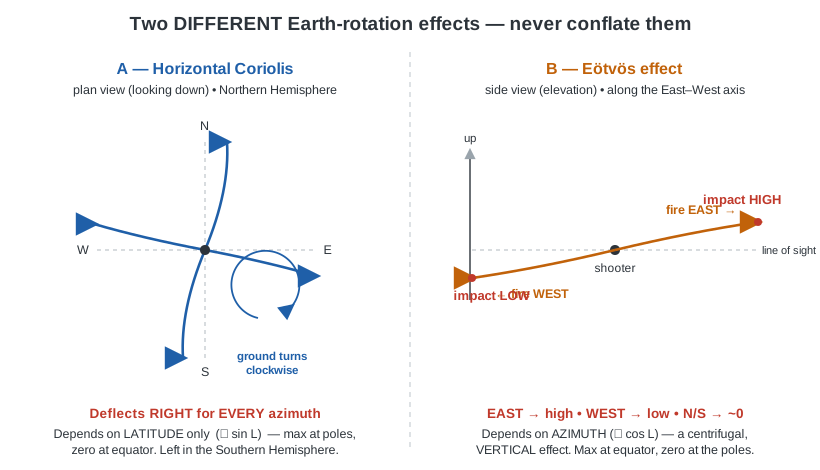
The horizontal Coriolis deflection depends on latitude only, not on the direction you fire. It is maximum at the poles, zero at the equator, and in the Northern Hemisphere it always deflects the bullet right (left in the Southern Hemisphere) — whether you shoot north, south, east, or west. Litz states it directly: “The horizontal component doesn’t depend on which direction you shoot.”1
Why azimuth cannot flip the sign — this is the part worth understanding rather than memorising. The dominant term comes from the vertical component of Earth’s rotation vector at your latitude, Ω·sin(latitude), crossed with the bullet’s velocity. That is mathematically equivalent to the shooter’s local horizontal plane slowly rotating underneath the bullet during its flight — like a giant, very slow, latitude-dependent turntable. A turntable rotating clockwise (as seen from above, in the Northern Hemisphere) carries the ground out from under every trajectory in the same rotational sense, no matter which compass direction the bullet was launched. The bullet flies straight; the world turns beneath it. It is the exact analogue of a Foucault pendulum, whose swing plane rotates the same direction all day regardless of which way you first pushed it.1 A general closed form cited via McCoy/Pejsa has the shape:
Deflection ≈ K * R^2 * sin(L) / V(K a constant, R range, L latitude, V average velocity) — explicitly latitude-dependent via sin(L), with no azimuth term in the leading-order horizontal deflection.3 This specific closed form is medium confidence (secondary attribution to McCoy/Pejsa); the qualitative claim is high confidence from Litz.
Magnitude: typically 2.5–3.0 inches to the right at 1000 yards at about 45° N.1
9.3 The Eötvös Effect — Vertical, Azimuth-Dependent, a Separate Phenomenon
The Eötvös effect is the vertical component of Earth’s rotation on the bullet, and it is a separate phenomenon from horizontal Coriolis — same origin, different term, different dependence. Never conflate them.
It depends on latitude and azimuth: maximum at the equator, zero at the poles (the opposite latitude dependence from the horizontal term), and zero when firing due north or south, maximum when firing due east or west.1 The rule:
Firing east → the bullet impacts high. Firing west → it impacts low.
Physically, this is the centrifugal component of Earth’s rotation. Firing east adds to the bullet’s eastward (with-rotation) velocity, which slightly increases the centrifugal “lightening” it experiences — gravity is opposed a fraction more, so the bullet drops a hair less and hits high. Firing west works against Earth’s spin, slightly increasing the net downward pull, so it hits low.1
Magnitude: Litz gives the same order as the horizontal term at 45° — about ±2.5 to 3.0 inches at 1000 yards (high firing east, low firing west). The numeric coincidence with horizontal Coriolis at 45° is exactly that — a coincidence: sin(45°) = cos(45°), so the two effects happen to be comparable there. They diverge everywhere else — horizontal Coriolis grows toward the poles, Eötvös grows toward the equator.1 The “under 1% of total drop” framing from a secondary source is consistent in order of magnitude and is medium confidence.4
9.4 Aerodynamic Jump — Mechanism and Magnitude, but Not the Sign
Aerodynamic jump is the vertical deflection a crosswind induces on a spinning, gyroscopically stable bullet. When the bullet first meets a crosswind — treated classically as near-instantaneous exposure at the muzzle — it weather-vanes its nose into the apparent wind (the vector sum of the true crosswind and its own forward velocity). That nose deflection sets off a lopsided precession that nets out to a constant angular vertical deflection for the rest of the flight. Because it is a fixed angle set once, early, it is linear with range: an aerodynamic jump of 0.2 MOA is 0.2 MOA at 100 yards and still 0.2 MOA at 1000 yards (growing in linear inches, constant in MOA) — unlike spin drift, which re-accumulates continuously.5
Magnitude: roughly half a MOA (about 0.34–0.37 MOA cited across two air-density conditions) of vertical deflection in a 10 mph full-value crosswind at 1000 yards — for comparison, spin drift at 1000 yards is on the order of 1 MOA.6 A commonly cited empirical fit for the jump, attributed to Litz, is Y = 0.01·SG − 0.0024·L + 0.032 MOA per mph of crosswind (SG the stability factor, L the bullet length in calibers), but this equation is medium confidence — it was not independently verified against a primary Applied Ballistics document in the source research and should be re-checked against Litz’s book before its coefficients are quoted verbatim.5
The sign is not asserted here. For a right-hand-twist bullet, a full-value crosswind from the shooter’s left produces a small vertical jump — but whether that jump is up or down flips with barrel twist direction, and the research behind this series could not pin the left-wind-to-up-or-down pairing to a primary source with a concrete worked example. So this volume states the mechanism and the magnitude and stops there: the direction depends on crosswind side and twist direction, and the absolute sign convention is unsettled in the sources consulted. Do not infer it from anything above. A shooter who needs the sign for a real solution should get it from their own solver’s output for their exact bullet and twist, confirmed against observed impacts — not from a rule of thumb.5
9.5 The Worked Example — Everything Ranked
Here is the point of the whole volume, in one table. Baseline: .308 Winchester, 175 gr Sierra MatchKing, ~2600–2700 fps, at 1000 yards, near 45° N, right-hand twist, 10 mph full-value crosswind unless noted. Because sources used slightly different MV/BC/atmosphere, figures vary source-to-source by up to ~15–20% — flagged, not papered over.7
Table 1 — The Worked Example — Everything Ranked
| Effect | Magnitude at 1000 yd | Direction | Confidence |
|---|---|---|---|
| Gravity drop (baseline) | ~226″–411″ (varies with MV/BC/atmosphere — a range, not one number) | Down | medium |
| Wind drift, 10 mph full value | ~100″ | Toward the wind’s downwind side | medium |
| Spin drift (gyroscopic) | ~8–9″ (up to ~10–12″ across calibers) | Right (right-hand twist) | high |
| Coriolis (horizontal) | ~2.5–3.0″ | Right (N. Hemisphere, any azimuth) | high |
| Eötvös (vertical) | ~±2.5–3.0″ | High firing east, low firing west; ~0 firing N/S | high |
| Aerodynamic jump (same 10 mph wind) | ~½ MOA (~3.5–3.9″) | Vertical — sign not asserted (depends on wind side + twist) | medium |
| Humidity (50-pt RH swing) | negligible (~0.32% density change; well under an inch) | Higher humidity → very slightly less drop | medium |
Litz’s own combined worked example is instructive: for a right-twist barrel in the Northern Hemisphere with no wind, gyro drift and horizontal Coriolis add to about 11.5 inches total right — but for a left-twist barrel they partially cancel, netting only about 6.5 inches, because the left-twist spin drift goes left while Coriolis still goes right.7
The ranking, largest to smallest: wind (~100″) ≫ spin drift (~8–9″) ≈ Coriolis ≈ Eötvös (~2.5–3″ each) ≳ aerodynamic jump (~3.5–4″ in that wind) ≫ humidity (negligible). This is exactly why shooters obsess over the wind call and dial spin drift as a matter of course (it is usually baked into a G7-based solver’s solution), while treating Coriolis, Eötvös, and humidity as curiosities until they reach genuine extreme range (1500 yd+), where they finally become firing-solution-relevant.
9.6 Gyroscopic Stability — the Miller Twist Rule
All of the above assumes the bullet is stably spinning to begin with. Gyroscopic stability is captured by the stability factor Sg, and the field-standard estimator is the Miller twist rule:
s = 30 * m / (t^2 * d^3 * l * (1 + l^2))with m = bullet mass in grains, d = diameter in inches, l = bullet length in calibers (length ÷ diameter), t = twist rate in calibers per turn (twist-in-inches ÷ diameter), and s = the dimensionless stability factor.8 To convert twist from calibers-per-turn back to inches-per-turn: T = t·d.
The constant 30 bakes in a standard reference atmosphere — velocity 2800 ft/s, 59 °F, 750 mmHg, 78% relative humidity (Army Standard Metro).8 Outside those conditions the raw formula needs correction: a velocity correction f_v = (v/2800)^(1/3), and an altitude correction f_a = e^(3.158e-5 · h) with h in feet — the altitude term capturing that thinner air produces less overturning torque, so the same twist yields higher effective stability at altitude (and standard-atmosphere numbers therefore understate real high-altitude stability).8
Target window: the broadly cited safe design range is Sg ≈ 1.4 to 2.0. Below ~1.4, stability is marginal and erratic — especially dangerous through the transonic zone (Volume 4). Well above 2.0 is “over-stabilised,” which mostly affects behaviour on yaw and impact rather than in-flight stability. Note honestly: the primary Miller-rule reference documents 2.0 as a quick safe default but does not itself justify the 1.4 minimum; the 1.4 figure is near-universally repeated across the ballistic-calculator ecosystem but should ideally be traced to Miller’s or Litz’s original stability papers before being treated as a hard number.9
How the four physical inputs move Sg: faster twist (smaller inches-per-turn) → higher Sg; longer bullet (more calibers) → lower Sg (which is exactly why low-drag, long-ogive bullets need faster twist than short flat-base bullets of the same caliber and weight); higher velocity → higher Sg; and denser air (lower, colder, drier) → lower Sg, because dense air produces more overturning torque.10 That last point closes the loop with Volume 6: the same density variable that drives drag and spin drift also drives twist-rate requirements. Temperature, pressure, humidity, and altitude do not just reshape the trajectory — they change how fast you need to spin the bullet to keep it pointed the right way in the first place.
9.7 Bibliography
Footnotes
-
Bryan Litz / Applied Ballistics, “Gyroscopic (spin) Drift and Coriolis Effect” — spin drift mechanism and magnitude (“has nothing to do with the earth’s rotation”); horizontal Coriolis (latitude only, not azimuth); Eötvös (east-high/west-low, latitude+azimuth). https://appliedballisticsllc.com/wp-content/uploads/2021/06/Gyroscopic-Drift-and-Coriolis-Effect.pdf (confidence: high). ↩ ↩2 ↩3 ↩4 ↩5 ↩6 ↩7 ↩8 ↩9
-
Spin-drift closed form SD = 1.25·(SG+1.2)·TOF^1.83, attributed to Litz via https://en.wikipedia.org/wiki/External_ballistics (confidence: medium; not found in the primary Litz PDF). ↩
-
Coriolis closed form ≈ K·R²·sin(L)/V, McCoy/Pejsa via secondary summary (confidence: medium for the form; high for the qualitative latitude-only claim). ↩
-
Eötvös “<1% of drop” framing. https://www.gunssavelife.com/2015/03/05/eotvos-coriolis-effects-on-long-range-shooting/ (confidence: medium; the Litz inches figure is high). ↩
-
Aerodynamic jump mechanism, linearity, the Y = 0.01·SG − 0.0024·L + 0.032 fit, and the sign dependence on twist. https://forum.accurateshooter.com/threads/aerodynamic-jump.3939113/ (summarizing Litz, Applied Ballistics for Long-Range Shooting 2nd ed., pp. 75–83); https://en.wikipedia.org/wiki/External_ballistics (confidence: medium-high on mechanism; the jump equation is medium and unverified against a primary source; the left-wind sign convention is unresolved and not asserted). ↩ ↩2 ↩3
-
Aerodynamic-jump magnitude (~½ MOA in 10 mph) and spin-drift ~1 MOA comparison. Forum-aggregated Litz citation, https://forum.accurateshooter.com/threads/crosswind-effects-on-vertical.3972006/ (confidence: medium). ↩
-
Worked-example table and Litz’s combined gyro+Coriolis example (11.5″ right-twist vs 6.5″ left-twist). Same Litz PDF as 1; wind/drop figures from https://backfire.tv/wind-deflection/ and https://www.accurateshooter.com/shooting-skills/horizontal-wind-drift-vs-distance/ (confidence: high for the Litz figures; medium for wind/drop). ↩ ↩2
-
Miller twist rule, the constant-30 reference atmosphere, and the velocity/altitude corrections. https://en.wikipedia.org/wiki/Miller_twist_rule (confidence: high). ↩ ↩2 ↩3
-
Sg 1.4–2.0 window; the 1.4 minimum is widely repeated but not traced to a primary derivation in the source research. https://a2zcalculators.com/science-and-engineering-calculators/twist-rate-stability-calculator ; https://jsbartunek.github.io/josefs-stability-calculator/ (confidence: medium). ↩
-
Qualitative effect of twist, bullet length, velocity, and air density on Sg — directly implied by the Miller formula structure. https://en.wikipedia.org/wiki/Miller_twist_rule (confidence: high). ↩
Comments (0)