Ballistics Overview · Volume 10
Terminal Ballistics
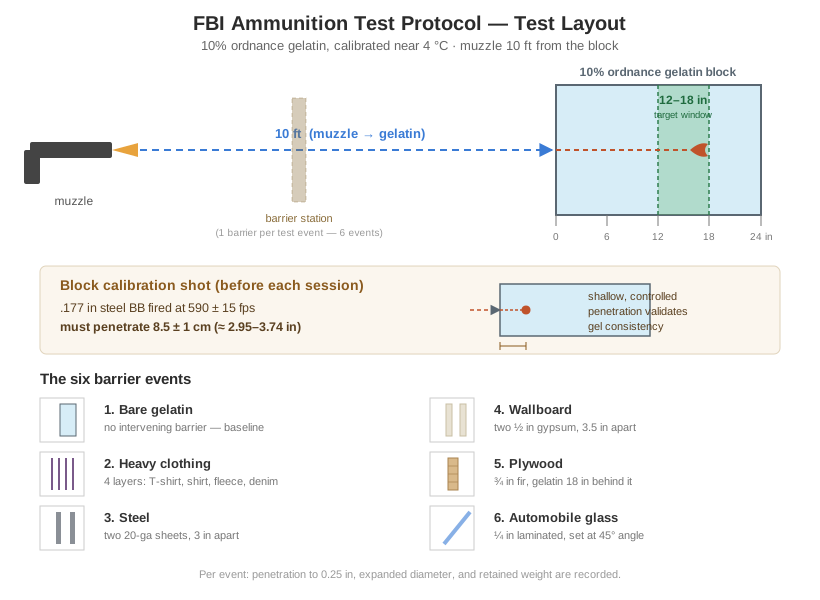
Terminal ballistics is the interaction of the bullet with the target medium, and it is the domain where the physics is clean but the folklore is thick. This volume keeps to what is measurable — penetration, expansion, fragmentation, sectional density, and energy transfer — and treats the one genuinely contested claim in the field, hydrostatic shock, as the live scientific dispute it still is, without picking a winner.
10.1 Sectional Density and Penetration
Sectional density, defined in Volume 4 as SD = weight(lb) / diameter(in)², correlates directly with penetration potential. For a given impact velocity and bullet construction, a higher-SD bullet — longer and heavier for its caliber — tends to penetrate deeper, because it carries more momentum per unit of frontal area pushing through the resisting medium.1 This is the uncontested backbone of terminal ballistics: penetration is momentum delivered through a cross-section against a drag-like tissue resistance.
10.2 Expansion versus Penetration — the Central Trade-off
Expansion and penetration trade against each other. A bullet that expands more presents a larger frontal area, cuts a larger permanent cavity, and dumps its energy faster — and therefore, for a given velocity and construction, penetrates less. A bullet that resists expansion penetrates deeper but leaves a narrower wound channel.2 Bullet design is largely the management of this trade-off across the range of impact velocities and intervening barriers a bullet might actually encounter. The hard part is that expansion is velocity-dependent and barrier-dependent: a hollow point that expands beautifully in bare gelatin may plug with denim and fail to open, or may over-expand and under-penetrate at close range. Characterising exactly this behaviour, across realistic barriers, is what the FBI protocol exists to do.
10.3 The FBI Protocol — What It Actually Measures
The FBI’s ammunition test protocol is a reproducibility standard for penetration and expansion behaviour, not a “stopping power” oracle. The tissue simulant is 10% (by weight) ordnance gelatin — Kind & Knox or Vyse 250-A gelatin powder, calibrated near 4 °C.3 Each block is validated before use with a calibration shot: a .177” steel BB fired at 590 ± 15 fps must penetrate 8.5 ± 1 cm (about 2.95–3.74 inches) into the block, which is how gel-to-gel consistency (temperature, mixing, bloom) is held constant across sessions.3
The protocol fires through six barrier events, at a 10-foot muzzle-to-gelatin distance:3
- Bare gelatin.
- Heavy clothing — four layers: cotton t-shirt, cotton shirt, fleece, denim.
- Steel — two pieces of 20-gauge hot-rolled galvanized steel, 3 inches apart.
- Wallboard — two ½-inch gypsum pieces, 3.5 inches apart.
- Plywood — ¾-inch fir, with the gelatin 18 inches behind it.
- Automobile glass — ¼-inch laminated safety glass, 15×18 inches, set at 45° and offset 15 inches to the side of the bullet path, simulating an angled through-glass shot.
For each event, penetration is measured to the nearest 0.25 inch, along with expanded diameter and retained weight.3
The 12-to-18-inch window is the protocol’s headline number. The 12-inch minimum ensures the bullet can still reach vital organs after passing through an intervening arm, heavy clothing, or light bone — real defensive shootings are rarely clean broadside hits into bare torso. The 18-inch maximum is a public-safety ceiling, meant to limit dangerous through-and-through over-penetration that could strike a bystander behind the target.4 The origin story — that the standard grew out of the FBI’s review after the 1986 Miami shootout — is widely repeated but was not independently verified against a primary FBI document in the source research, so it is stated here as reported, not as flatly established fact.4 What the protocol measures, clinically, is penetration depth, permanent-cavity/expansion diameter, and retained weight through a standard barrier set. It explicitly does not attempt to quantify or validate any one-shot-stop claim.4
10.4 Hydrostatic Shock — Contested, Not Adjudicated
Here the field genuinely disagrees, and this volume presents both sides without ruling. The dispute is not over whether any pressure wave exists — it is over its magnitude and clinical relevance.
The claim: a sufficiently fast, sufficiently energetic bullet impact generates a pressure wave that radiates through the body’s fluid-filled tissues fast and hard enough to cause remote injury or incapacitation away from the direct wound channel — for example, claimed remote neurological effects from a torso hit.5
The skeptic position — mainstream in wound-ballistics practice: Dr. Martin Fackler, the Vietnam-era trauma surgeon who headed the US Army’s Wound Ballistics Laboratory and is probably the single most-cited authority in small-arms terminal ballistics, argued that hydrostatic shock as a meaningful wounding mechanism is disproved — a myth at handgun velocities. Duncan MacPherson (Bullet Penetration) argued the physics do not support a meaningful shock wave from typical bullet impacts. The FBI’s own ammunition-selection guidance rests on penetration depth, permanent wound channel, and shot placement — not on any shock mechanism.5
The proponent position: Michael and Amy Courtney have published a series of papers (arXiv preprints and some peer-reviewed placements in Neurosurgery, NeuroImage, Brain Injury, and Injury) arguing for a real ballistic pressure wave with remote physiological effects, particularly at high-velocity rifle impact energies as distinct from handgun energies, drawing parallels with blast-wave TBI research. Separately, Caltech shock-wave physicist Brad Sturtevant is cited as having found that shock waves can result from handgun-caliber tissue impacts — a physics-of-the-wave finding, distinct from any clinical incapacitation claim.5
Where the field sits: the Courtneys’ claims are rejected by most mainstream wound-ballistics practitioners and the ammunition-testing establishment (FBI, most Western militaries) as insufficiently supported relative to the well-established penetration and permanent-cavity mechanisms — though the underlying physics of a pressure wave existing at all is not itself “myth.” One critical summary notes that if hydrostatic shock at handgun energies were as clinically significant as claimed, purpose-built low-penetration, high-energy-transfer rounds like the Glaser Safety Slug would be expected to dominate law-enforcement selection on stopping-power grounds — and they do not; the field converged instead on FBI-protocol penetration-and-expansion criteria.5 Both named positions are real and correctly attributed here. This series does not adjudicate which is correct — present both, decide nothing.
10.5 The Clinical Bottom Line
Strip the folklore and terminal ballistics reduces to a short, defensible list: put a bullet of adequate sectional density and appropriate construction into the target with enough velocity to penetrate 12–18 inches through likely barriers while expanding reliably, and place it where it does anatomical work. Energy transfer matters as the mechanism that drives expansion and permanent-cavity formation, not as a magic incapacitation number. Everything the FBI protocol measures is downstream of that sentence, and everything contested — hydrostatic shock, one-shot-stop energy thresholds — sits outside what the mainstream testing establishment is willing to bank on.
10.6 Bibliography
Footnotes
-
Sectional density and penetration potential — standard uncontested terminal-ballistics relationship (see also Vol 4 for the SD definition) (confidence: high). ↩
-
Expansion-versus-penetration trade-off — standard terminal-ballistics design principle, implicit in the FBI protocol’s purpose (confidence: high). ↩
-
FBI test protocol — 10% ordnance gelatin, BB calibration shot, six barrier events, 10-ft distance, measurement method. https://www.hornadyle.com/resources/fbi-test-protocol (confidence: high). ↩ ↩2 ↩3 ↩4
-
The 12–18 inch rationale and the (softly-qualified) Miami-shootout origin. https://www.usconcealedcarry.com/blog/fbi-ammo-testing/ (confidence: high for the rationale; the causal link to the 1986 shootout is UNVERIFIED against a primary FBI document and is stated as reported). ↩ ↩2 ↩3
-
Hydrostatic shock controversy — Fackler and MacPherson (skeptic), Courtney & Courtney and Sturtevant (proponent), FBI’s penetration-based posture, and the Glaser counter-argument. https://en.wikipedia.org/wiki/Hydrostatic_shock ; https://arxiv.org/abs/0803.3051 ; https://tacticaledgemagazine.com/hydrostatic-shock-unraveling-the-controversy-in-ballistics/ (confidence: high that the controversy and both positions are real and correctly attributed; contested/low as to which side is correct — both presented, neither adjudicated). ↩ ↩2 ↩3 ↩4
Comments (0)