Ballistics Overview · Volume 5
Trajectory & Zero
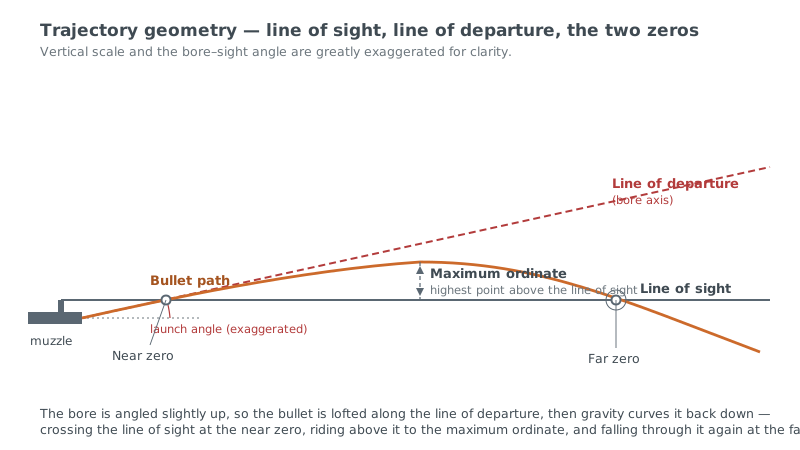
A trajectory is the compromise between two forces that never let up: the forward velocity the powder gave the bullet, and gravity, which starts pulling it down the instant it leaves the bore. Everything else in external ballistics — drag, wind, spin drift — is a modification of this basic falling-body geometry. This volume lays down that geometry and the vocabulary a firing solution is written in, because the subtle effects in later volumes are all measured against this baseline path.
5.1 Gravity Never Waits
The moment the bullet’s base clears the muzzle, gravity accelerates it downward at about 9.8 m/s² (32.2 ft/s²), and it keeps doing so for the entire flight regardless of how fast the bullet is going forward.1 There is no “flat” part of any trajectory; a bullet leaving the muzzle perfectly horizontal begins dropping immediately and would strike the ground at the same time as one simply dropped from the same height. The only reason a bullet reaches a distant target at all is that the barrel is not pointed at the target — it is angled slightly upward so the bullet is lofted, arcs up, and falls back down to intersect the aim point.
5.2 Line of Sight versus Line of Departure
Two straight lines frame the curved path. The line of sight is the straight line from the shooter’s eye through the sights to the target. The line of departure is the straight line the bore is pointed along at the instant of firing. Because the sight sits above the bore and the bore is tilted slightly up relative to the line of sight, these two lines are not parallel — they diverge from the muzzle. The bullet launches along the line of departure, immediately begins falling away from it under gravity, and traces a curve that crosses the line of sight, rises above it, then falls back through it.1
5.3 Near Zero, Far Zero, Maximum Ordinate
Because the launch angle lofts the bullet above the line of sight and gravity brings it back down, the curved path crosses the straight line of sight twice. The first crossing, close to the muzzle, is the near zero. The second, downrange, is the far zero — the distance the rifle is conventionally said to be “zeroed” at. Between them the bullet rides above the line of sight, reaching its maximum ordinate (the highest point of the path above the line of sight) somewhere between the two zeros — for a flat-shooting cartridge, well before the far zero.1
This is standard exterior-ballistics geometry and is high confidence, but a couple of practical consequences are worth stating for someone setting a zero:
- A 100-yard-zeroed flat-shooting rifle has its near zero very close to the far zero and a small maximum ordinate — the path barely rises above the line of sight.
- A longer far zero (say 200 or 300 yards) buys a “point-blank range” where the bullet never rises or falls more than some acceptable amount from the line of sight, at the cost of a higher maximum ordinate mid-range. This is the basis of the maximum-point-blank-range zeroing philosophy hunters use: choose the far zero so the whole arc stays inside the vital zone out to as far as possible.
- Past the far zero, the path falls away from the line of sight increasingly steeply, because the bullet is now both descending under gravity and decelerating under drag, so it spends more time dropping over each successive increment of range. This is why drop grows faster than linearly with distance.
5.4 The Shape of the Path
Two effects combine to give a real trajectory its characteristic shape. Gravity alone would produce a symmetric parabola. Drag breaks the symmetry: the bullet is fastest early and slowest late, so it covers the first half of the range quickly (little time to fall) and the second half slowly (much time to fall). The result is an asymmetric arc — shallow and fast on the way out, steep and slow on the way down. The descending branch is always steeper than the ascending branch would be in a vacuum. This asymmetry is why the far zero is not simply twice the near-zero distance, and why drop tables are non-linear.
Everything from here builds on this picture. Air density (Volume 6) scales the drag that sets how fast the bullet decelerates along this arc. Wind (Volume 7) pushes the whole arc sideways. Angle firing (Volume 8) changes how much of gravity’s pull acts along the sight line. And the subtle deflections (Volume 9) are small departures from this arc — a few inches of spin drift and Coriolis riding on top of a path that is fundamentally this: a lofted, drag-slowed, gravity-driven fall from the line of departure back through the line of sight.
5.5 Bibliography
Footnotes
-
Standard exterior-ballistics trajectory geometry — line of sight, line of departure, near/far zero, maximum ordinate — as covered by the general drag-and-gravity treatment in the external-ballistics references for this series. https://en.wikipedia.org/wiki/External_ballistics (confidence: high; textbook geometry). ↩ ↩2 ↩3
Comments (0)