Ballistics Overview · Volume 3
Transitional Ballistics — the Muzzle Interval
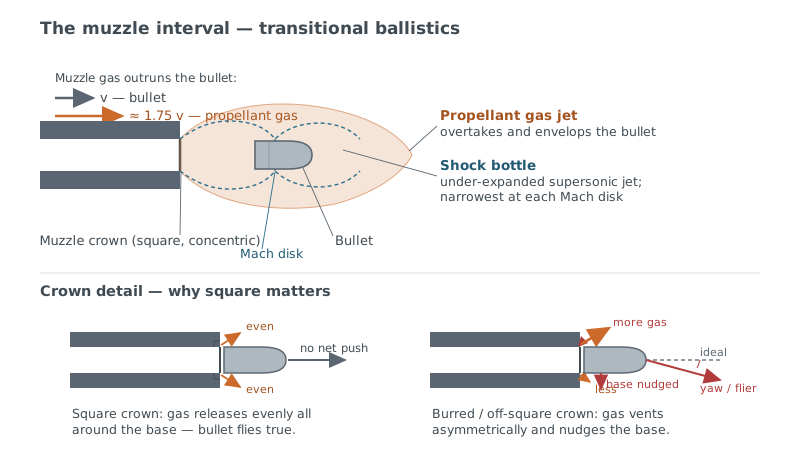
Transitional ballistics is the shortest domain and the one shooters think about least, yet it is where a perfectly good barrel and a perfectly good bullet can be quietly sabotaged. It covers the interval from the instant the bullet’s base clears the muzzle until the propellant gas has expanded enough to stop pushing on it — pressure roughly equalising with the atmosphere.1 It lasts a few inches of travel and a few hundred microseconds, but a bullet leaves this interval either pointed cleanly along its flight path or already fighting a yaw it will spend the first stretch of free flight damping out.
3.1 The Gas Jet Overtakes the Bullet
At the muzzle, the propellant gas behind the bullet is moving substantially faster than the bullet itself — commonly cited around 1.75 times the projectile’s velocity.2 The instant the base uncorks the bore, that high-pressure gas is no longer confined; it expands violently, accelerates through the muzzle, and overtakes and envelops the bullet in a turbulent, high-pressure jet before dropping behind. For a few calibres of travel the bullet is flying through a cloud of its own propellant gas moving faster than it is. The 1.75× multiplier comes from an airgun-pellet context and is medium confidence, but the qualitative mechanism — gas overtakes bullet — is well established for firearms.2
This is the physical reason the muzzle interval matters. The bullet’s base is briefly awash in asymmetric, high-energy flow, and anything that makes that flow asymmetric can push the base sideways while the bullet is still too slow-relative-to-the-gas to resist it aerodynamically.
3.2 Crown Quality
The crown is the last thing the bullet touches, and it is the referee for whether the escaping gas is symmetric. If the bore meets the crown at a perfectly even, square angle, the gas releases evenly around the full circumference and imparts no net sideways force. A burred, dinged, eroded, or off-square crown lets gas escape unevenly while it is still at hundreds of atmospheres, and that asymmetric jet nudges the bullet’s base as it clears the muzzle.3 This is the classic mechanism behind a damaged crown opening up group size or throwing occasional unexplained fliers, and it is why re-crowning is a standard accuracy repair. The same logic condemns a muzzle device machined or threaded off-square: it re-introduces exactly the asymmetry a good crown removes. For a shop like this one, a square, concentric crown cut is cheap insurance and the first thing to check when a known-good barrel starts stringing.
3.3 In-Bore and Near-Muzzle Yaw
The bullet does not necessarily exit perfectly aligned. A precursor pressure wave can precede the bullet out of the muzzle — gas leaking past the bullet, or through the barrel-cylinder gap on a revolver — and then the main gas outflow overtakes the bullet, which “may suffer severe yawing” in this brief window before aerodynamic forces settle it onto a stable path.4 This is why the first few calibres of free flight are not wasted distance: a bullet’s transition to a stable, nose-forward “weather-vaning” attitude is not instantaneous. A bullet that leaves the muzzle with in-bore yaw — from a tight gas-check, a bent crown, or an imperfect bore-to-throat alignment — arrives at the target having converted some of that initial tip into dispersion. Gyroscopic stability (Volume 9) is what damps this yaw; a marginally stable bullet damps it slowly and pays for it downrange, especially into the transonic zone.
3.4 Muzzle Devices Are All Transitional-Ballistics Interventions
Every muzzle device works by manipulating the gas during this interval, and it is worth seeing them as a family rather than as unrelated accessories.5
- Flash suppressors introduce turbulence into the fuel-air mixing of the exiting gas so the unburned propellant cannot flare into a bright secondary flash. They manage combustion, not recoil.
- Sound suppressors slow and stage the gas expansion through a series of baffled volumes, dropping the peak intensity of the muzzle shockwave. They are, in effect, controlled-expansion transitional-ballistics devices.
- Muzzle brakes redirect gas rearward and sideways to reduce free recoil — and because a brake changes the free recoil itself, not just the perception, it is doing real momentum work on the gas.
- Compensators redirect gas upward to counter muzzle rise.
All four are interventions in the same brief, violent, high-pressure flow that this domain describes. And all four re-open the crown-concentricity question: a device that vents asymmetrically, or that sits crooked on the threads, will disturb the base exactly the way a bad crown does. The lesson of this whole domain is that the muzzle interval is short, but it sets the initial conditions for everything external ballistics then has to model.
3.5 Bibliography
Footnotes
-
Wikipedia, “Transitional ballistics” — definition of the interval. https://en.wikipedia.org/wiki/Transitional_ballistics (confidence: high). ↩
-
Gas-overtakes-bullet mechanism and the ~1.75× multiplier (airgun-context source). https://www.pyramydair.com/blog/2011/09/the-importance-of-the-crown/ (confidence: medium for the multiplier; the qualitative mechanism is well established). ↩ ↩2
-
Crown quality and asymmetric gas release. https://en.wikipedia.org/wiki/Transitional_ballistics (confidence: medium-high). ↩
-
Precursor blast and near-muzzle yaw. https://en.wikipedia.org/wiki/Transitional_ballistics (confidence: medium). ↩
-
Muzzle devices as transitional-ballistics interventions. https://en.wikipedia.org/wiki/Transitional_ballistics (confidence: high). ↩
Comments (0)