Ballistics Overview · Volume 7
Wind
Wind is the effect that dominates every long-range miss. At 1000 yards a .308 match load drifts roughly 100 inches in a 10 mph crosswind — an order of magnitude larger than spin drift, Coriolis, and every exotic effect in Volume 9 combined. Reading wind is the single highest-value skill in long-range shooting, and it is also the effect most tangled with a plausible-sounding piece of folklore that is exactly backwards. This volume covers the model, the clock, and the nuance.
7.1 The Lag-Time Model
The clean way to understand crosswind deflection is McCoy’s lag-time model, from Modern Exterior Ballistics:
D = (T - R/MV) * Wwhere D is the deflection, T is the actual time of flight, R is the range, MV is muzzle velocity, and W is the crosswind speed.1 The term R/MV is the vacuum time of flight — how long the bullet would take to arrive if it never slowed down. So the whole expression (T − R/MV) is the lag time: how much longer the real, drag-slowed bullet takes to arrive than a dragless bullet would.
The insight buried in that equation is that wind does not act on the bullet’s speed — it acts on the bullet’s lag. A bullet that never slowed down would not drift at all in a crosswind, no matter how hard the wind blew, because it would spend zero extra time in the wind. Deflection is proportional to the time the bullet spends lagging behind its own dragless schedule. This is why a high-BC bullet drifts less: it sheds velocity more slowly, accumulates less lag, and gives the wind less to work with.
Wind sensitivity grows much faster than linearly with range because lag time itself grows nonlinearly. For a .308 175 gr SMK, deflection per unit of crosswind runs roughly 0.1 m per m/s at 400 m, 0.25 at 600 m, 0.47 at 800 m, and 0.83 at 1000 m — roughly doubling from 400 to 600 m and again from 600 to 1000 m.2 In familiar units, a .308 175 gr in a 10 mph full-value crosswind drifts about 7.3 inches at 300 yd, 21.3 inches at 500 yd, and roughly 100 inches at 1000 yd.3 Drift is often described as growing “with the square of distance” — a serviceable rule of thumb, though the true growth is governed by the nonlinear lag-time relationship, not a clean power law. Those magnitudes are medium confidence and vary with the exact load and atmosphere, but the shape — accelerating with range — is not in doubt.
7.2 The Wind Clock
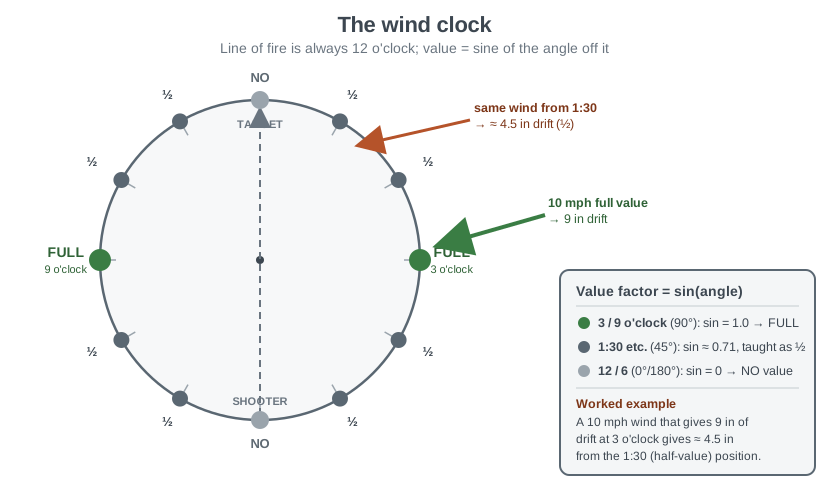
The standard field method treats wind direction as a clock face with the direction of fire always at 12 o’clock.4
- Full value — wind from 3 or 9 o’clock, directly across the line of fire — produces the maximum lateral deflection for a given wind speed.
- No value — wind from 12 or 6 o’clock, straight into the face or straight from behind — produces zero lateral deflection. It is not entirely harmless: a headwind slightly increases effective drag and drop, a tailwind slightly decreases them, but there is no sideways push.
- Half value — wind from any of the eight intermediate hours (1, 2, 4, 5, 7, 8, 10, 11) — produces roughly half the lateral deflection of a full-value wind of the same speed.
Worked: a 10 mph full-value (3 o’clock) wind that deflects a bullet 9 inches at 300 yards deflects it only about 4.5 inches from 1:30 (half value) at the same speed and range.4 The clock is a field approximation — the true value factor is the sine of the angle off the firing line, so 3 o’clock is 1.0, the intermediate hours are nearer 0.5–0.87 than a flat 0.5 — but the three-bucket clock is accurate enough for a fast hold and is how the correction is taught.
7.3 Where in the Trajectory the Wind Matters — the Nuance
Here is the folklore worth demolishing. It is commonly claimed that “wind near the target matters more, because the bullet has slowed down and is more wind-sensitive there.” As a global statement about where a wind puff does the most damage, this is backwards.
Split the trajectory into equal thirds. The first third of the range contributes the largest single share of total deflection — about 56% of the total wind effect at 200 m, dropping to about 44% at 1000 m as the middle third’s share rises. The last third contributes the least — about 12% at 200 m, rising only to 17% at 1000 m.5 The reason is the lag-time logic again: a wind acting on the bullet early in flight has the entire remaining time of flight to compound its lateral push before impact, and that time-to-act advantage dominates the fact that the slower late bullet is more wind-sensitive per unit time. Two equal-strength puffs — one near the shooter, one near the target — do not deflect the bullet equally; the near-shooter puff wins, and it would take a much stronger downrange gust to match an early one.
There is a real grain of truth the folklore is built on: per unit of time, the slowed bullet near the target genuinely is more sensitive. But integrated over the flight, the early wind’s longer lever arm wins. Read the wind everywhere, but if you can only trust one part of the range, trust the part nearest you.
7.4 Wind Gradient and Mirage
Wind is not uniform with height. A boundary-layer gradient sits near the ground — terrain, vegetation, and thermal effects all modify wind speed and direction along the actual bullet path, which rarely matches the wind at the shooter’s own position.6 Spotters read mirage — the heat-shimmer refraction of light through temperature- and density-graded air layers — to estimate wind along the path. As widely repeated field lore (medium confidence, not a hard physical law): mirage boiling straight up means no meaningful crosswind; a slight lean or wave, about 1–3 mph; mirage “boiling over” into near-horizontal flow, roughly 4–5 mph; a hard, flat, fast horizontal run, a full-value wind around 15 mph.6 Best practice is to set the spotting scope’s parallax and focus at the midpoint of the shot distance, so the mirage read reflects the average condition across the bullet’s actual flight path — the “river of air” — which, given the first-third dominance above, is a reasonable single-point proxy for the whole. Everything in this volume points to the same conclusion: the wind call is the shot, and it is a call about the wind along the path, not the wind on your cheek.
7.5 Bibliography
Footnotes
-
McCoy’s lag-time model, via Dan Periard / Applied Ballistics (nVisti), “Where does wind matter?” citing McCoy, Modern Exterior Ballistics 2nd ed. https://appliedballisticsllc.com/wp-content/uploads/2021/06/Where-does-wind-matter.pdf (confidence: high). ↩
-
Wind-influence-vs-range figures (.308 175 gr SMK), same nVisti/McCoy source (confidence: high). ↩
-
Drift magnitudes at 300/500/1000 yd. https://backfire.tv/wind-deflection/ ; https://www.accurateshooter.com/shooting-skills/horizontal-wind-drift-vs-distance/ (confidence: medium). ↩
-
Wind clock and full/half/no value. USMC Weapons Training Battalion, “Effects of Weather.” https://www.trngcmd.marines.mil/Portals/207/Docs/wtbn/ART-A%203%20Effects%20of%20Weather.doc (confidence: high). ↩ ↩2
-
Thirds-of-the-trajectory contribution and the near-vs-far nuance, same nVisti/McCoy source (confidence: high). ↩
-
Wind gradient and mirage reading. https://gundigest.com/more/how-to/firearm-training/how-to-read-the-mirage-to-control-for-wind (confidence: medium; mirage-speed correspondences are field lore, not a physical law). ↩ ↩2
Comments (0)