Ballistics Overview · Volume 8
Angle Firing & the Rifleman's Rule
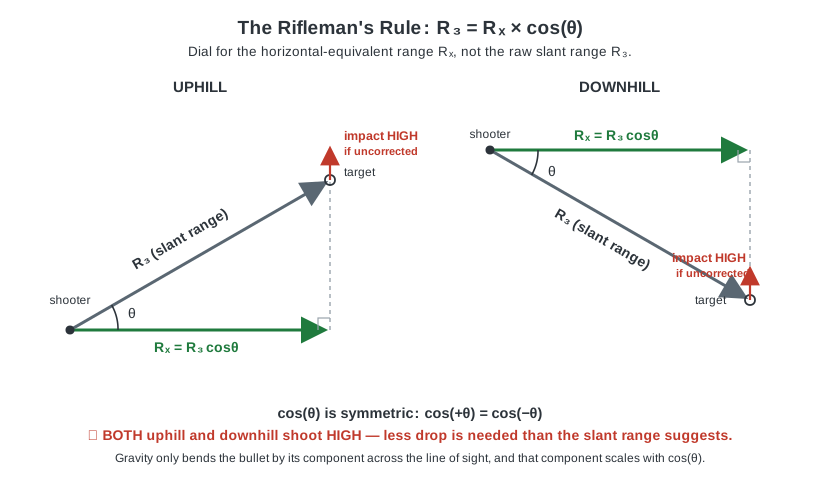
Shooting up or down a slope breaks a habit built entirely on flat ground, and it breaks it in a way that fools almost everyone the first time. The counterintuitive truth is simple to state and hard to believe: both uphill and downhill shots impact high relative to a hold based on the raw line-of-sight distance. Not one or the other — both. This volume explains the rule that corrects for it, why the correction is symmetric, and where the simple rule stops being good enough.
8.1 The Basic Rifleman’s Rule
For a target at slant range R_S and inclination angle θ above or below horizontal, aim as if the target were at the horizontal-equivalent range:
R_H = R_S * cos(θ)Range your target, multiply by the cosine of the look angle, and dial or hold for that shorter horizontal distance instead of the slant distance.1 A target 500 yards away up a 30° slope is dialed as if it were at 500 × cos(30°) = 500 × 0.866 = 433 yards.
The physical basis is that bullet drop is driven by gravity acting across the line of sight, and only the component of gravity perpendicular to the sight line bends the bullet away from where the sights point. Working in the inclined frame, the effective gravity dose the bullet receives — resolved into the sight-line frame over the flight — is reduced in the same proportion as cos(θ).1 Less effective gravity along the way means less drop relative to the line of sight, so the bullet needs less compensation than the slant range alone would demand.
8.2 Why Both Uphill and Downhill Shoot High
This is the part that fools people. The instinct is that gravity should hurt you going uphill (you are fighting it) and help you going downhill (it is pulling the bullet toward the target), so uphill should need extra holdover and downhill extra holdunder — as if the direction of the slope mattered.
It does not, because gravity’s effect on the trajectory is about drop relative to the sight line, and cos(θ) is symmetric: cos(+30°) and cos(−30°) are both 0.866. Whether the target is above or below you, the geometry that matters is the angle away from horizontal, not its sign. The bullet’s flight is governed by time of flight along the actual trajectory interacting with a gravity vector that only has to be resolved into the sight-line frame — and that resolution reduces the perpendicular gravity component by cos(θ) for uphill and downhill alike.1 So both cases need less drop compensation than the slant range suggests, and if you dial for the raw slant range in either direction, you shoot high. Uphill and downhill are the same problem wearing different hats.
8.3 Where the Simple Rule Breaks Down
The basic rifleman’s rule is a small-angle, short-range approximation, and it has two known failure modes.2
First, it ignores how gravity’s reduced component still interacts nonlinearly with aerodynamic drag over the actual — longer, inclined — flight path. Drag depends on the true air-relative velocity and the true time of flight, not on the horizontal-equivalent range, so applying cos(θ) to a flat-fire drop table is only approximately right. Second, and following from the first, a simple cos(θ)-on-the-range calculator will predict identical solutions for uphill and downhill at the same angle and range — but the real trajectories differ slightly, because the drag integral along the true 3D path is not the same going up as coming down. A proper solver that integrates gravity and drag together along the true trajectory produces slightly different actual solutions for uphill versus downhill at the same angle and range.2 At moderate hunting ranges and angles the difference is negligible; at steep angles and long ranges it is not.
8.4 The Improved Rifleman’s Rule
There is a better second-order approximation. Instead of applying cos(θ) to the range and then looking up the drop for that shortened horizontal distance, the improved rifleman’s rule computes the drop for the full slant range as if fired on a flat range, then multiplies that drop value — not the range — by cos(θ).3
basic:    correct for drop at range  (R_S * cos θ)
improved: correct for [drop at full R_S] * cos θ
The improved rule better captures how the drag-accumulated drop over the true (longer) path is then geometrically projected onto the sight line. It is medium confidence as a field method and still an approximation — but it is a meaningfully better one than the basic rule at longer ranges and steeper angles.
For anything beyond moderate ranges and angles, though, the honest answer is that neither rule is what you should rely on. A modern point-mass or 6-DOF solver that integrates gravity and drag along the actual 3D trajectory — the kind built into any Kestrel/Applied Ballistics workflow (Volume 11) — is what “doing it right” means. The rifleman’s rule is a good mental model and a fine field expedient inside a couple hundred yards and thirty-odd degrees; past that, dial the angle into the solver and let it do the integration. What the rule is genuinely good for is inoculating you against the instinct that uphill and downhill are opposite problems. They are the same problem, and it always shoots high.
8.5 Bibliography
Footnotes
-
Basic rifleman’s rule, R_H = R_S·cos(θ), the g·cos(θ) basis, and both-shoot-high symmetry. https://en.wikipedia.org/wiki/Rifleman%27s_rule (confidence: high). ↩ ↩2 ↩3
-
Breakdown at steep angles / long ranges; uphill vs downhill differing in a full solver. https://en.wikipedia.org/wiki/Rifleman%27s_rule ; https://www.precisioncutarchery.com/documentation/tutorials-and-guides/feature-walkthroughs/rangefinders/ (confidence: high). ↩ ↩2
-
Improved rifleman’s rule (apply cos θ to the full-slant-range drop). Search-aggregated field discussion, e.g. https://www.longrangehunting.com/threads/riflemans-rule.89641/ (confidence: medium). ↩
Comments (0)