Ballistics Overview · Volume 6
Air Density — the Dominant Environmental Factor
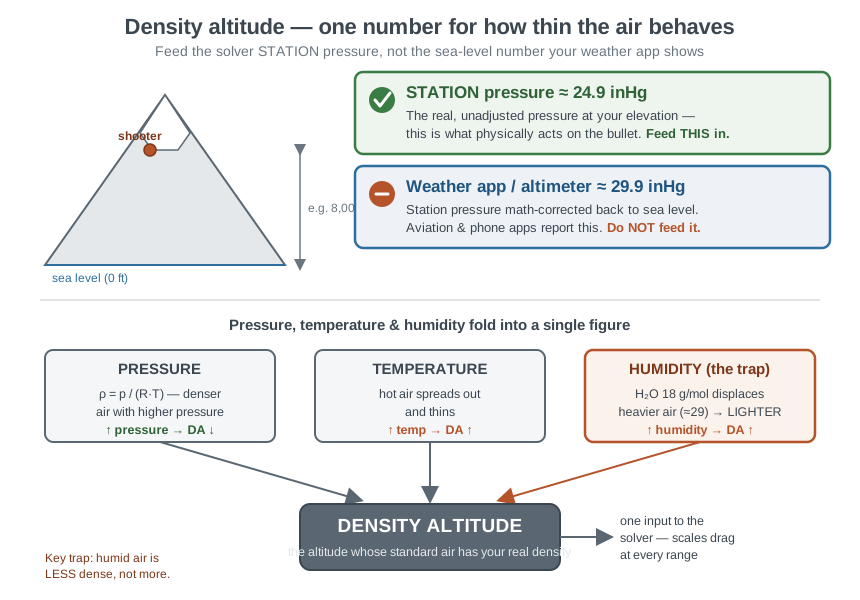
Look back at the drag equation from Volume 4: F_d = 0.5 * rho * v^2 * C_d * A. Density, rho, is the only environmental variable in it, and it is the environmental variable that matters most. Wind moves the impact sideways, but density scales the entire drag force, so it reshapes the whole trajectory — every foot of drop, at every range. This volume is about what sets air density, how shooters capture it in a single number, and the one atmospheric effect that nearly every shooting article gets backwards.
6.1 The Ideal Gas Law
For dry air, density follows the ideal gas law in its specific-gas form:
rho = p / (R_specific * T)where p is the absolute (station) pressure, T is absolute temperature in kelvin, and R_specific is the specific gas constant for air (about 287 J/kg·K).1 The signs are worth internalising: density rises with pressure and falls with temperature. Cold, high-pressure air is dense and draggy — bullets drop more. Hot, low-pressure air is thin — bullets drop less. That much matches intuition. Humidity does not.
6.2 The Humidity Trap
Here is the effect that is printed backwards more often than any other in shooting literature: humid air is less dense than dry air at the same temperature and pressure.
The reasoning is pure ideal-gas bookkeeping. Total pressure is fixed (it is set by the weather, not by composition). Into that fixed-pressure volume, water vapour molecules are added — and by Dalton’s law they displace an equal partial pressure of dry-air molecules. Water vapour has a molar mass of about 18 g/mol. The dry air it displaces averages about 29 g/mol (mostly N₂ at 28 and O₂ at 32). So every water molecule that enters replaces a heavier average air molecule, and the mixture gets lighter.2 More humidity therefore means lower density, less drag, and a slightly flatter trajectory — the bullet lands very slightly high relative to what dry-air dope would predict.
This is the exact opposite of the “thick, soupy, humid air” intuition. Humid air feels heavy to a person because of heat-stress physiology, not because it is dense. It is not dense; it is dilute. Any source that tells you humidity adds drag or drops the bullet has the sign wrong, and it is worth correcting explicitly whenever it comes up.
Magnitude — read this as medium confidence. A 50-percentage-point swing in relative humidity changes air density by only about 0.32%.3 The sign of that change (more humidity, less dense) is high confidence — it is textbook atmospheric physics. The specific 0.32%-per-50-points figure is medium confidence: it is consistently repeated across ballistics-education sites but was not traced to a primary meteorological calculation in the research behind this series, and it is worth an independent sanity check from vapour-pressure tables before quoting it to two significant figures. Either way, humidity is by a wide margin the smallest of the three atmospheric variables — a full humidity swing moves density less than a modest change in temperature or pressure would. Get the sign right; do not lose sleep over the magnitude.
6.3 Density Altitude — the One Number That Captures Everything
Rather than juggle pressure, temperature, and humidity separately, shooters fold all three into a single figure: density altitude (DA). Density altitude is the altitude in a standard atmosphere at which the air would have the density you are actually experiencing.4 Hot, high, humid, low-pressure conditions all push DA up (thinner air behaves like higher altitude); cold, low, dry, high-pressure conditions push it down. A solver fed the correct DA has, in one number, everything it needs to scale drag correctly. On a Kestrel, DA reads correctly regardless of the reference-altitude setting — it is designed to be the single “how thin does this air behave” number.4
6.4 Station Pressure versus Altimeter Setting — Use Station Pressure
This is the second place shooters go wrong, and it can put real error into a solution at altitude.
- Station pressure is the actual, unadjusted pressure measured at the shooter’s exact location and elevation. This is what physically acts on the bullet.
- Barometric / altimeter-setting / sea-level-corrected pressure is station pressure mathematically corrected to what it would read at sea level under a standard atmosphere. This is what aviation weather and almost every phone weather app and home weather station report.4
A shooter must feed the solver station pressure, not the sea-level-corrected number. At altitude the two differ substantially — the sea-level correction inflates the reading to a much higher value — and using the corrected number would tell the solver the air is far denser than it really is, understating how much the thin mountain air is reducing drag. On a Kestrel, setting the reference altitude to 0 forces the pressure display to true station pressure.4 If your ballistic app has one pressure field and you are pulling the number off a weather app, you are almost certainly feeding it sea-level-corrected pressure, and at any real elevation that is wrong.
6.5 How Much Does It Move the Impact?
Enough to matter at distance, and it scales with the load. A commonly cited rule of thumb is roughly 1% change in bullet drop per 1000 ft of density-altitude change, and roughly 1000 ft of elevation ≈ 1 inHg of barometric-pressure worth of density effect.5 Two worked examples from the source research bracket the real spread: a .30-caliber load showed about 226 inches of drop at 1000 yd at 1000 ft elevation versus 207 inches at 8000 ft (~19 inches across 7000 ft, ~2.7 in/1000 ft), while a 142 gr SMK at 2800 fps showed 290 inches at 1000 ft versus 252 inches at 10,000 ft (~38 inches across 9000 ft, ~4.2 in/1000 ft).5
These figures are medium confidence and, importantly, they do not reconcile to a single universal constant — the two examples give 2.7 versus 4.2 inches per 1000 ft because they are different loads, velocities, BCs, and baselines. Do not carry a fixed “X inches per 1000 ft” number. The correct takeaway is the order of magnitude — a few inches to a few tens of inches per 1000 ft of DA change at 1000 yards, scaling with the load — and the practical rule that a real solver does not use a rule of thumb at all: it integrates the actual atmosphere from the DA you give it. Which is exactly why getting DA (and therefore station pressure) right is the whole game.
6.6 Speed of Sound and the Transonic Onset
Air density is not the only thing temperature changes. The speed of sound also depends on temperature:
c ≈ 331.3 + 0.606 * T(°C) [m/s]— the standard linear approximation near room temperature (331.3 m/s is the 0 °C intercept; 0.606 m/s per °C is the local slope of the underlying square-root-of-temperature relationship, valid near typical shooting temperatures, not far from it).6 Because Mach number is v/c and c rises with temperature, the same muzzle velocity is a lower Mach number on a hot day than a cold one. The transonic transition is fixed in Mach terms (roughly Mach 1.2 down to 0.9, Volume 4), so it occurs at a different true airspeed — and therefore at a different range downrange — depending on temperature. On a cold day the bullet reaches the destabilising transonic band at a shorter range than on a hot day. For a load that is marginal at extreme range, temperature can decide whether the bullet is still cleanly supersonic at the target or already buffeting through Mach 1. This is high confidence physics, and it is the link between the environment and the transonic trap of Volume 4.
6.7 Bibliography
Footnotes
-
Ideal gas law, specific-gas form. Standard atmospheric physics. https://en.wikipedia.org/wiki/Density_of_air (confidence: high). ↩
-
Humidity lowers density (molar mass 18 vs ~29 g/mol; Dalton’s-law displacement). https://ballistixco.com/blogs/news/how-environmental-factors-impact-ballistic-compensation-in-custom-turrets ; https://gundigest.com/more/how-to/firearm-training/humidity-effects-bullet-trajectory (confidence: high for the sign — standard ideal-gas reasoning). ↩
-
~0.32% density change per 50-point RH swing — search-aggregated across ballistics-education sources; not traced to a primary meteorological calculation in the source research (confidence: medium for the magnitude; the sign is high confidence). ↩
-
Density altitude, station pressure vs. altimeter setting, Kestrel workflow. https://kestrelmeters.com/pages/understanding-pressure-altitud-and-density-altitude (confidence: high). ↩ ↩2 ↩3 ↩4
-
Elevation/DA effect on drop, with two worked examples. https://www.accurateshooter.com/technical-articles/ballitics-altitude-and-air-pressure/ (content via search summary; direct fetch 404’d — re-verify exact figures) (confidence: medium; present as an illustrative range, not a constant). ↩ ↩2
-
Speed of sound vs temperature and the Mach/transonic-range consequence. https://en.wikipedia.org/wiki/Speed_of_sound (confidence: high). ↩
Comments (0)